

Archive position — measured, not model output
1 like on Devpost
505 of the 7,850 archived projects have more likes, and 1,758 share exactly 1 — so this project's #1,231 place in the like-ranked listing is a tie-break inside that group, not a ranking.
Projects (log scale)
Likes on Devpost. ▲ marks this project's group.
Show the figures
| Likes | Projects | Share of archive |
|---|---|---|
| 0 | 5,587 | 71.2% |
| 1 | 1,758 | 22.4% |
| 2 | 284 | 3.6% |
| 3–4 | 132 | 1.7% |
| 5–9 | 75 | 1.0% |
| 10+ | 14 | 0.2% |
 User Stories BotA demo video on every pull request
Get a demo video on every new feature
GitHub App that watches your pull requests and records a narrated, captioned demo.
Save time on demo prep and make informed decisions faster with a video walkthrough of every new feature.
Executive Summary
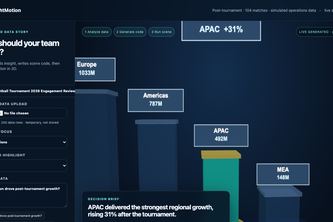
What the company appears to be: InsightMotion is a self-reported tool that uses GPT-5.6 Terra and AI-generated 3D visualizations to answer business questions from data. It allows users to ask plain-language questions about simulated or uploaded datasets, and generates live, explorable 3D scenes that highlight insights.
What changed: The project was built as a submission for the OpenAI 2026 hackathon. It is described as a prototype with no persistent data storage, no database, and one developer (Junwei Lai) on the team.
Single most important open question: Is there any evidence of traction, revenue, or customer adoption beyond the author’s own demonstration? The description states no such evidence exists.
What The Product Actually Is
- The description states InsightMotion is a tool that accepts business questions in plain language and generates live 3D scenes from data.
- It uses GPT-5.6 Terra for analysis and scene-code generation, with outputs rendered via three.js and anime.js.
- It supports simulated datasets or temporary CSV uploads (up to 200 rows × 20 columns).
- The generated scenes are interactive: users can orbit, zoom, and pan.
- Scene code is generated at runtime and executed in the browser.
- No API keys or database are exposed; all data is ephemeral.
Inference: The product appears to be a proof-of-concept prototype built for a hackathon. It does not appear to have any persistent infrastructure or production-grade features.
Positioning & Claim Evolution
- The description states InsightMotion is positioned as a Work & Productivity tool.
- It claims to address the “bottleneck” of finding insights and directing attention in data review processes.
- It positions itself as an alternative to traditional dashboards, focusing on answering “where should we look, and why” rather than just “what are the numbers.”
- The author says it leverages GPT-5.6’s ability to reason over data and choreograph visual attention.
Inference: The positioning is self-reported and focused on solving a perceived problem in team-based data review workflows. There is no evidence of market validation or customer feedback beyond the author's own account.
Target Customer & ICP
- The description does not name specific customer segments.
- It implies use by teams reviewing business data, particularly in contexts like Monday reviews.
- It targets users who ask questions about data and want visual direction to insights.
- No evidence of a defined ideal customer profile (ICP) beyond the author’s own use case.
Inference: The target customer is likely internal business analysts or product managers working with data-heavy teams, but no explicit segmentation or persona is described.
Business Model & Pricing Evidence
- No pricing information is provided.
- No evidence of a monetization strategy or business model is given.
- The project is described as a hackathon submission with no revenue streams mentioned.
Inference: There is no evidence of a business model or pricing structure. The product appears to be a prototype, not a commercial offering.
Technical & Delivery Signals
- Built with Next.js 16.2 App Router, React 19, TypeScript, and Vercel.
- Uses OpenAI’s gpt-5.6-terra for analysis and scene generation.
- Renders visualizations using three.js, anime.js, and OrbitControls.
- Scene code is generated at runtime and executed in the browser.
- Includes error handling and repair attempts (up to 3) for generated code.
- No database or API keys exposed; data is ephemeral.
Inference: The technical stack suggests a modern web-based prototype with AI integration. The use of GPT-5.6 and runtime scene generation is novel but not validated in production.
Traction & Maturity Signals
- The project was submitted to the OpenAI 2026 hackathon.
- It includes 2 simulated business scenarios, 104 simulated tournament matches, and support for up to 200-row CSVs.
- No evidence of users, customers, or adoption beyond the author’s own use case.
- No mention of revenue, usage metrics, or product-market fit.
Inference: The project is a prototype with no demonstrated traction or maturity. It lacks any evidence of real-world usage or customer feedback.
Competitive Context
- The description does not name competitors.
- It positions itself as an alternative to dashboards and static data visualizations.
- It emphasizes AI-driven insight generation and dynamic 3D visualization.
- No evidence of competitive analysis, market positioning, or differentiation from existing tools is provided.
Inference: There is no evidence of a competitive landscape or awareness of existing players in the space. The product appears to be self-contained with no external validation.
Open Questions & Risks
- The project is described as a hackathon submission with no production infrastructure.
- No database, API keys, or persistent data storage are mentioned — suggesting it’s not scalable or production-ready.
- The use of GPT-5.6 Terra for live scene generation introduces risk around code quality and runtime stability.
- The author is the sole team member (1 person), which raises concerns about scalability and long-term development.
- No evidence of revenue, customers, or traction.
Inference: The product is a prototype with no commercial viability or scalability. It lacks any signs of real-world adoption or monetization.
Questions the description leaves open
- What is the actual business problem you're solving, and how do you know it exists?
- Have you tested this with real users or teams in a business context?
- How does the product handle edge cases or data that doesn’t conform to expected formats?
- Are there plans to integrate with real BI or warehouse tools?
- What is your roadmap for moving from prototype to product, and what resources are needed?
Overall Assessment
- The project is described as a hackathon submission with no evidence of traction, revenue, or customer adoption.
- It is a prototype built by one person using AI and 3D visualization tools.
- No business model, pricing, or scalability is evident.
- The author states the product is not yet production-ready.
Inference: This is not a viable investment or partnership opportunity at this stage. It is a proof-of-concept with no demonstrated commercial potential or market validation.
User Stories BotA demo video on every pull request
Get a demo video on every new feature
GitHub App that watches your pull requests and records a narrated, captioned demo.
Save time on demo prep and make informed decisions faster with a video walkthrough of every new feature.
Source
Submitted to the OpenAI 2026 hackathon on Devpost. Project home on Devpost. Back to the full gallery on Devpost.
This competitive analysis was produced by top-founders.com (opens in a new tab)
Generated by a language model from this project's public Devpost page — its tagline, the author's own write-up and any built-with tags listed there — as captured in August 2026. Short quotations are the author's words. It is an opinion on the idea as a business, not on the people behind it, and it reflects the description as published then. If the project has moved on, request a correction below. The analysis is not independent research and contains no verified traction, revenue or customer data.
An independent guide by KFG International LLC — not affiliated with, endorsed by, or connected to Devpost or OpenAI.