

Archive position — measured, not model output
0 likes on Devpost
2,263 of the 7,850 archived projects have more likes, and 5,587 share exactly 0 — so this project's #3,194 place in the like-ranked listing is a tie-break inside that group, not a ranking.
Projects (log scale)
Likes on Devpost. ▲ marks this project's group.
Show the figures
| Likes | Projects | Share of archive |
|---|---|---|
| 0 | 5,587 | 71.2% |
| 1 | 1,758 | 22.4% |
| 2 | 284 | 3.6% |
| 3–4 | 132 | 1.7% |
| 5–9 | 75 | 1.0% |
| 10+ | 14 | 0.2% |
 User Stories BotA demo video on every pull request
Get a demo video on every new feature
GitHub App that watches your pull requests and records a narrated, captioned demo.
Save time on demo prep and make informed decisions faster with a video walkthrough of every new feature.
Executive Summary
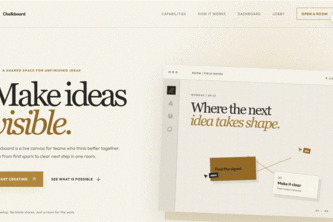
The company appears to be a solo-developer project named Chalkboard, an open-source collaborative whiteboard tool built for real-time team collaboration and online learning. The author states it aims to recreate the experience of a physical chalkboard in a digital, accessible format. It is presented as a hackathon submission with no evidence of revenue, customers or traction.
What changed: This is a self-reported project description from a single developer, submitted to a hackathon. There is no indication of prior development, funding, or commercial activity beyond the author's own account.
The single most important open question: Is there any evidence that this project has moved beyond the prototype phase, or whether it has been adopted by users in real-world settings?
What The Product Actually Is
- The description states: “Chalkboard is an open-source collaborative whiteboard that lets teams and students draw, brainstorm, and collaborate in real time.”
- It is described as a tool for online learning and teamwork.
- Built with: hono, html5-canvas-api, node.js, postgresql, react, redis, socket.io, typescript.
- The author states: “I built Chalkboard as a real-time collaborative whiteboard where multiple users can draw, write, and brainstorm together.”
- The product is presented as a digital version of a physical chalkboard, designed to be intuitive and simple.
Not evidenced: No information on whether the tool is currently in use, how many users it supports, or if it has been deployed beyond the developer's own environment.
Positioning & Claim Evolution
- The author states: “I was inspired by how ineffective many online classes and virtual meetings can be.”
- The product is positioned as a solution to the lack of interaction in digital environments.
- It is described as bringing back “the simplicity and familiarity of a traditional chalkboard” into a digital format.
- The goal is to make online learning and teamwork more interactive.
Not evidenced: No claims about market fit, competitive positioning, or adoption by users. The description does not indicate whether this is an MVP, a product in development, or a finished tool.
Target Customer & ICP
- The author states: “Chalkboard is an open-source collaborative whiteboard that lets teams and students draw, brainstorm, and collaborate in real time.”
- It targets “teams and students”.
- The use case includes online learning and virtual meetings.
- No further segmentation or customer personas are described.
Not evidenced: No indication of specific customer types beyond general categories (teams, students), no evidence of user research or feedback, or customer validation.
Business Model & Pricing Evidence
- The description states: “Chalkboard is an open-source collaborative whiteboard.”
- No pricing model or monetization strategy is mentioned.
- No information on whether the tool is free to use, paid, or supported by a business model beyond its open-source nature.
Not evidenced: No evidence of revenue streams, pricing tiers, or commercial intent beyond the developer’s own description.
Technical & Delivery Signals
- Built with: hono, html5-canvas-api, node.js, postgresql, react, redis, socket.io, typescript.
- The author states: “I built Chalkboard as a real-time collaborative whiteboard.”
- Real-time collaboration is a key feature.
- It uses technologies like socket.io for real-time communication and React for UI.
Not evidenced: No information on scalability, performance, or deployment details. No evidence of production use or infrastructure beyond the developer's own setup.
Traction & Maturity Signals
- The project was submitted to the OpenAI 2026 hackathon.
- It is described as a solo-developer effort.
- No evidence of user adoption, customer base, or usage metrics.
- No mention of any funding, partnerships, or product launches beyond the hackathon submission.
Not evidenced: No data on users, revenue, or product maturity. The project appears to be in an early stage, possibly a prototype or proof-of-concept.
Competitive Context
- The author does not reference any competitors.
- No mention of existing tools in the collaborative whiteboard space (e.g., Miro, Jamboard, Notion, etc.).
- No indication of competitive differentiation or market analysis.
Not evidenced: No information on the competitive landscape, how this tool compares to others, or whether it addresses a specific gap in the market.
Open Questions & Risks
- The project is described as a solo effort with no team or external support.
- It is an open-source hackathon submission — no indication of commercial viability or long-term development.
- No evidence of traction, revenue, or user feedback.
- The lack of any business model or monetization strategy raises questions about sustainability.
- The tool may be in early prototype phase and not yet ready for real-world use.
Inference: If this is a prototype, it may not yet have the features or stability to compete with established tools in its space.
Questions the description leaves open
- What is the current status of Chalkboard? Is it a working prototype or a deployed product?
- Has it been tested by users outside of the developer’s own environment?
- Are there any plans for monetization or commercial use beyond its open-source nature?
- How does it compare to existing collaborative whiteboard tools in the market?
- What is the long-term roadmap for the project, and how will it evolve beyond the hackathon version?
Overall Assessment
- The description states that Chalkboard is a solo-developer hackathon submission.
- No evidence of revenue, customers, or traction.
- It is presented as an open-source tool with no commercial intent or business model described.
- The project appears to be in its early stages and lacks any indication of product-market fit or scalability.
Assessment: Not evidenced as a viable investment or partnership opportunity at this time. The project is described as a prototype, and there is no evidence of adoption, monetization, or commercial traction beyond the developer’s own account.
User Stories BotA demo video on every pull request
Get a demo video on every new feature
GitHub App that watches your pull requests and records a narrated, captioned demo.
Save time on demo prep and make informed decisions faster with a video walkthrough of every new feature.
Source
Submitted to the OpenAI 2026 hackathon on Devpost. Project home on Devpost. Back to the full gallery on Devpost.
This competitive analysis was produced by top-founders.com (opens in a new tab)
Generated by a language model from this project's public Devpost page — its tagline, the author's own write-up and any built-with tags listed there — as captured in August 2026. Short quotations are the author's words. It is an opinion on the idea as a business, not on the people behind it, and it reflects the description as published then. If the project has moved on, request a correction below. The analysis is not independent research and contains no verified traction, revenue or customer data.
An independent guide by KFG International LLC — not affiliated with, endorsed by, or connected to Devpost or OpenAI.