

Archive position — measured, not model output
0 likes on Devpost
2,263 of the 7,850 archived projects have more likes, and 5,587 share exactly 0 — so this project's #7,373 place in the like-ranked listing is a tie-break inside that group, not a ranking.
Projects (log scale)
Likes on Devpost. ▲ marks this project's group.
Show the figures
| Likes | Projects | Share of archive |
|---|---|---|
| 0 | 5,587 | 71.2% |
| 1 | 1,758 | 22.4% |
| 2 | 284 | 3.6% |
| 3–4 | 132 | 1.7% |
| 5–9 | 75 | 1.0% |
| 10+ | 14 | 0.2% |
 User Stories BotA demo video on every pull request
Get a demo video on every new feature
GitHub App that watches your pull requests and records a narrated, captioned demo.
Save time on demo prep and make informed decisions faster with a video walkthrough of every new feature.
Executive Summary
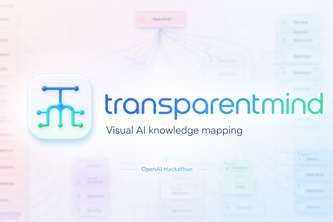
What the company appears to be: Transparent Mind is a self-reported visual note-taking and mind-mapping tool designed for students, lifelong learners, and anyone who wants to organize ideas over time. The author states it allows users to create frameworks, build expandable mind maps, and organize information into connected cells and folders. It is built using VS Code and Codex, with the goal of helping users preserve, revisit, export, and present their learning.
What changed: This is a self-reported project submitted to the OpenAI 2026 hackathon. No evidence of prior versions, product development history, or commercial activity exists beyond this single submission.
Single most important open question: Is there any evidence of user adoption, revenue, or traction that would indicate demand for this tool beyond the author’s personal use case?
What The Product Actually Is
The description states:
- Transparent Mind is a visual note-taking and mind-mapping tool.
- It allows users to create frameworks, build expandable mind maps, and organize information into connected cells and folders.
- The tool supports exporting, presenting, and sharing of notes.
- It is built using VS Code and Codex.
Inference: Based on the author's own description, it appears to be a prototype or early-stage product intended for personal or educational use. No evidence exists regarding its current functionality beyond what is described in the submission.
Positioning & Claim Evolution
The author states:
- The tool was inspired by someone describing their mind as a filing cabinet.
- It aims to help people preserve learning in a way that is visual, organized, revisitable, and easy to share.
- It targets students, lifelong learners, and anyone who wants to organize ideas over time.
- The tool is meant to make notes more than temporary study material — they should become part of a lifelong learning system.
Inference: The positioning appears to be centered on educational use cases, particularly for students and lifelong learners. It positions itself as a tool that goes beyond simple note-taking, aiming to support long-term knowledge retention and sharing.
Target Customer & ICP
The description states:
- Transparent Mind is designed for students, lifelong learners, and anyone who wants to organize ideas over time.
- The author mentions using it personally as a medical student, suggesting an initial focus on highly structured learning environments.
Inference: The target customer segment appears to be students and educators, with a possible expansion toward lifelong learners. No evidence of segmentation beyond this general audience is provided.
Business Model & Pricing Evidence
The description states:
- There is no mention of pricing, subscriptions, or monetization strategies.
- The tool is described as being built for people who want their notes to become something more permanent, useful, and shareable.
Inference: No evidence exists regarding a business model or pricing structure. The author does not describe any commercial intent beyond personal use or community sharing.
Technical & Delivery Signals
The description states:
- Built using VS Code and Codex.
- Development involved many iterations to shape layout, styling, and user experience.
- Codex was used for proofreading, troubleshooting, refining, and improving the interface.
- The goal was to create something that feels approachable for students while still being flexible enough for large, expandable mind maps.
Inference: The tool is likely a web-based prototype or early-stage application, built with AI-assisted development tools. There is no evidence of production deployment, scalability, or technical infrastructure beyond the author's own development environment.
Traction & Maturity Signals
The description states:
- This is a project submitted to the OpenAI 2026 hackathon.
- The author has been using it personally as a medical student.
- It was built through many iterations and improvements.
Inference: There is no evidence of user adoption, customer base, or revenue. No metrics, usage data, or product maturity beyond the initial prototype are provided.
Competitive Context
The description states:
- The author mentions that mind-mapping tools can quickly become overwhelming, so the design needed to support structure without making the user feel lost.
- It is built around the idea of preserving and organizing thought.
Inference: While not explicitly named, Transparent Mind likely competes with existing note-taking and mind-mapping tools such as Notion, Obsidian, or MindMeister. However, no evidence exists regarding competitive positioning, differentiation, or market analysis.
Open Questions & Risks
- The project is a self-reported hackathon submission, with no evidence of prior traction or product development history.
- No revenue, customer data, or commercial activity is evidenced.
- The tool is described as personal use only and not yet released to the public.
- The author is a single individual (1 person team), which raises questions about scalability and long-term maintenance.
- There is no mention of IP protection, partnerships, or go-to-market strategy.
Questions the description leaves open
- What specific user feedback have you received from students or educators who have tried the tool?
- Have you conducted any usability testing or iteration cycles beyond your own use?
- Are there plans to monetize the product, and if so, what is your business model?
- How do you plan to scale beyond a single developer’s personal use case?
- What are your long-term goals for Transparent Mind — is it intended as a standalone tool or part of a larger platform?
Overall Assessment
The description states:
- This is a self-reported hackathon submission.
- It is described as a personal project with no commercial traction or evidence of market demand.
Inference: There is no evidence of commercial viability, revenue, or user adoption. The product appears to be an early-stage prototype with no demonstrated traction or business model. Any investment or partnership decision would require further validation of market need and product-market fit beyond this single submission.
User Stories BotA demo video on every pull request
Get a demo video on every new feature
GitHub App that watches your pull requests and records a narrated, captioned demo.
Save time on demo prep and make informed decisions faster with a video walkthrough of every new feature.
Source
Submitted to the OpenAI 2026 hackathon on Devpost. Project home on Devpost. Back to the full gallery on Devpost.
This competitive analysis was produced by top-founders.com (opens in a new tab)
Generated by a language model from this project's public Devpost page — its tagline, the author's own write-up and any built-with tags listed there — as captured in August 2026. Short quotations are the author's words. It is an opinion on the idea as a business, not on the people behind it, and it reflects the description as published then. If the project has moved on, request a correction below. The analysis is not independent research and contains no verified traction, revenue or customer data.
An independent guide by KFG International LLC — not affiliated with, endorsed by, or connected to Devpost or OpenAI.