

Archive position — measured, not model output
0 likes on Devpost
2,263 of the 7,850 archived projects have more likes, and 5,587 share exactly 0 — so this project's #7,374 place in the like-ranked listing is a tie-break inside that group, not a ranking.
Projects (log scale)
Likes on Devpost. ▲ marks this project's group.
Show the figures
| Likes | Projects | Share of archive |
|---|---|---|
| 0 | 5,587 | 71.2% |
| 1 | 1,758 | 22.4% |
| 2 | 284 | 3.6% |
| 3–4 | 132 | 1.7% |
| 5–9 | 75 | 1.0% |
| 10+ | 14 | 0.2% |
 User Stories BotA demo video on every pull request
Get a demo video on every new feature
GitHub App that watches your pull requests and records a narrated, captioned demo.
Save time on demo prep and make informed decisions faster with a video walkthrough of every new feature.
Executive Summary
What the company appears to be
TransportUrbain is an Android-based platform designed to connect passengers with taxi and motorcycle drivers in African cities. The project was built by a single developer (Kanto PERRY) using modern Android technologies and AI-assisted development tools including GPT-5.6 and Codex.
What changed
The author states that this is a self-contained project submitted for the OpenAI 2026 hackathon, with no evidence of prior traction or commercial deployment. It was built as a proof-of-concept to address urban mobility challenges in African cities.
Single most important open question
Is there any evidence of actual user adoption, revenue generation, or pilot testing in real-world African cities?
What The Product Actually Is
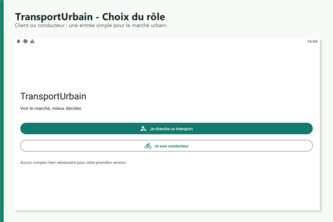
The description states that TransportUrbain is an Android application designed to connect passengers with taxi and motorcycle drivers. It allows passengers to publish transportation requests and enables drivers to browse and accept trips more efficiently.
It uses Kotlin, Jetpack Compose, MVVM architecture, Firebase Authentication, Cloud Firestore, and Firebase Cloud Messaging. The platform was built using GPT-5.6 and Codex as development tools, but these are not integrated into the application itself.
Evidence
- "TransportUrbain AI is an Android application that connects passengers with taxi and motorcycle taxi drivers."
- "Built with: android, api, authentication, cloud, codex, compose, design, firebase, firestore, git, github, gpt-5.6, gradle, jetpack, kotlin, material, messaging, mvvm, openai, rest, studio"
Inference The product is described as a mobile app for urban mobility in African cities, but no functional prototype or live deployment is evidenced.
Positioning & Claim Evolution
The author positions TransportUrbain as a solution to inefficiencies in informal transportation ecosystems in African cities. It aims to improve real-time information flow between passengers and drivers without replacing existing systems.
Key claims:
- "Improves urban mobility across African cities"
- "Designed specifically for African cities"
- "Focuses on improving the circulation of transportation information without replacing the existing transportation ecosystem"
Evidence
- "Unlike traditional ride-hailing platforms, TransportUrbain AI focuses on improving the circulation of transportation information without replacing the existing transportation ecosystem."
- "Rather than replacing existing transportation systems, it aims to make them more efficient by improving access to transportation information."
Inference The positioning is framed around solving an inefficiency in informal transport networks. However, there is no evidence of prior market validation or customer feedback.
Target Customer & ICP
The target customers are:
- Passengers seeking reliable and timely transportation
- Taxi and motorcycle taxi drivers who rely on daily earnings for household income
The ICP appears to be individuals in African cities where informal transport systems dominate, particularly those with limited access to real-time information about available vehicles.
Evidence
- "Every morning, millions of people leave their homes hoping to reach work, school, hospitals, or markets on time."
- "For drivers—especially motorcycle taxi drivers whose families often depend entirely on their daily earnings—every minute without a passenger represents lost income."
Inference The ICP is inferred from the stated problem and user demographics. No explicit segmentation or customer personas are provided.
Business Model & Pricing Evidence
There is no evidence of pricing, monetization strategy, or business model in the description.
Evidence
- "No revenue, customer or traction data is available beyond what they state."
- The project is described as a hackathon submission with no mention of commercial viability or monetization plans.
Inference The business model remains undefined. It's unclear whether the platform will be free-to-use, subscription-based, or involve transaction fees.
Technical & Delivery Signals
The application was built using:
- Kotlin
- Jetpack Compose
- MVVM architecture
- Firebase backend (Authentication, Firestore, Cloud Messaging)
- GPT-5.6 and Codex for development assistance
Evidence
- "Developed using modern Android technologies, including: Kotlin, Jetpack Compose, MVVM Architecture, Firebase Authentication, Cloud Firestore, Firebase Cloud Messaging, Material Design 3"
- "GPT-5.6 and Codex played a significant role in the development process."
Inference The technical stack suggests a scalable, maintainable solution. However, no evidence of production deployment or performance metrics is provided.
Traction & Maturity Signals
There is no evidence of traction, user adoption, or live deployment.
Evidence
- "This project was submitted to the OpenAI 2026 hackathon on Devpost."
- "No revenue, customer or traction data is available beyond what they state."
Inference The project exists only as a concept and prototype. No real-world usage or feedback from users is evidenced.
Competitive Context
The description does not provide any information about competitors or competitive landscape.
Evidence
- No mention of existing platforms or similar solutions in the African market.
- No comparison with traditional ride-hailing services or informal transport systems.
Inference It's unclear whether TransportUrbain operates in a crowded space or fills an unmet need. The lack of competitive analysis is notable.
Open Questions & Risks
Key risks and open questions include:
- Single-person team (no team structure or operational support)
- No revenue, customer data, or traction
- AI-assisted development may not translate into scalable product delivery
- Lack of real-world testing or feedback
- Unclear path to monetization or market expansion
Evidence
- "Team size: 1"
- "No revenue, customer or traction data is available beyond what they state."
- "The project also demonstrates how AI-assisted software engineering can help independent developers build complex applications faster while maintaining professional quality."
Inference The lack of team support and real-world validation raises concerns about long-term viability and scalability.
Questions the description leaves open
- What specific African cities have you tested or piloted this in?
- How do you plan to monetize the platform, if at all?
- Have you validated your solution with actual users in the field?
- What are the key challenges in scaling beyond a single city?
- How do you intend to onboard drivers and passengers into the system?
- Is there any existing partnership or collaboration with local transport stakeholders?
Overall Assessment
Not evidenced.
The project is described as a hackathon submission with no evidence of traction, revenue, or customer adoption. The author claims it addresses urban mobility issues in African cities but provides no data to support commercial viability or scalability.
Confidence Level Low This analysis is based entirely on self-reported information and lacks any independent verification or market validation.
User Stories BotA demo video on every pull request
Get a demo video on every new feature
GitHub App that watches your pull requests and records a narrated, captioned demo.
Save time on demo prep and make informed decisions faster with a video walkthrough of every new feature.
Source
Submitted to the OpenAI 2026 hackathon on Devpost. Project home on Devpost. Back to the full gallery on Devpost.
This competitive analysis was produced by top-founders.com (opens in a new tab)
Generated by a language model from this project's public Devpost page — its tagline, the author's own write-up and any built-with tags listed there — as captured in August 2026. Short quotations are the author's words. It is an opinion on the idea as a business, not on the people behind it, and it reflects the description as published then. If the project has moved on, request a correction below. The analysis is not independent research and contains no verified traction, revenue or customer data.
An independent guide by KFG International LLC — not affiliated with, endorsed by, or connected to Devpost or OpenAI.