

Archive position — measured, not model output
1 like on Devpost
505 of the 7,850 archived projects have more likes, and 1,758 share exactly 1 — so this project's #1,487 place in the like-ranked listing is a tie-break inside that group, not a ranking.
Projects (log scale)
Likes on Devpost. ▲ marks this project's group.
Show the figures
| Likes | Projects | Share of archive |
|---|---|---|
| 0 | 5,587 | 71.2% |
| 1 | 1,758 | 22.4% |
| 2 | 284 | 3.6% |
| 3–4 | 132 | 1.7% |
| 5–9 | 75 | 1.0% |
| 10+ | 14 | 0.2% |
 User Stories BotA demo video on every pull request
Get a demo video on every new feature
GitHub App that watches your pull requests and records a narrated, captioned demo.
Save time on demo prep and make informed decisions faster with a video walkthrough of every new feature.
Executive Summary
What the company appears to be
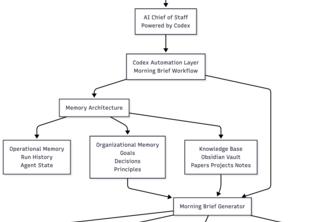
MorningBrief: AI Chief of Staff is a self-reported personal knowledge management and AI assistant system built around a structured memory architecture. The author describes it as an AI-powered tool that maintains organizational memory, transforms knowledge and priorities into decision-ready briefs, and integrates with existing tools like Obsidian.
What changed
The project evolved from a basic AI chatbot or automation script into a more sophisticated system focused on persistent memory design, human-AI collaboration, and long-term project support. It positions itself as a "Chief of Staff" that supports execution while keeping strategic decisions under human control.
Single most important open question
Is there evidence of actual usage beyond the author's own development and testing? The description does not indicate any external adoption or customer base.
What The Product Actually Is
The description states:
- MorningBrief is an AI Chief of Staff powered by Codex, designed to maintain organizational memory.
- It transforms knowledge, projects, and priorities into decision-ready daily briefs.
- It supports execution while keeping strategic decisions under human control.
- It uses a persistent memory architecture that separates temporary operational information from stable organizational knowledge.
Inference The system appears to be a local-first, personal knowledge management tool integrated with AI agents, built using Python and Streamlit, and connected to tools like Obsidian and OpenAI models (including GPT-5.6).
Positioning & Claim Evolution
The description states:
- The product is positioned as an AI Chief of Staff that helps manage knowledge, projects, and priorities.
- It emphasizes the need for structure in AI memory to avoid information overload.
- It distinguishes between AI execution and human decision-making.
- It claims to be more than a chatbot or automation script — it's a framework for long-term project support.
Inference The positioning evolved from a generic AI assistant to a structured, boundary-based system that supports human thinking rather than replacing it. The author frames this as a shift in perspective on what AI assistants should achieve: not just better answers, but systems that maintain context and support better decisions over time.
Target Customer & ICP
The description states:
- The product is described as being used by individuals managing research, projects, and personal knowledge.
- It supports founders or people working on complex long-term work.
- It is built for a "personal vault-based Chief of Staff workflow."
Inference The primary target appears to be individual professionals or founders who manage their own knowledge and workflows, rather than enterprise clients. The ICP seems to be self-directed knowledge workers with a need for structured AI support.
Business Model & Pricing Evidence
Not evidenced.
The description does not mention any pricing model, monetization strategy, or business model.
Technical & Delivery Signals
The description states:
- Built with Python, Streamlit, Codex, GPT-5.6, and OpenAI models.
- Integrates with Obsidian and other knowledge tools.
- Designed as a local-first system.
- Uses a persistent memory architecture that separates temporary, stable, and raw information.
Inference The technical stack suggests a developer-focused, personal tool built for integration with existing workflows. The emphasis on local-first design and structured memory indicates an early-stage prototype or personal project rather than a scalable product.
Traction & Maturity Signals
Not evidenced.
There is no mention of users, customers, revenue, ARR, or adoption beyond the author's own use.
Competitive Context
Not evidenced.
The description does not reference competitors or market positioning relative to other AI assistants, knowledge management tools, or Chief of Staff platforms.
Open Questions & Risks
- No evidence of traction: The project is described as a personal tool with no external users or adoption.
- Self-reported only: All claims are unverified and based on the author's own account.
- Unclear commercial viability: No pricing, monetization, or business model is described.
- Limited scope: The system appears to be a prototype or personal project, not a scalable product.
Questions the description leaves open
- What specific use cases have you identified for MorningBrief beyond your own?
- Have you tested the system with others, and if so, how did they respond?
- How do you plan to scale this from a personal tool to a product that others can use?
- What is your roadmap for monetization or commercialization?
- Are there any external partners or early adopters currently using it?
Overall Assessment
Not evidenced.
There is no evidence of revenue, customers, or traction to support an investment or partnership decision. The project appears to be a personal prototype or hackathon submission with no indication of commercial viability or market demand.
User Stories BotA demo video on every pull request
Get a demo video on every new feature
GitHub App that watches your pull requests and records a narrated, captioned demo.
Save time on demo prep and make informed decisions faster with a video walkthrough of every new feature.
Source
Submitted to the OpenAI 2026 hackathon on Devpost. Project home on Devpost. Back to the full gallery on Devpost.
This competitive analysis was produced by top-founders.com (opens in a new tab)
Generated by a language model from this project's public Devpost page — its tagline, the author's own write-up and any built-with tags listed there — as captured in August 2026. Short quotations are the author's words. It is an opinion on the idea as a business, not on the people behind it, and it reflects the description as published then. If the project has moved on, request a correction below. The analysis is not independent research and contains no verified traction, revenue or customer data.
An independent guide by KFG International LLC — not affiliated with, endorsed by, or connected to Devpost or OpenAI.