

Archive position — measured, not model output
0 likes on Devpost
2,263 of the 7,850 archived projects have more likes, and 5,587 share exactly 0 — so this project's #3,449 place in the like-ranked listing is a tie-break inside that group, not a ranking.
Projects (log scale)
Likes on Devpost. ▲ marks this project's group.
Show the figures
| Likes | Projects | Share of archive |
|---|---|---|
| 0 | 5,587 | 71.2% |
| 1 | 1,758 | 22.4% |
| 2 | 284 | 3.6% |
| 3–4 | 132 | 1.7% |
| 5–9 | 75 | 1.0% |
| 10+ | 14 | 0.2% |
 User Stories BotA demo video on every pull request
Get a demo video on every new feature
GitHub App that watches your pull requests and records a narrated, captioned demo.
Save time on demo prep and make informed decisions faster with a video walkthrough of every new feature.
Executive Summary
Company: CollegePrep
Self-reported basis: The entire analysis is based on a single author-supplied description of a project submitted to the OpenAI 2026 hackathon. No external verification or historical data is available.
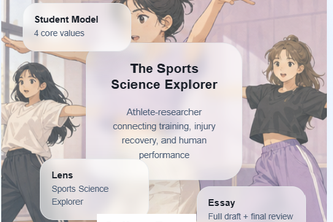
What it appears to be: A self-described AI-powered platform designed to help high school students discover and structure their college application narratives, using visual storytelling and AI-assisted guidance rather than traditional text-based questionnaires.
What changed: The project was submitted as a hackathon entry; no indication of prior development or commercial activity exists in the description.
Most important open question: Is there evidence that this concept resonates with students or counselors in real-world use, or is it purely a demo?
What The Product Actually Is
The description states that CollegePrep is an AI-powered platform for high school students preparing for college applications. It guides users through a process involving:
- Finding experiences using picture story cards.
- Organizing experiences into a growth timeline by grade or time period.
- Building a Student Model based on values, strengths, interests, goals, and growth stories.
- Exploring narratives via different "Story Lenses" (e.g., educator, researcher).
- Planning and writing essays, with feedback and review features.
The system is described as intentionally not an “AI essay writer,” but rather an “AI counselor” that helps students understand themselves before writing.
Inference: The product appears to be a demo or prototype built for a hackathon, using Next.js, React, TypeScript, and AI tools like Codex and GPT-5.6.
Positioning & Claim Evolution
The description states that CollegePrep aims to help students "discover student's story before writing and find their identity." It positions itself as an alternative to traditional text-based questionnaires or in-person counseling, offering a more visual and reflective approach.
It claims to be a platform that helps students “find meaning even in small activities” and supports long-term personal development beyond college admissions.
Inference: The positioning is centered on empathy, reflection, and narrative discovery rather than just task completion. It reflects an intent to support student identity formation through structured storytelling.
Target Customer & ICP
The description identifies the primary user as high school students preparing for college applications, with a secondary audience of school counselors who may use summary materials.
It also mentions families as part of the target group, though not explicitly defined.
Inference: The core ICP is likely high school students aged 16–18, particularly those who struggle to articulate their experiences or feel overwhelmed by the college application process. Counselors are mentioned as a potential future user base.
Business Model & Pricing Evidence
No evidence of pricing, monetization strategy, or business model is provided in the description.
Inference: The project is described as a demo submitted for a hackathon; no commercial activity or revenue streams are evident.
Technical & Delivery Signals
The product was built using:
- Next.js, React, TypeScript
- AI tools: Codex, GPT-5.6
Key technical components include:
- Follow-Up Question Engine
- Lens-Specific Story Structure Rules
- Evidence-to-Essay Mapping
- Student Voice Model
- Dynamic Feedback Engine
The description also mentions debugging Next.js hydration issues and TypeScript errors, indicating a basic but functional tech stack.
Inference: The platform is built with modern web technologies and integrates AI for personalization and feedback. It appears to be a prototype or MVP, not a production-ready system.
Traction & Maturity Signals
There is no evidence of traction, customers, revenue, or adoption beyond the project being submitted to a hackathon.
The description states that it was built by one person (YW Jeong) and includes sample student profiles but no real-world usage data.
Inference: The product has not yet reached market maturity. It is a demo or prototype with limited evidence of real-world use.
Competitive Context
No mention of competitors or competitive landscape in the description.
Inference: No information is available to assess how this product compares to existing tools for college prep, essay writing, or student counseling.
Open Questions & Risks
- Unproven concept: The idea has not been tested with real students or counselors.
- Demo-only status: There is no evidence of a functioning product beyond a hackathon submission.
- Single-person team: Limited capacity for development or scaling.
- AI dependency: Reliance on tools like Codex and GPT-5.6 may be unstable or unscalable.
- No commercial viability: No pricing, monetization, or business model described.
Questions the description leaves open
- What specific user feedback did you gather during development?
- Have you tested this with actual high school students or counselors?
- How do you plan to transition from a demo to a scalable product?
- What is your long-term vision for monetization or growth?
- Are there any legal or ethical concerns around AI-generated narrative guidance?
Overall Assessment
Not evidenced: The description provides no information on financials, traction, or commercial readiness.
Inference: This project appears to be a hackathon demo with no evidence of market validation, revenue, or product-market fit. It is not ready for investment or partnership at this stage.
User Stories BotA demo video on every pull request
Get a demo video on every new feature
GitHub App that watches your pull requests and records a narrated, captioned demo.
Save time on demo prep and make informed decisions faster with a video walkthrough of every new feature.
Source
Submitted to the OpenAI 2026 hackathon on Devpost. Project home on Devpost. Back to the full gallery on Devpost.
This competitive analysis was produced by top-founders.com (opens in a new tab)
Generated by a language model from this project's public Devpost page — its tagline, the author's own write-up and any built-with tags listed there — as captured in August 2026. Short quotations are the author's words. It is an opinion on the idea as a business, not on the people behind it, and it reflects the description as published then. If the project has moved on, request a correction below. The analysis is not independent research and contains no verified traction, revenue or customer data.
An independent guide by KFG International LLC — not affiliated with, endorsed by, or connected to Devpost or OpenAI.