

Archive position — measured, not model output
0 likes on Devpost
2,263 of the 7,850 archived projects have more likes, and 5,587 share exactly 0 — so this project's #3,451 place in the like-ranked listing is a tie-break inside that group, not a ranking.
Projects (log scale)
Likes on Devpost. ▲ marks this project's group.
Show the figures
| Likes | Projects | Share of archive |
|---|---|---|
| 0 | 5,587 | 71.2% |
| 1 | 1,758 | 22.4% |
| 2 | 284 | 3.6% |
| 3–4 | 132 | 1.7% |
| 5–9 | 75 | 1.0% |
| 10+ | 14 | 0.2% |
 User Stories BotA demo video on every pull request
Get a demo video on every new feature
GitHub App that watches your pull requests and records a narrated, captioned demo.
Save time on demo prep and make informed decisions faster with a video walkthrough of every new feature.
Executive Summary
Project: ColorHelper
Self-reported basis: The description is entirely from the author’s own submission to a hackathon, unverified and without external corroboration.
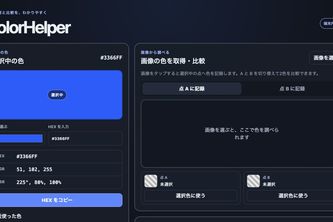
Commercial due-diligence read: This appears to be a privacy-focused browser-based color sampling tool built as a lightweight Web app. It allows users to sample colors from images or live camera feeds, compare them, and view precise color data (HEX, RGB, HSB). The author states the tool works offline, requires no account, and processes all data locally. No evidence of revenue, customers, or traction is provided. The most important open question is whether this tool has any commercial viability beyond a hackathon prototype.
What The Product Actually Is
The description states that ColorHelper is a privacy-first browser app that allows users to:
- Enter a HEX value
- Sample a color from an uploaded image
- Use a live camera to sample colors
It reports precise HEX, RGB, and HSB values, supports side-by-side comparison of two sampled colors, and calculates both a visual similarity score and RGB distance. The app is built as a lightweight installable Web app using HTML, CSS, JavaScript, and the Canvas API for pixel sampling. It uses the MediaDevices API for optional live camera access and has no runtime dependencies in production.
Inference: The tool is designed to be a browser-based utility with no backend or cloud processing.
Positioning & Claim Evolution
The author states that ColorHelper was built to address a common need: color work in design reviews, accessibility checks, brand matching, photography, and curiosity, but without requiring uploads, heavy software, or accounts. The tool is positioned as:
- Fast
- Privacy-first
- Works offline
- No account required
The author also notes that the tool was built with AI assistance (Codex and GPT-5.6), which helped in architecture, implementation, testing, and documentation.
Inference: The positioning emphasizes privacy, simplicity, and local processing, but no claims are made about market demand or adoption.
Target Customer & ICP
The description does not state a specific customer segment or ideal customer profile (ICP). It implies the tool is for:
- Designers
- Developers
- Accessibility professionals
- Photographers
- General users curious about color
It is described as useful in “design reviews, accessibility checks, brand matching, photography, and everyday curiosity.”
Inference: The target audience is likely creative professionals or tech-savvy individuals who work with color and value privacy. No evidence of a defined customer persona or market segmentation.
Business Model & Pricing Evidence
There is no evidence in the description of any business model or pricing structure. The author states that:
- The tool works offline
- Requires no account
- Sends no photos to a server
- Has no runtime dependencies
Inference: No monetization strategy is described, and there is no indication of paid features, subscriptions, or sales.
Technical & Delivery Signals
The app is built as a lightweight installable Web app, using:
- HTML, CSS, JavaScript
- Canvas API for pixel sampling
- MediaDevices API for live camera access
- A minimal Node server only for local HTTPS testing (not in production)
- No runtime dependencies
It supports:
- Offline use after initial load
- Local processing of images and camera data
- Responsive interface for desktop and mobile
Inference: The technical stack is simple, browser-based, and privacy-focused. It’s not a complex SaaS or platform product.
Traction & Maturity Signals
The description does not provide any evidence of traction:
- No revenue
- No customers
- No usage metrics
- No adoption data
It was submitted to the OpenAI 2026 hackathon, and is described as a prototype. The author notes that it works offline, but no further maturity or user feedback is mentioned.
Inference: This is a prototype-level product, likely not yet in production use by end users.
Competitive Context
The description does not mention any competitors or market context. It does not state whether similar tools exist or how ColorHelper differentiates from them.
Inference: No competitive analysis is provided, and no evidence of existing solutions or market positioning is available.
Open Questions & Risks
- No revenue or customer data: The tool is described as a hackathon submission with no commercial traction.
- Unproven market demand: No evidence that users actually need this tool or would pay for it.
- Limited scope and maturity: It’s a browser-based prototype, not a scalable product.
- No monetization strategy: No indication of how the tool might generate revenue.
- AI dependency: The author used AI tools extensively, which may indicate lack of in-house technical depth or reliance on external assistance.
Questions the description leaves open
- What is the actual use case for this tool? Who specifically would pay for it?
- Have you tested it with real users or in a production environment?
- Are there any plans to monetize, and if so, what model are you considering?
- How do you plan to scale beyond a prototype?
- What is the competitive landscape, and how does ColorHelper differ from existing tools?
- Have you considered adding features like export or palette saving as part of a monetization path?
Overall Assessment
Not evidenced: There is no evidence of commercial traction, revenue, customers, or a clear business model. The project is described as a hackathon prototype, not a product in the market.
Inference: This is a conceptual or experimental tool, not a viable investment or partnership opportunity at this stage. It may have potential if further developed into a product with a defined market and monetization strategy, but no evidence supports that yet.
User Stories BotA demo video on every pull request
Get a demo video on every new feature
GitHub App that watches your pull requests and records a narrated, captioned demo.
Save time on demo prep and make informed decisions faster with a video walkthrough of every new feature.
Source
Submitted to the OpenAI 2026 hackathon on Devpost. Project home on Devpost. Back to the full gallery on Devpost.
This competitive analysis was produced by top-founders.com (opens in a new tab)
Generated by a language model from this project's public Devpost page — its tagline, the author's own write-up and any built-with tags listed there — as captured in August 2026. Short quotations are the author's words. It is an opinion on the idea as a business, not on the people behind it, and it reflects the description as published then. If the project has moved on, request a correction below. The analysis is not independent research and contains no verified traction, revenue or customer data.
An independent guide by KFG International LLC — not affiliated with, endorsed by, or connected to Devpost or OpenAI.