

Archive position — measured, not model output
0 likes on Devpost
2,263 of the 7,850 archived projects have more likes, and 5,587 share exactly 0 — so this project's #7,377 place in the like-ranked listing is a tie-break inside that group, not a ranking.
Projects (log scale)
Likes on Devpost. ▲ marks this project's group.
Show the figures
| Likes | Projects | Share of archive |
|---|---|---|
| 0 | 5,587 | 71.2% |
| 1 | 1,758 | 22.4% |
| 2 | 284 | 3.6% |
| 3–4 | 132 | 1.7% |
| 5–9 | 75 | 1.0% |
| 10+ | 14 | 0.2% |
 User Stories BotA demo video on every pull request
Get a demo video on every new feature
GitHub App that watches your pull requests and records a narrated, captioned demo.
Save time on demo prep and make informed decisions faster with a video walkthrough of every new feature.
Executive Summary
What the company appears to be
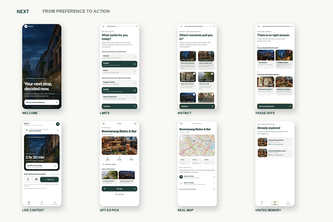
TravelNext is a self-reported mobile app built as a hackathon project that uses GPT-5.6 and location data to recommend one place for spontaneous travelers to visit next, based on real-time context like time left, budget, preferences and nearby POIs.
What changed
The description indicates this was developed in the context of an OpenAI 2026 hackathon, suggesting it is a prototype or proof-of-concept with no commercial traction or revenue yet. It does not appear to have launched publicly beyond a demo.
Single most important open question
Is there any evidence of actual user adoption, customer feedback, or monetization strategy beyond the self-reported project description?
What The Product Actually Is
The description states that TravelNext is a mobile decision companion for spontaneous travelers. It recommends one place to go next using:
- Live location data
- Time remaining
- Travel preferences (including pace, spending style, visual interests)
- Real-time POIs from OpenStreetMap and Overpass API
- GPT-5.6 via the OpenAI Responses API
- Structured Outputs to ensure model choices are validated against real place IDs
It includes features such as:
- Deterministic feasibility filtering (e.g., visited places, budget, time)
- A final recommendation made by GPT-5.6 from a safe candidate set
- Persistent visited history and preference learning
- Map integration with directions and place details
- A public web demo for judges
Inference The product is described as a mobile app built with Expo, React Native, and TypeScript, but no evidence of production deployment or user-facing functionality beyond the hackathon submission exists.
Positioning & Claim Evolution
The author states that travel products are excellent at showing more, but spontaneous travelers need one trustworthy answer to an immediate question: where should I go next?
This positioning is framed around:
- Simplicity for spontaneous travelers
- Personalization through preference learning
- Contextual decision-making using real-time data
The claim evolution shows a shift from generic travel tools to a focused, contextual recommendation engine that balances practicality and instinct.
Inference There is no evidence of prior positioning or product iteration beyond this single submission. The project appears to be a one-off hackathon effort with no known market validation or prior version.
Target Customer & ICP
The description states the app targets spontaneous travelers who:
- Do not want to plan every hour in advance
- Want their next move to feel personal, realistic and worth the time
It also mentions that preference learning combines:
- Practical limits (pace, spending style)
- Visual travel moments (instinctive interests)
- Pairwise trade-offs between appealing options
Inference The ICP is not clearly defined beyond "spontaneous travelers." No segmentation or persona details are provided. The target is implied to be casual, mobile-first users who value real-time decision-making.
Business Model & Pricing Evidence
There is no evidence of a business model or pricing strategy in the description.
The project is presented as a hackathon submission with no mention of monetization, subscriptions, partnerships, or paid features.
Inference No commercial structure is evident. The app appears to be a prototype without any indication of how it would generate revenue.
Technical & Delivery Signals
The product is built using:
- Expo, React Native, TypeScript
- GPT-5.6 via OpenAI API
- OpenStreetMap and Overpass API for live POI discovery
- Structured Outputs to validate model responses
- AsyncStorage for persistent data
- Leaflet.js, React Native Maps, Node.js
- A public web demo
Challenges mentioned include:
- Balancing distance and preference strength
- Handling incomplete OpenStreetMap records
- Securing API keys
- Creating consistent map experiences across platforms
Inference The technical stack is standard for a mobile app with AI integration. The use of GPT-5.6 and structured outputs suggests an attempt to ground AI decisions in factual data, but no evidence of scalability or production-grade infrastructure is provided.
Traction & Maturity Signals
The project is described as a hackathon submission (OpenAI 2026) with:
- A public web demo
- A complete mobile experience
- A curated offline fallback
- No mention of users, customers or adoption metrics
There is no evidence of:
- User engagement
- Customer feedback
- Revenue
- Product usage data
- Commercial launch
Inference This is a prototype with no demonstrated traction or maturity beyond the hackathon submission. It has not been released to the public or validated in real-world use.
Competitive Context
The description does not mention any competitors, nor does it provide context about existing solutions in the travel recommendation space.
Inference No competitive analysis is evident. The project appears to be self-contained and unanchored to a broader market landscape.
Open Questions & Risks
- Unverified claims: All statements are self-reported and unverified.
- No traction or revenue: No evidence of users, customers or monetization.
- Prototype nature: Built for a hackathon with no indication of production readiness.
- Limited commercial viability: No business model or pricing strategy described.
- AI dependency: Heavy reliance on GPT-5.6 and OpenAI API without any indication of cost control or scalability.
- No team or roadmap beyond one person: The team size is listed as 1, suggesting limited development capacity.
Questions the description leaves open
- What is the actual user feedback or testing data from anyone who has used this beyond the demo?
- How do you plan to scale the POI discovery and recommendation logic for more cities or regions?
- Is there any intention to monetize, and if so, what business model are you considering?
- How do you intend to handle privacy concerns with location data and user preferences?
- What is the long-term vision for this product beyond a hackathon prototype?
- Are there any plans to release native iOS/Android versions or expand beyond the current demo?
Overall Assessment
Not evidenced
There is no evidence of commercial traction, revenue, customer adoption, or a clear business model. The project is described as a hackathon submission with no indication of market validation or product maturity.
Confidence Low This analysis is based entirely on the self-reported description and lacks any external corroboration or data points to support claims about viability, scalability or commercial potential.
User Stories BotA demo video on every pull request
Get a demo video on every new feature
GitHub App that watches your pull requests and records a narrated, captioned demo.
Save time on demo prep and make informed decisions faster with a video walkthrough of every new feature.
Source
Submitted to the OpenAI 2026 hackathon on Devpost. Project home on Devpost. Back to the full gallery on Devpost.
This competitive analysis was produced by top-founders.com (opens in a new tab)
Generated by a language model from this project's public Devpost page — its tagline, the author's own write-up and any built-with tags listed there — as captured in August 2026. Short quotations are the author's words. It is an opinion on the idea as a business, not on the people behind it, and it reflects the description as published then. If the project has moved on, request a correction below. The analysis is not independent research and contains no verified traction, revenue or customer data.
An independent guide by KFG International LLC — not affiliated with, endorsed by, or connected to Devpost or OpenAI.