

Archive position — measured, not model output
0 likes on Devpost
2,263 of the 7,850 archived projects have more likes, and 5,587 share exactly 0 — so this project's #3,452 place in the like-ranked listing is a tie-break inside that group, not a ranking.
Projects (log scale)
Likes on Devpost. ▲ marks this project's group.
Show the figures
| Likes | Projects | Share of archive |
|---|---|---|
| 0 | 5,587 | 71.2% |
| 1 | 1,758 | 22.4% |
| 2 | 284 | 3.6% |
| 3–4 | 132 | 1.7% |
| 5–9 | 75 | 1.0% |
| 10+ | 14 | 0.2% |
 User Stories BotA demo video on every pull request
Get a demo video on every new feature
GitHub App that watches your pull requests and records a narrated, captioned demo.
Save time on demo prep and make informed decisions faster with a video walkthrough of every new feature.
Executive Summary
What the company appears to be
Colorless Slime is an interactive educational tool built by a single developer (Gaeun Kim) that allows users to cultivate and observe a minimal, transparent AI model. The project is self-described as an "AI cultivation laboratory" where users can experiment with machine learning concepts through direct interaction with the model's internal state.
What changed
The author states they wanted to understand how AI systems actually learn—not just how to use them—and built Colorless Slime as a way to make that process visible and tangible. It is presented as an experimental, educational project submitted to the OpenAI 2026 hackathon.
Single most important open question
Is there evidence of traction or commercial interest beyond the author’s own development? The description provides no data on usage, adoption, or revenue; it is entirely self-reported and unverified.
What The Product Actually Is
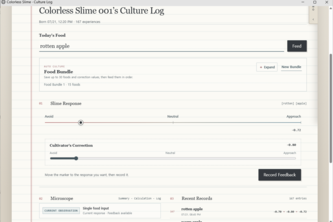
The description states that Colorless Slime is an interactive AI cultivation laboratory. Users cultivate a minimal learning model by feeding it examples, observe its predictions and updates, and inspect internal calculations via a "microscope interface". It runs as a web app or locally on Windows, built with React and TypeScript.
It uses a deliberately simple model based on word-level and phrase-level memory, weighted sums, bias, tanh activation, and gradient-based updates. The system produces a single continuous reaction between avoidance and approach.
Inference The author describes the tool as intentionally favoring transparency over capability, suggesting it is not meant for production or high-performance use but rather for learning and experimentation.
Positioning & Claim Evolution
The author claims Colorless Slime was built to help users "understand how AI systems actually learn", moving beyond black-box applications. It is positioned as a way to "cultivate, observe, and experiment with machine learning" through direct interaction.
It is described as an educational tool, not a commercial product or service. The author explicitly states that the goal was to make the learning process visible and tangible, rather than to build another chatbot or application.
Inference The positioning has evolved from a personal curiosity-driven project into a potential educational platform, though no evidence suggests it has moved beyond prototype or personal use.
Target Customer & ICP
The description does not name specific customer segments. However, the author’s stated intent is to help people "understand machine learning through experimentation", suggesting an audience of learners, educators, or developers interested in AI internals.
It is described as a tool for those who want to "cultivate a tiny AI" and observe how it learns—implying interest from students, educators, or hobbyists exploring ML concepts.
Inference The ICP appears to be individuals or small groups with an interest in machine learning education or experimentation. No evidence of institutional or enterprise adoption is provided.
Business Model & Pricing Evidence
There is no evidence of a business model or pricing structure. The project is described as a personal educational tool, submitted to a hackathon, and not intended for commercial sale or use.
Inference No revenue streams, monetization plans, or pricing are evident. It is likely non-commercial in nature.
Technical & Delivery Signals
The product is built with React, TypeScript, C#, Next.js, OpenAI APIs, Vite, and uses a simple neural network model with:
- Word-level and phrase-level memory
- Weighted sums
- Shared bias
- Tanh activation function
- Gradient-based updates from user feedback
It can run as a web application or locally on Windows, and includes a microscope interface that allows users to inspect internal calculations.
Inference The technical stack suggests a lightweight, educational prototype. The model is described as simple and intentionally minimal, not designed for scalability or production use.
Traction & Maturity Signals
There is no evidence of traction, customers, or adoption beyond the author’s own development. It was submitted to the OpenAI 2026 hackathon, but no data on usage, downloads, or user engagement is provided.
The project is described as a personal prototype with no indication of ongoing development or commercial deployment.
Inference No maturity signals are evident beyond the initial build and submission. No evidence of growth, retention, or product-market fit.
Competitive Context
The description does not mention competitors or similar products. However, it is positioned as an educational AI tool, which may place it in a space with other platforms for learning machine learning concepts—such as interactive coding environments, ML playgrounds, or educational apps.
No direct comparison to existing tools is made.
Inference It is unclear whether similar tools exist. The project appears to be unique in its focus on transparency and cultivation of a minimal AI model.
Open Questions & Risks
- No commercial traction or revenue: The project is described as educational and personal, with no evidence of monetization.
- Single developer: The team size is listed as one, which may limit scalability or long-term development capacity.
- Limited scope: The model is intentionally simple and not designed for production use.
- Unverified claims: All descriptions are self-reported and unverified; no third-party validation exists.
Inference The project lacks commercial viability or traction. It is a prototype with educational intent, not a scalable product.
Questions the description leaves open
- What is the intended long-term vision for Colorless Slime beyond its current educational scope?
- Has there been any user feedback or testing beyond personal use?
- Are there plans to expand the model’s capabilities or make it more accessible to a broader audience?
- Is there any interest from educators, institutions, or platforms that might adopt or promote this tool?
- What are the technical limitations of the current model and how would they be addressed in future versions?
Overall Assessment
Not evidenced: There is no evidence of commercial traction, revenue, or institutional interest to support an investment or partnership decision.
The project is described as a personal educational prototype, submitted to a hackathon. It does not appear to have moved beyond the initial concept or demonstration phase.
Inference At this stage, Colorless Slime is not a viable candidate for investment or strategic partnership. It may be of interest for educational or research purposes, but lacks commercial or market signals.
User Stories BotA demo video on every pull request
Get a demo video on every new feature
GitHub App that watches your pull requests and records a narrated, captioned demo.
Save time on demo prep and make informed decisions faster with a video walkthrough of every new feature.
Source
Submitted to the OpenAI 2026 hackathon on Devpost. Project home on Devpost. Back to the full gallery on Devpost.
This competitive analysis was produced by top-founders.com (opens in a new tab)
Generated by a language model from this project's public Devpost page — its tagline, the author's own write-up and any built-with tags listed there — as captured in August 2026. Short quotations are the author's words. It is an opinion on the idea as a business, not on the people behind it, and it reflects the description as published then. If the project has moved on, request a correction below. The analysis is not independent research and contains no verified traction, revenue or customer data.
An independent guide by KFG International LLC — not affiliated with, endorsed by, or connected to Devpost or OpenAI.