

Archive position — measured, not model output
0 likes on Devpost
2,263 of the 7,850 archived projects have more likes, and 5,587 share exactly 0 — so this project's #3,454 place in the like-ranked listing is a tie-break inside that group, not a ranking.
Projects (log scale)
Likes on Devpost. ▲ marks this project's group.
Show the figures
| Likes | Projects | Share of archive |
|---|---|---|
| 0 | 5,587 | 71.2% |
| 1 | 1,758 | 22.4% |
| 2 | 284 | 3.6% |
| 3–4 | 132 | 1.7% |
| 5–9 | 75 | 1.0% |
| 10+ | 14 | 0.2% |
 User Stories BotA demo video on every pull request
Get a demo video on every new feature
GitHub App that watches your pull requests and records a narrated, captioned demo.
Save time on demo prep and make informed decisions faster with a video walkthrough of every new feature.
Executive Summary
Company: Comic Creator
Self-reported basis: The description is entirely self-reported by the author, Mehmet Akgunay, and unverified.
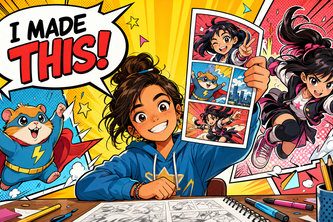
What it appears to be: A browser-based tool for children aged 9–13 to create printed comic books using AI-generated illustrations, with full control over story content and explicit child-authorship rules.
What changed: The project evolved from a personal idea sparked by the author’s daughter into a prototype that implements a five-step creative process, including local persistence, editable lettering, and PDF export.
Most important open question: Does the product concept align with actual user needs or is it a speculative build based on a single anecdote?
What The Product Actually Is
The description states that Comic Creator is a browser-based application for children aged 9–13 to create printed comic books using AI. It guides users through five steps:
- Create and approve an original hero.
- Choose and refine a visual style.
- Write the Setup, Problem, Big Moment, and Ending.
- Direct each panel (scene, action, dialogue, captions).
- Present and export as a printable PDF.
The child writes all plot events, character facts, captions, and dialogue. AI generates illustrations based on those directions but never rewrites or creates content independently.
Artwork is treated as a candidate for approval or dismissal; it does not silently replace approved work. Dialogue and captions remain editable word boxes by default.
The prototype includes:
- Local filesystem persistence
- Sample mode (no API key required)
- Multi-panel comics (up to 16 panels)
- Same-device coauthoring
- PDF export
- Reference-guided artwork generation
Not evidenced: No revenue, customers, or adoption data. The product is described as a prototype built for an OpenAI hackathon.
Positioning & Claim Evolution
The author states that the product is designed to give children screen time that creates rather than consumes content, while introducing them to AI and imagination.
It positions itself in the education + creative tools space, targeting kids aged 9–13 who want to tell stories but lack drawing skills. The core claim is that it enables child-authored storytelling with AI-assisted illustration, without AI taking over creative control.
The positioning has evolved from a personal idea (inspired by the author’s daughter) into a structured prototype with defined workflows and technical constraints, such as:
- AI only renders what the child directs
- No automatic rewriting or story generation
- Local-only architecture to preserve privacy
Not evidenced: No market research, competitive positioning, or user feedback beyond the author's own account.
Target Customer & ICP
The description states that Comic Creator is for children aged 9–13. It also implies a secondary audience of parents and educators, who may be interested in educational outcomes or parental controls.
The product is built with:
- A child-as-author rule
- Local-only architecture (no cloud storage, no accounts)
- No public sharing or remote collaboration features
Not evidenced: No explicit customer segmentation beyond age group. No evidence of parental consent mechanisms or classroom workflows.
Business Model & Pricing Evidence
The description does not state a business model or pricing strategy. It mentions:
- A bundled Sample mode that demonstrates the workflow without requiring an API key
- No paid requests or accounts in the prototype
- Future plans to include supervised usability testing and legal/privacy work
Not evidenced: No revenue streams, monetization plans, or pricing tiers.
Technical & Delivery Signals
The product is built with:
- Frontend: React, TypeScript, Vite
- Backend: Express.js, Node.js
- AI models: GPT-5.6 Luna, GPT Image 2, OpenAI Moderation
- Storage: Local filesystem (no cloud or database)
- Validation: Zod schemas for data contracts and model boundaries
Key technical decisions include:
- Separated roles for AI models (story coaching vs. image generation)
- Non-destructive revisions
- Deterministic verification suite with 291 passing tests
- Strict typechecking and production build
Not evidenced: No deployment, scaling, or infrastructure details beyond local development.
Traction & Maturity Signals
The description states that this is a prototype built for an OpenAI hackathon. It includes:
- Local persistence
- Project recovery
- Multi-page comics
- PDF export
- Sample mode
- 291 passing tests
No evidence of:
- Revenue or monetization
- Customer base or usage metrics
- Product-market fit validation
- Public adoption or user testing beyond the author’s own account
Competitive Context
The description does not mention any competitors. It implies a niche in child-friendly AI storytelling tools, possibly overlapping with:
- Educational apps for creative writing
- AI-powered drawing or comic creation tools
- Tools for children to express creativity through digital media
Not evidenced: No competitive analysis, market size, or positioning relative to existing tools.
Open Questions & Risks
- Speculative build: The product is based on a single anecdote (the author’s daughter) and lacks user research or testing.
- No monetization strategy: No evidence of how the product will generate revenue.
- Limited scope: The prototype has no accounts, analytics, cloud storage, or public sharing — which may limit scalability or adoption.
- Privacy constraints: While local-only architecture is a feature, it also limits potential growth and user engagement.
- Unproven educational outcomes: The author notes that educational outcomes are hypotheses to test, not claims.
Questions the description leaves open
- What evidence do you have that children aged 9–13 want or need this tool?
- How did you validate the five-step process with real users?
- What is your plan for parental consent and data privacy compliance?
- Are there any plans to integrate cloud storage, collaboration, or analytics?
- How would you monetize this product if it were to scale beyond a prototype?
Overall Assessment
Confidence: Low — based on self-reported evidence only.
The project is a prototype built for a hackathon, with no demonstrated traction, revenue, or user validation. It is positioned as an educational tool for children that uses AI to assist storytelling while preserving child-authored content.
It has:
- A clear technical architecture
- A defined target audience
- A strong privacy focus
- No evidence of monetization or scalability
Assessment: Not ready for investment or partnership without further validation, including usability testing, market research, and a defined business model. The idea is intriguing but unproven.
User Stories BotA demo video on every pull request
Get a demo video on every new feature
GitHub App that watches your pull requests and records a narrated, captioned demo.
Save time on demo prep and make informed decisions faster with a video walkthrough of every new feature.
Source
Submitted to the OpenAI 2026 hackathon on Devpost. Project home on Devpost. Back to the full gallery on Devpost.
This competitive analysis was produced by top-founders.com (opens in a new tab)
Generated by a language model from this project's public Devpost page — its tagline, the author's own write-up and any built-with tags listed there — as captured in August 2026. Short quotations are the author's words. It is an opinion on the idea as a business, not on the people behind it, and it reflects the description as published then. If the project has moved on, request a correction below. The analysis is not independent research and contains no verified traction, revenue or customer data.
An independent guide by KFG International LLC — not affiliated with, endorsed by, or connected to Devpost or OpenAI.