

Archive position — measured, not model output
0 likes on Devpost
2,263 of the 7,850 archived projects have more likes, and 5,587 share exactly 0 — so this project's #5,417 place in the like-ranked listing is a tie-break inside that group, not a ranking.
Projects (log scale)
Likes on Devpost. ▲ marks this project's group.
Show the figures
| Likes | Projects | Share of archive |
|---|---|---|
| 0 | 5,587 | 71.2% |
| 1 | 1,758 | 22.4% |
| 2 | 284 | 3.6% |
| 3–4 | 132 | 1.7% |
| 5–9 | 75 | 1.0% |
| 10+ | 14 | 0.2% |
 User Stories BotA demo video on every pull request
Get a demo video on every new feature
GitHub App that watches your pull requests and records a narrated, captioned demo.
Save time on demo prep and make informed decisions faster with a video walkthrough of every new feature.
Executive Summary
What the company appears to be
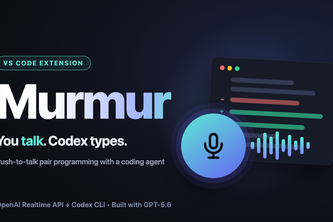
Murmur is a self-reported VS Code extension that enables voice-driven pair programming using OpenAI's Codex CLI and Realtime API. The author states it allows developers to speak changes they want, with Codex executing them locally while the user continues talking. It includes features like real-time voice interaction, background job execution, and voice feedback on diffs.
What changed
The project is described as a one-day hackathon effort that shipped a working prototype from specification to installable .vsix file. It was submitted to the OpenAI 2026 hackathon.
Single most important open question
Is there any evidence of commercial traction, revenue, or customer adoption beyond the author's own account?
What The Product Actually Is
The description states that Murmur is a VS Code extension designed for hands-free pair programming. It uses:
- OpenAI's Codex CLI installed locally
- OpenAI Realtime API over WebRTC
- A voice interface where users speak changes they want to make
- Voice feedback on git diffs after execution
The author claims it enables a "voice to working code loop" where spoken requests are executed and the resulting diff is narrated back aloud.
Evidence The project write-up explicitly describes how it works, including architecture details like extension host vs webview components, tool schemas (get_context, run_codex, read_diff, stop_codex), and async job pattern for long-running CLI work.
Inference Based on the description, Murmur appears to be a developer productivity tool built as a VS Code plugin that leverages AI agents for code editing through voice interaction.
Positioning & Claim Evolution
The author states:
- "Coding agents have become really capable now, they can do actual work."
- "We are still driving them the old way, typing long paragraphs into a chat box."
- "I wanted to just say the change I want, keep thinking about next thing, and hear back what happened."
This suggests a positioning shift from traditional text-based interaction with AI agents to voice-driven workflows.
The claim evolution shows:
- Problem: Current coding agent interfaces are inefficient (typing long prompts)
- Solution: Voice-first workflow for hands-free pair programming
- Differentiation: Accessibility focus for developers with RSI or low vision
Evidence The inspiration and what-it-does sections clearly articulate this progression from problem to solution.
Inference The positioning appears to be about improving developer experience through accessibility and efficiency, though no market validation is provided.
Target Customer & ICP
The description states:
- Murmur targets developers who want hands-free coding
- Specifically mentions accessibility needs for those with RSI or low vision
- Positions itself as a tool for "developers with RSI or low vision, coding by voice is not some fancy gimmick, it can be the only comfortable way to code"
Evidence The author explicitly identifies this group as primary users.
Inference The ICP seems to be developers who face physical limitations in typing or prefer voice interaction for productivity reasons. However, there's no evidence of broader market targeting beyond this niche.
Business Model & Pricing Evidence
The description does not contain any information about:
- Revenue model
- Pricing structure
- Monetization strategy
- Customer acquisition costs
- Unit economics
Evidence Not evidenced.
Inference Since this is a hackathon project and no commercial data exists, it's unclear if there is any business model beyond personal use or future development plans.
Technical & Delivery Signals
The author states:
- Built in one day from spec to installable .vsix
- Uses Codex for code generation with full architecture and tool schemas provided upfront
- Implements async job pattern to keep voice session responsive during background work
- Handles WebRTC session setup, VS Code webview messaging, esbuild packaging
- Secures API key never leaves extension host; webview holds only ephemeral credentials
- Includes confirmation dialog for workspace edits and stop functionality with SIGTERM escalation
Evidence The "How we built it" section provides detailed technical implementation.
Inference The delivery approach shows strong engineering discipline, particularly around security (credential handling) and async job management. However, no evidence of production deployment or scalability considerations.
Traction & Maturity Signals
The description states:
- Shipped everything in one day
- Spec to installable .vsix
- Submitted to OpenAI 2026 hackathon
There is no evidence of:
- Revenue
- Customer base
- Usage metrics
- Product-market fit validation
- Market traction beyond the hackathon submission
Evidence Not evidenced.
Inference This appears to be a proof-of-concept prototype, not a mature product with real-world adoption or commercial success.
Competitive Context
The description does not mention:
- Direct competitors
- Indirect substitutes
- Market size or growth trends
- Competitive advantages or disadvantages
Evidence Not evidenced.
Inference Without any competitive analysis in the description, it's impossible to assess Murmur's positioning relative to existing tools like GitHub Copilot, Tabnine, or voice-enabled IDE plugins.
Open Questions & Risks
Key risks identified from the description:
- Unproven commercial viability: No evidence of revenue, customers, or market traction
- Limited scope: One-person team, hackathon project, no clear path to product-market fit
- Security assumptions: Relies heavily on local execution and ephemeral credentials; unclear how this scales or handles edge cases
- Dependency risks: Uses Codex CLI and OpenAI APIs which may change or become unavailable
- Accessibility focus without validation: Positions itself for accessibility but lacks evidence of user testing or feedback from target users
Evidence These are inferred from the lack of commercial data, team size, and absence of traction signals.
Questions the description leaves open
- What is your plan to validate demand beyond the hackathon?
- How do you intend to monetize this tool if at all?
- Have you tested with actual users who have RSI or low vision?
- What are the technical limitations of running Codex CLI locally in VS Code?
- Are there any known issues with scaling this approach for larger teams or enterprise use?
- How do you plan to handle privacy concerns around voice data and local execution?
Overall Assessment
Confidence Level Low — based on self-reported evidence only, no third-party validation.
Assessment Murmur is a hackathon prototype that demonstrates technical capability in voice-driven coding workflows. However, there is no evidence of commercial traction, revenue, or customer adoption. The project appears to be an experimental tool focused on accessibility and developer experience, but lacks any indication of market readiness or scalability beyond the author's own use case.
Investment/Partnership Recommendation
Not recommended for investment or partnership at this stage without further validation of demand, product-market fit, and commercial viability.
User Stories BotA demo video on every pull request
Get a demo video on every new feature
GitHub App that watches your pull requests and records a narrated, captioned demo.
Save time on demo prep and make informed decisions faster with a video walkthrough of every new feature.
Source
Submitted to the OpenAI 2026 hackathon on Devpost. Project home on Devpost. Back to the full gallery on Devpost.
This competitive analysis was produced by top-founders.com (opens in a new tab)
Generated by a language model from this project's public Devpost page — its tagline, the author's own write-up and any built-with tags listed there — as captured in August 2026. Short quotations are the author's words. It is an opinion on the idea as a business, not on the people behind it, and it reflects the description as published then. If the project has moved on, request a correction below. The analysis is not independent research and contains no verified traction, revenue or customer data.
An independent guide by KFG International LLC — not affiliated with, endorsed by, or connected to Devpost or OpenAI.