

Archive position — measured, not model output
1 like on Devpost
505 of the 7,850 archived projects have more likes, and 1,758 share exactly 1 — so this project's #1,493 place in the like-ranked listing is a tie-break inside that group, not a ranking.
Projects (log scale)
Likes on Devpost. ▲ marks this project's group.
Show the figures
| Likes | Projects | Share of archive |
|---|---|---|
| 0 | 5,587 | 71.2% |
| 1 | 1,758 | 22.4% |
| 2 | 284 | 3.6% |
| 3–4 | 132 | 1.7% |
| 5–9 | 75 | 1.0% |
| 10+ | 14 | 0.2% |
 User Stories BotA demo video on every pull request
Get a demo video on every new feature
GitHub App that watches your pull requests and records a narrated, captioned demo.
Save time on demo prep and make informed decisions faster with a video walkthrough of every new feature.
Executive Summary
What the company appears to be
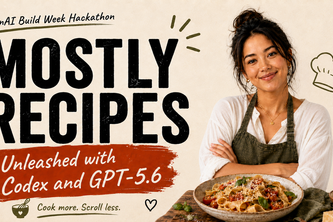
Mostly Recipes is a local-first recipe app that stores recipes offline, without ads or clutter. The author states it was built as part of an OpenAI Build Week hackathon project and uses GPT-5.6 as an engineering collaborator for building a shared sync system across apps.
What changed
The project evolved from a basic local-first recipe app to a platform-level infrastructure component — the "Cloud Data Sync" module — designed to support multiple apps in the "Mostly family". This new system enables incremental synchronization, offline editing, conflict resolution, and cross-app data sharing while maintaining local ownership of data.
Single most important open question
Is there any evidence that the described sync system has been deployed beyond a prototype or proof-of-concept stage? The description states it's being tested in "Mostly Page", but does not confirm whether this is live usage or just an internal proving ground.
What The Product Actually Is
The description states:
- Mostly Recipes imports recipes from websites and unstructured text.
- It allows users to organize, search, edit, plan, and use collections offline.
- It uses GPT-5.6 for AI assistance in parsing messy content into usable recipes.
- A "Chef AI" (OpenAI API) helps recover structured recipes when ordinary parsing fails and can generate recipe cover images.
The major contribution during OpenAI Build Week was the development of a shared, account-scoped sync system called "Mostly Cloud Data Sync", intended for use across multiple apps in the "Mostly family".
Positioning & Claim Evolution
The description states:
- The app started with the idea that recipe collections should live locally and work offline.
- It emphasizes privacy by avoiding ads or clutter, and keeping data private.
- The original product principle was to keep local data useful even when network/cloud services are unavailable.
Evolution claimed:
- The project expanded from a single app to a shared infrastructure layer for syncing across apps.
- GPT-5.6 was used not just for demo features but as an engineering collaborator on production code.
- The sync system is described as being built for incremental changes, offline edits, safe recovery, and cross-app data sharing.
Inference: The positioning shifted from a personal recipe app to a platform-level sync engine, although the core product remains focused on local-first recipe management.
Target Customer & ICP
The description states:
- People who collect recipes over time, tie them to memories, and share them with family/friends.
- Users who value privacy and want control over their data.
No explicit customer segments or personas are described beyond this general user group. The author does not state whether the app targets individuals, families, or professional chefs.
Inference: Based on the emphasis on personal data and offline use, the ICP likely includes tech-savvy individuals who prioritize privacy and local ownership of digital content.
Business Model & Pricing Evidence
The description states:
- The app uses Stripe for billing.
- There is mention of "Mostly+" entitlement checks, suggesting a paid tier or subscription model.
No pricing details, revenue figures, or monetization strategy are provided beyond the use of Stripe and reference to entitlements.
Inference: A freemium or tiered model may exist, but no evidence supports specific pricing tiers or customer acquisition costs.
Technical & Delivery Signals
The description states:
- Built with React, TanStack Start, TanStack DB, Dexie, IndexedDB, TypeScript, Zod, Better Auth, Stripe, and Cloudflare services including Workers, D1, R2, Queues, and Durable Objects.
- GPT-5.6 was used as an engineering collaborator in a production monorepo with multiple apps and shared packages.
- The sync system includes:
- A standalone Cloudflare Worker hosting a SQLite-backed Durable Object.
- Zod-validated push/pull protocol for incremental row synchronization.
- TanStack DB collection adapter capturing local mutations without forcing product code to adopt a separate sync API.
- Local outbox staging changes before persistence, recovering interrupted writes and replaying offline mutations.
- Web Locks coordinating sync, backup, restore, sign-out, and multiple browser tabs.
- App-owned routes enforcing session freshness, entitlement checks, and access grants.
Inference: The technical stack shows a sophisticated approach to local-first architecture with cloud coordination. However, the system is still in early stages of deployment — being tested in "Mostly Page" while "Mostly Recipes" continues using legacy R2 snapshot system.
Traction & Maturity Signals
The description states:
- The Cloud Data worker and its SQLite Durable Object have been deployed.
- Automated exercises cover convergence, fresh-device restoration, offline replay, idempotent retries, paging, deletion propagation, schema-version protection, and recovery after Epoch Reset.
- Independent protocol clients have converged through the real Durable Object boundary.
However:
- No revenue, ARR, customer base, or adoption metrics are mentioned.
- The migration from legacy R2 to Cloud Data is described as staged and backwards-compatible, indicating ongoing development rather than full rollout.
- "Mostly Recipes" still uses its legacy system while preparing for migration.
Not evidenced:
- No data on active users, retention rates, monetization, or product usage beyond the developer's own account.
Competitive Context
The description does not mention any competitors or market positioning relative to existing recipe apps. It focuses solely on internal architecture and features without reference to how it compares with other tools in the space.
Inference: Given the focus on local-first design and privacy, it may compete indirectly with mainstream recipe apps that centralize data or require online access. However, no competitive analysis is provided.
Open Questions & Risks
- Prototype vs. Production: The sync system appears to be under development and tested in a limited context ("Mostly Page"), not yet fully rolled out to users of "Mostly Recipes".
- Dependency on GPT-5.6: Heavy reliance on AI for engineering tasks raises questions about scalability, maintainability, and whether the same approach can be replicated without AI assistance.
- Migration Complexity: The migration from legacy R2 snapshots to Cloud Data is described as complex and requires careful handling of backward compatibility.
- Lack of Traction Evidence: No evidence of revenue, customers, or user engagement beyond the author’s own account.
Questions the description leaves open
- Is the "Cloud Data Sync" system currently used in production by any app in the "Mostly family", or is it still experimental?
- What are the exact steps and timeline for migrating "Mostly Recipes" from its legacy R2 snapshot system to Cloud Data?
- How does the sync system handle conflicts between devices when users edit the same recipe simultaneously?
- Are there any known performance bottlenecks or limitations in the current implementation?
- What is the long-term roadmap for monetization and scaling beyond the current prototype phase?
Overall Assessment
The description states that this project was submitted to an OpenAI Build Week hackathon, indicating it is likely a proof-of-concept or early-stage prototype. While the technical architecture shows promise and innovation in local-first sync systems, there is no evidence of traction, revenue, or customer adoption.
Confidence Level: Low
Assessment: Not ready for investment or partnership at this time. The project demonstrates strong engineering capability but lacks commercial validation or market readiness. Further diligence would be needed to assess whether the described platform can scale beyond a prototype and gain real-world usage.
User Stories BotA demo video on every pull request
Get a demo video on every new feature
GitHub App that watches your pull requests and records a narrated, captioned demo.
Save time on demo prep and make informed decisions faster with a video walkthrough of every new feature.
Source
Submitted to the OpenAI 2026 hackathon on Devpost. Project home on Devpost. Back to the full gallery on Devpost.
This competitive analysis was produced by top-founders.com (opens in a new tab)
Generated by a language model from this project's public Devpost page — its tagline, the author's own write-up and any built-with tags listed there — as captured in August 2026. Short quotations are the author's words. It is an opinion on the idea as a business, not on the people behind it, and it reflects the description as published then. If the project has moved on, request a correction below. The analysis is not independent research and contains no verified traction, revenue or customer data.
An independent guide by KFG International LLC — not affiliated with, endorsed by, or connected to Devpost or OpenAI.