

Archive position — measured, not model output
0 likes on Devpost
2,263 of the 7,850 archived projects have more likes, and 5,587 share exactly 0 — so this project's #5,412 place in the like-ranked listing is a tie-break inside that group, not a ranking.
Projects (log scale)
Likes on Devpost. ▲ marks this project's group.
Show the figures
| Likes | Projects | Share of archive |
|---|---|---|
| 0 | 5,587 | 71.2% |
| 1 | 1,758 | 22.4% |
| 2 | 284 | 3.6% |
| 3–4 | 132 | 1.7% |
| 5–9 | 75 | 1.0% |
| 10+ | 14 | 0.2% |
 User Stories BotA demo video on every pull request
Get a demo video on every new feature
GitHub App that watches your pull requests and records a narrated, captioned demo.
Save time on demo prep and make informed decisions faster with a video walkthrough of every new feature.
Executive Summary
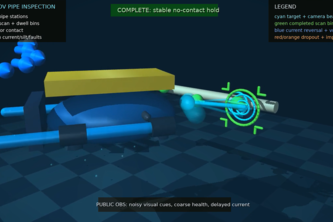
The description states that this is a MuJoCo-based simulation environment for training and evaluating reinforcement learning (RL) agents in underwater pipeline inspection tasks using an 8-thruster ROV. The author claims the benchmark challenges an agent to inspect subsea pipelines under turbulent conditions, with performance measured via a cost function involving tracking, camera alignment, yaw control, stability, and actuator usage.
The project is presented as a publicly available robotics simulation intended for RL research or benchmarking, including a reference controller, deterministic scorer, and rendered video. It was submitted to the OpenAI 2026 hackathon.
Key commercial due-diligence question: Is there any evidence that this simulation environment has been adopted by researchers, developers or institutions beyond its author? If not, what is the path to traction or monetization?
What The Product Actually Is
The description states:
- This is a MuJoCo-based simulation environment for underwater ROV (Remotely Operated Vehicle) inspection.
- It simulates an 8-thruster robot inspecting pipelines under turbulent currents and failures.
- The system includes:
- A public ROV environment API
- A deterministic scorer
- A reference/oracle controller
- A 20-second rendered video of the inspection
- A visual audit gallery in the README
- Validation artifacts for the rollout
This is a simulation framework, not a commercial product or service. It is described as a research tool intended to support RL training and evaluation.
Positioning & Claim Evolution
The description states:
- The project was built with the goal of making underwater pipeline inspection challenges visually clear.
- It aims to simulate real-world robotics problems such as current recovery, partial actuation, delay, and disturbance handling.
- The author claims it is a frontier-grade MuJoCo RL benchmark, comparing an oracle agent (1.00 score) against a frontier agent (0.15 score).
- It is positioned as a publicly available environment for RL researchers or developers.
There is no evidence of prior positioning or evolution in the description — it is presented as a single, self-contained project submitted to a hackathon.
Target Customer & ICP
The description states:
- The target audience appears to be researchers and developers working in robotics and reinforcement learning.
- It is intended for use in training and evaluating RL agents in underwater inspection tasks.
- The environment is described as publicly accessible, suggesting it targets open-source or academic users.
No explicit customer segments, personas or ICP are defined beyond the implied audience of RL practitioners and robotics researchers.
Business Model & Pricing Evidence
The description states:
- The project is a publicly available simulation environment.
- It includes a reference controller, deterministic scorer, and rendered video.
- No pricing, monetization strategy, or business model is described.
There is no evidence of any commercial offering or revenue-generating mechanism.
Technical & Delivery Signals
The description states:
- Built using MuJoCo, with a free-body ROV model, eight vectored thrusters, pipeline geometry, inspection stations, current fields, impulse disturbances, and actuator dropout events.
- The environment exposes policy observations, control actions, and dynamics.
- Includes:
- A public ROV environment API
- A deterministic scorer
- A reference/oracle controller
- A 20-second rendered video
- A visual audit gallery in the README
- Validation artifacts for the rollout
The project is described as self-contained, with no external dependencies beyond standard tools like Python, Docker, and MuJoCo.
Traction & Maturity Signals
The description states:
- The project was submitted to the OpenAI 2026 hackathon.
- It includes a rendered video and visual audit gallery.
- No evidence of adoption, usage metrics, or user feedback is provided.
There is no evidence of traction beyond its submission to a hackathon. No customer base, usage data, or product maturity indicators are evident.
Competitive Context
The description states:
- The project is a MuJoCo-based RL benchmark for underwater robotics.
- It simulates an 8-thruster ROV in pipeline inspection tasks.
- It includes a deterministic scorer and reference controller.
No comparison to existing benchmarks or platforms is made. No evidence of prior similar tools or market presence is provided.
Open Questions & Risks
The description states:
- The project is self-contained and submitted as a hackathon entry.
- There is no evidence of adoption, traction, or commercial viability.
- It is not clear if the environment has been used by others beyond its author.
- The project is described as a single-person effort, with no team or institutional backing.
Key risks:
- Lack of adoption or usage beyond the author.
- No clear path to monetization or product-market fit.
- Limited evidence of technical or commercial viability.
Questions the description leaves open
- Has this simulation environment been used by others beyond your own experiments?
- Are there any plans for ongoing development, maintenance, or community engagement around this benchmark?
- What is the intended use case for this benchmark — academic research, open-source tooling, or commercial RL training?
- Do you have any metrics or feedback from users who have tried to train agents on this environment?
- Is there a plan to expand the simulation beyond the current scope (e.g., multi-ROV coordination, 3D obstacles, sonar perception)?
Overall Assessment
The description states:
- This is a self-contained hackathon submission.
- It is presented as a research tool, not a commercial product.
- No evidence of traction, revenue, or adoption exists.
Assessment: Not evidenced. The project appears to be an academic or experimental simulation environment with no demonstrated commercial or market traction. It has no evident path to monetization or user adoption beyond its author. Any investment or partnership value would depend on future development, adoption, or integration into larger platforms — none of which are evident in the description.
User Stories BotA demo video on every pull request
Get a demo video on every new feature
GitHub App that watches your pull requests and records a narrated, captioned demo.
Save time on demo prep and make informed decisions faster with a video walkthrough of every new feature.
Source
Submitted to the OpenAI 2026 hackathon on Devpost. Project home on Devpost. Back to the full gallery on Devpost.
This competitive analysis was produced by top-founders.com (opens in a new tab)
Generated by a language model from this project's public Devpost page — its tagline, the author's own write-up and any built-with tags listed there — as captured in August 2026. Short quotations are the author's words. It is an opinion on the idea as a business, not on the people behind it, and it reflects the description as published then. If the project has moved on, request a correction below. The analysis is not independent research and contains no verified traction, revenue or customer data.
An independent guide by KFG International LLC — not affiliated with, endorsed by, or connected to Devpost or OpenAI.