

Archive position — measured, not model output
0 likes on Devpost
2,263 of the 7,850 archived projects have more likes, and 5,587 share exactly 0 — so this project's #7,369 place in the like-ranked listing is a tie-break inside that group, not a ranking.
Projects (log scale)
Likes on Devpost. ▲ marks this project's group.
Show the figures
| Likes | Projects | Share of archive |
|---|---|---|
| 0 | 5,587 | 71.2% |
| 1 | 1,758 | 22.4% |
| 2 | 284 | 3.6% |
| 3–4 | 132 | 1.7% |
| 5–9 | 75 | 1.0% |
| 10+ | 14 | 0.2% |
 User Stories BotA demo video on every pull request
Get a demo video on every new feature
GitHub App that watches your pull requests and records a narrated, captioned demo.
Save time on demo prep and make informed decisions faster with a video walkthrough of every new feature.
Executive Summary
What the company appears to be
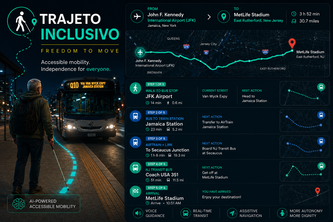
Trajeto Inclusivo is an academic project initiated by a single developer (Celso Lino) that aims to improve public transportation accessibility for people with visual impairments, aging populations, low literacy users, and others navigating unfamiliar transit systems. It began as a university brainstorming idea and evolved into a multimodal navigation platform combining voice guidance, real-time transit data, and accessible interfaces.
What changed
The project transitioned from an academic prototype to a publicly available web application with support for multiple cities, integration of accessibility principles in design, and alignment with open-source repositories like UNIVESP’s. It has also gained recognition through academic endorsement and potential future research opportunities.
Single most important open question — the commercial due-diligence read
Is there evidence that Trajeto Inclusivo is moving beyond an academic or personal mission toward a sustainable product or service model with measurable impact, users, or revenue streams? The description provides no traction data, customer base, monetization strategy, or commercial viability indicators.
What The Product Actually Is
The description states that Trajeto Inclusivo is a multimodal navigation platform designed to help people travel independently using public transportation. It combines:
- Voice guidance
- Real-time public transit information
- Accessible interface elements
- Geolocation and mapping services
- Speech synthesis (using Microsoft's Francesca Neural voice)
- Modular architecture separating route processing, mapping, speech, geolocation, and UI components
It supports simple, sequential journey stages such as initial walk, bus ride, final walk, with each stage presenting only necessary information at that moment.
The platform was built using technologies including Flask, Python, JavaScript, HTML5, CSS3, Google Maps APIs, SQLite, and voice interaction tools like Codex and ChatGPT.
Note
The product is described as a web-based application but lacks evidence of deployment scale, user adoption metrics, or commercial usage.
Positioning & Claim Evolution
The description positions Trajeto Inclusivo as an inclusive mobility solution that adapts technology to people rather than expecting users to adapt to technology. It emphasizes:
- Helping blind individuals
- Supporting older adults
- Assisting those with low literacy
- Enabling anyone navigating unfamiliar transit systems
It started with a narrow focus on blind passengers but evolved into a broader accessibility tool for diverse user groups.
The project’s positioning is rooted in human-centered design, where accessibility is not an afterthought but a core principle guiding every technical decision.
Inference The evolution from a simple idea to a scalable platform suggests intent to expand beyond its original scope, though no evidence supports whether this expansion has occurred or been validated by users.
Target Customer & ICP
The description identifies several target personas:
- Blind people
- Older adults
- People with low literacy
- Tourists unfamiliar with local transit systems
- Anyone needing assistance navigating public transportation
It does not specify a clear Ideal Customer Profile (ICP), nor does it define segmentation strategies or prioritization of these groups.
Claim
The platform targets users who struggle with traditional navigation due to sensory or cognitive limitations.
Not evidenced No data on user demographics, usage frequency, or geographic distribution.
Business Model & Pricing Evidence
There is no mention of a business model, pricing structure, monetization strategy, or revenue streams in the description.
The project is described as an academic initiative that has been accepted into UNIVESP’s official repository and may be submitted to FAPESP for funding.
Claim
The platform is not currently monetized.
Not evidenced No evidence of paid subscriptions, partnerships, grants, or commercial relationships.
Technical & Delivery Signals
Key technical aspects include:
- Modular architecture
- Use of Flask, Python, JavaScript, HTML5, CSS3
- Integration with Google Maps API and geolocation services
- Voice interaction via Microsoft Neural voice
- Speech synthesis using AI tools (Codex, ChatGPT)
- Responsive design for accessibility
- Caching strategies to reduce API costs
The platform was built iteratively based on user feedback and accessibility testing.
Inference The modular architecture implies scalability potential.
Not evidenced No evidence of production deployment, server uptime, or performance benchmarks.
Traction & Maturity Signals
The project has:
- Been accepted into UNIVESP’s official project repository
- Received academic recognition and encouragement from professors
- Continued development post-academic project completion
- Operated a live server since its inception
However, there is no evidence of user base, customer acquisition, revenue, or market traction.
Claim
The platform has matured beyond prototype stage.
Not evidenced No data on active users, retention rates, or adoption metrics.
Competitive Context
The description does not provide any information about competitors or market landscape. It does not reference existing solutions for accessible public transportation navigation.
Not evidenced No competitive analysis, market size estimates, or positioning relative to other platforms.
Open Questions & Risks
- Single-person development team: The project is led by one individual (Celso Lino), raising concerns about scalability and continuity.
- No commercial traction: No evidence of users, revenue, or monetization.
- Dependency on external APIs: Heavy reliance on Google Maps and other third-party services introduces cost and availability risks.
- Limited validation: Feedback comes primarily from academic institutions and accessibility organizations; no independent user testing data.
- Unclear path to sustainability: No indication of funding sources beyond academic support or possible FAPESP grant.
Inference The lack of commercial viability signals raises questions about long-term sustainability and potential for growth.
Questions the description leaves open
- What specific user feedback has driven changes in the platform?
- How many cities currently have active routes supported by Trajeto Inclusivo?
- Has there been any formal partnership with transit agencies or accessibility organizations?
- Are there plans to monetize or scale the platform beyond academic use?
- What are the main technical challenges that remain unresolved?
- Is there a plan for ongoing maintenance and updates post-academic project?
- How is data collected and validated for accuracy across different cities?
Overall Assessment
Not evidenced: There is no evidence of revenue, customers, or commercial traction to assess investment or partnership viability.
The project appears to be an academic initiative with strong intent and design principles, but lacks the indicators typically required for due-diligence evaluation in a commercial context.
Assessment Based on self-reported information only, Trajeto Inclusivo shows promise as a socially impactful tool but does not demonstrate readiness for investment or strategic partnership. Further evidence of user engagement, scalability, and business model clarity is needed before considering deeper diligence.
User Stories BotA demo video on every pull request
Get a demo video on every new feature
GitHub App that watches your pull requests and records a narrated, captioned demo.
Save time on demo prep and make informed decisions faster with a video walkthrough of every new feature.
Source
Submitted to the OpenAI 2026 hackathon on Devpost. Project home on Devpost. Back to the full gallery on Devpost.
This competitive analysis was produced by top-founders.com (opens in a new tab)
Generated by a language model from this project's public Devpost page — its tagline, the author's own write-up and any built-with tags listed there — as captured in August 2026. Short quotations are the author's words. It is an opinion on the idea as a business, not on the people behind it, and it reflects the description as published then. If the project has moved on, request a correction below. The analysis is not independent research and contains no verified traction, revenue or customer data.
An independent guide by KFG International LLC — not affiliated with, endorsed by, or connected to Devpost or OpenAI.