

Archive position — measured, not model output
0 likes on Devpost
2,263 of the 7,850 archived projects have more likes, and 5,587 share exactly 0 — so this project's #3,445 place in the like-ranked listing is a tie-break inside that group, not a ranking.
Projects (log scale)
Likes on Devpost. ▲ marks this project's group.
Show the figures
| Likes | Projects | Share of archive |
|---|---|---|
| 0 | 5,587 | 71.2% |
| 1 | 1,758 | 22.4% |
| 2 | 284 | 3.6% |
| 3–4 | 132 | 1.7% |
| 5–9 | 75 | 1.0% |
| 10+ | 14 | 0.2% |
 User Stories BotA demo video on every pull request
Get a demo video on every new feature
GitHub App that watches your pull requests and records a narrated, captioned demo.
Save time on demo prep and make informed decisions faster with a video walkthrough of every new feature.
Executive Summary
Company: Collab Pen
Self-reported basis: The description is entirely self-reported by the author, unverified, and submitted as part of a hackathon entry. No independent evidence of traction, revenue, customers, or operational history exists.
What it appears to be: A tool enabling on-screen drawing overlays for collaboration or live coaching, built using Codex 5.6 Sol and other technologies.
What changed: The project was submitted as a hackathon entry, indicating early-stage development with no commercial traction.
Single most important open question: Is there evidence of user demand or feedback beyond the author’s own experience?
What The Product Actually Is
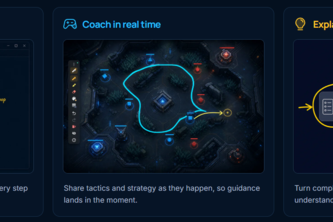
The description states that Collab Pen allows users to draw on screen, and that drawing is synchronized across screens. It also enables sharing of drawings for collaboration or live coaching — particularly in gaming contexts such as League of Legends.
- Claim: Users can draw on screen and see the content they are drawing.
- Claim: The drawing syncs to another user’s screen.
- Claim: It supports collaboration or live game coaching.
- Inference (based on author's own write-up): The tool is intended for use in gaming environments, where users want to interact with others while watching streams.
Not evidenced: No technical specifications, UI details, or functionality beyond the basic description are provided. The product is described as a prototype or proof-of-concept.
Positioning & Claim Evolution
The author describes Collab Pen as a tool for gaming collaboration and coaching — specifically to allow users to draw on screen while watching others play games like League of Legends.
- Claim: It allows interaction during live streaming by enabling drawing overlays.
- Inference (based on inspiration): The product is positioned for gamers or streamers who want to engage with others in real time.
- Inference (based on accomplishments): The tool can be downloaded and run on another computer, suggesting it’s portable or lightweight.
Not evidenced: No evolution of positioning beyond the initial hackathon idea. No evidence of market research, user personas, or competitive differentiation.
Target Customer & ICP
The author states that Collab Pen is intended for users who want to watch others play games (e.g., League of Legends) and interact with them by drawing on screen.
- Claim: The primary use case involves gamers or streamers.
- Inference (based on inspiration): The tool targets individuals or groups watching live gameplay and wanting to provide real-time input or coaching.
- Inference (based on what’s next): The author intends to increase user base, suggesting a focus on early adopters or niche communities.
Not evidenced: No specific customer segments, personas, or market size are described. No evidence of customer interviews or feedback loops beyond the author's own experience.
Business Model & Pricing Evidence
The description does not contain any information about pricing, monetization, or business model.
- Claim: None provided.
- Inference (based on project stage): As a hackathon submission, no commercial model is evident.
Not evidenced: No revenue streams, pricing tiers, or monetization strategy are described.
Technical & Delivery Signals
The author states that the tool was built using Codex 5.6 Sol, .NET, Netlify, and Velopack.
- Claim: Built with Codex 5.6 Sol.
- Claim: Uses .NET, Netlify, and Velopack for delivery.
- Inference (based on accomplishments): The tool can be downloaded and run on another computer — suggesting it’s a standalone application or lightweight web app.
Not evidenced: No details about architecture, scalability, security, or performance. No evidence of production deployment or infrastructure.
Traction & Maturity Signals
The project is described as a hackathon submission with no evidence of traction or user adoption beyond the author's own experience.
- Claim: The tool was built for a hackathon.
- Inference (based on accomplishments): It can be downloaded and run, indicating basic functionality.
- Inference (based on what’s next): The author plans to gather more feedback and increase user base — suggesting early-stage development.
Not evidenced: No customer data, usage metrics, or adoption indicators. No evidence of product-market fit or growth.
Competitive Context
The description does not mention any competitors or existing solutions in the space.
- Claim: None provided.
- Inference (based on project scope): The tool appears to be a niche solution for drawing overlays during gaming or collaboration, but no competitive landscape is described.
Not evidenced: No market analysis, competitive positioning, or benchmarking against similar tools.
Open Questions & Risks
- Risk: The product is a hackathon submission with no commercial traction or user feedback.
- Risk: No evidence of scalability, performance, or security considerations.
- Open Question: The author states that feature-specific tools were not polished during usage — indicating potential technical limitations.
- Open Question: No pricing model or monetization strategy is evident.
Not evidenced: No data on user retention, churn, or long-term viability. No evidence of team experience or prior product success.
Questions the description leaves open
- What specific use cases are you targeting beyond gaming?
- Have you tested the tool with real users outside of your own experience?
- How do you plan to scale beyond a single developer?
- Are there any technical limitations or performance issues that prevent broader adoption?
- What is your roadmap for monetization or commercial viability?
Overall Assessment
Not evidenced: No data to support investment or partnership potential.
- Inference (based on project stage): This is a very early-stage prototype, likely not ready for commercial investment or strategic partnership.
- Inference (based on lack of traction): There is no evidence of user demand or product-market fit.
- Inference (based on team size): With only one member, the project lacks operational capacity for rapid development or scaling.
Confidence: Low. The description is entirely self-reported and unverified, with no evidence of revenue, customers, or traction.
User Stories BotA demo video on every pull request
Get a demo video on every new feature
GitHub App that watches your pull requests and records a narrated, captioned demo.
Save time on demo prep and make informed decisions faster with a video walkthrough of every new feature.
Source
Submitted to the OpenAI 2026 hackathon on Devpost. Project home on Devpost. Back to the full gallery on Devpost.
This competitive analysis was produced by top-founders.com (opens in a new tab)
Generated by a language model from this project's public Devpost page — its tagline, the author's own write-up and any built-with tags listed there — as captured in August 2026. Short quotations are the author's words. It is an opinion on the idea as a business, not on the people behind it, and it reflects the description as published then. If the project has moved on, request a correction below. The analysis is not independent research and contains no verified traction, revenue or customer data.
An independent guide by KFG International LLC — not affiliated with, endorsed by, or connected to Devpost or OpenAI.