

Archive position — measured, not model output
0 likes on Devpost
2,263 of the 7,850 archived projects have more likes, and 5,587 share exactly 0 — so this project's #3,447 place in the like-ranked listing is a tie-break inside that group, not a ranking.
Projects (log scale)
Likes on Devpost. ▲ marks this project's group.
Show the figures
| Likes | Projects | Share of archive |
|---|---|---|
| 0 | 5,587 | 71.2% |
| 1 | 1,758 | 22.4% |
| 2 | 284 | 3.6% |
| 3–4 | 132 | 1.7% |
| 5–9 | 75 | 1.0% |
| 10+ | 14 | 0.2% |
 User Stories BotA demo video on every pull request
Get a demo video on every new feature
GitHub App that watches your pull requests and records a narrated, captioned demo.
Save time on demo prep and make informed decisions faster with a video walkthrough of every new feature.
Executive Summary
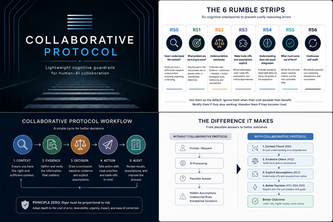
The company appears to be a solo project, Collaborative Protocol, self-described as a behavioral framework for improving human–AI collaboration in technical work. The author states it emerged from iterative experimentation with AI while building software systems. It is not evidenced to have any revenue, customers or traction.
The single most important open question is: What evidence exists that the protocol has been adopted or tested in real-world engineering teams?
This is a self-reported, unverified project description. The author states the framework consists of "Rumble Strips" — cognitive checkpoints inspired by roadside safety features — designed to interrupt reasoning failures before they become costly mistakes. It is not evidenced to have any commercial traction, pricing model or target customer base.
What The Product Actually Is
The description states that Collaborative Protocol is a lightweight behavioral framework for human–AI technical collaboration. It consists of a handful of operational heuristics called Rumble Strips, which are cognitive checkpoints designed to interrupt common reasoning failures before they become expensive mistakes.
The framework is described as:
- Not prescribing detailed workflows
- Inspired by roadside safety features (Rumble Strips)
- Focused on catching reasoning errors early
- Intentionally compact to minimize overhead while maximizing error detection probability
Inference: The framework appears to be a set of cognitive guardrails or decision-making heuristics, not a software tool or platform.
Positioning & Claim Evolution
The description states that the project emerged from observing predictable patterns in technical collaboration with AI:
- Jumping to conclusions before understanding context
- Optimizing proxies instead of real problems
- Treating plausible explanations as evidence
- Hiding critical assumptions
- Applying uniform rigor regardless of risk
Claim: Instead of solving these issues with complex prompts, the author asked "What if we could transfer a small set of cognitive guardrails instead of a large set of instructions?"
The framework is positioned as:
- Not aiming to make AI "smarter"
- Aiming to make collaboration more reliable
- A behavioral intervention rather than a procedural checklist
- Designed to detect cognitive drift early enough to correct it
Inference: The positioning evolved from identifying common failures in AI-assisted engineering to proposing a lightweight behavioral framework as an alternative approach.
Target Customer & ICP
Not evidenced. The description does not identify specific target customers or ideal customer profiles (ICP). It only states that the framework was developed through collaboration with AI while building software systems, but does not specify who would use it or how.
Inference: Based on the context of engineering work and technical collaboration, potential users might be software engineers, developers, or technical teams working with AI tools. However, this is speculative without evidence.
Business Model & Pricing Evidence
Not evidenced. The description does not contain any information about pricing, revenue streams, monetization strategy, or business model.
Inference: Since the project is described as a solo effort and no commercial traction is mentioned, it's unclear whether there's any formal business model in place.
Technical & Delivery Signals
The description states:
- The protocol was not designed top-down
- It emerged through hundreds of hours of iterative collaboration with AI while developing real software systems
- Every recurring failure became an opportunity to identify its underlying cognitive pattern
- Only heuristics that consistently reduced friction and improved decision quality survived
- The result is intentionally compact
Inference: This suggests a development process focused on practical application and iterative refinement, rather than theoretical design. However, no specific technical architecture or delivery mechanism is described.
Traction & Maturity Signals
Not evidenced. The description does not contain any information about:
- Revenue or customers
- Adoption rates
- Product usage metrics
- Market traction
- Business development milestones
Inference: The project appears to be in an early stage, possibly a prototype or personal experiment, with no demonstrated market adoption.
Competitive Context
Not evidenced. The description does not mention any competitors, similar products, or competitive landscape.
Inference: Without evidence of existing solutions or market positioning, it's impossible to assess the competitive environment.
Open Questions & Risks
- Solo operation: Only one team member is mentioned (Filippo Kania), which may limit scalability and execution capability
- No traction evidence: No revenue, customers, or adoption data provided
- Unproven effectiveness: The framework's impact on decision quality is claimed but not demonstrated
- Limited validation: The only validation appears to be personal experience during development work
- Unclear commercial viability: No business model or monetization strategy described
Questions the description leaves open
- What specific engineering problems have you observed that the protocol addresses?
- Have you tested the protocol with other engineers or teams beyond yourself?
- How do you measure improvements in decision quality or collaboration outcomes?
- What are your plans for scaling beyond personal use?
- Are there any early adopters or partners who could validate the framework's utility?
- How do you plan to monetize or commercialize this framework?
Overall Assessment
Not evidenced. The description does not provide sufficient information to assess investment or partnership potential.
Inference: Given that this is a solo project with no demonstrated traction, revenue, or customer base, it's difficult to evaluate its investment or partnership viability. The framework appears to be an experimental concept rather than a developed product with market validation.
User Stories BotA demo video on every pull request
Get a demo video on every new feature
GitHub App that watches your pull requests and records a narrated, captioned demo.
Save time on demo prep and make informed decisions faster with a video walkthrough of every new feature.
Source
Submitted to the OpenAI 2026 hackathon on Devpost. Project home on Devpost. Back to the full gallery on Devpost.
This competitive analysis was produced by top-founders.com (opens in a new tab)
Generated by a language model from this project's public Devpost page — its tagline, the author's own write-up and any built-with tags listed there — as captured in August 2026. Short quotations are the author's words. It is an opinion on the idea as a business, not on the people behind it, and it reflects the description as published then. If the project has moved on, request a correction below. The analysis is not independent research and contains no verified traction, revenue or customer data.
An independent guide by KFG International LLC — not affiliated with, endorsed by, or connected to Devpost or OpenAI.