

Archive position — measured, not model output
0 likes on Devpost
2,263 of the 7,850 archived projects have more likes, and 5,587 share exactly 0 — so this project's #5,408 place in the like-ranked listing is a tie-break inside that group, not a ranking.
Projects (log scale)
Likes on Devpost. ▲ marks this project's group.
Show the figures
| Likes | Projects | Share of archive |
|---|---|---|
| 0 | 5,587 | 71.2% |
| 1 | 1,758 | 22.4% |
| 2 | 284 | 3.6% |
| 3–4 | 132 | 1.7% |
| 5–9 | 75 | 1.0% |
| 10+ | 14 | 0.2% |
 User Stories BotA demo video on every pull request
Get a demo video on every new feature
GitHub App that watches your pull requests and records a narrated, captioned demo.
Save time on demo prep and make informed decisions faster with a video walkthrough of every new feature.
Executive Summary
What the company appears to be
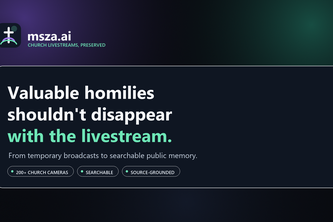
MszaAI is a self-reported project that claims to turn church livestreams into searchable transcripts, sermon studies, and source-grounded AI answers. It monitors more than 200 livestream sources using local audio checks to detect Masses, then activates transcription only when a live event is detected. The system builds an archive of sermons and studies, with a public AI assistant that retrieves relevant passages from real homilies and includes clickable citations.
What changed
During the OpenAI Build Week, the project added GPT-5.6 and Codex to extend its functionality, including building a public AI assistant for the complete archive, source-grounded retrieval, clickable citations, and improved privacy and cost controls. The system now supports bilingual UI and on-demand translation while preserving original content.
The single most important open question
Is there any evidence of actual use or traction beyond the self-reported development work?
What The Product Actually Is
The description states that MszaAI monitors over 200 church livestream sources using local audio checks to detect when a Mass is likely beginning. Only then does it activate transcription, aiming to reduce unnecessary processing and API costs.
After a broadcast, users can:
- Read transcripts and structured timelines;
- Find sermons, announcements, and summaries;
- Explore daily, weekly, and monthly sermon studies;
- Search the public archive;
- Follow selected churches and receive notifications;
- Translate published content on demand;
- Ask an AI assistant questions across the archive.
The AI assistant retrieves relevant passages from real homilies and studies, with clickable citations allowing users to inspect the original sermon instead of trusting unsupported AI responses.
Evidence The author's own write-up describes these features in detail. However, no evidence is provided that any of this functionality has been deployed or used beyond the development phase.
Positioning & Claim Evolution
The project positions itself as a tool for preserving valuable homilies and parish information that otherwise disappear after livestreams end. It emphasizes turning temporary church broadcasts into lasting, searchable, and verifiable public knowledge.
During OpenAI Build Week, the team extended the product with GPT-5.6 and Codex to build:
- A public AI assistant for the complete archive;
- Source-grounded retrieval across sermons and studies;
- Clickable citations leading to original passages;
- Transparent explanations of the assistant's limitations;
- Stronger privacy and cost controls;
- An English user-facing interface with shareable language links;
- On-demand translation while preserving original source content.
Evidence The author claims these additions were made during Build Week. No evidence is provided that any of this functionality has been released or tested in production beyond the hackathon context.
Target Customer & ICP
The description states that MszaAI targets people who missed Mass, are homebound, or want to revisit a sermon later. It also mentions that it helps those who cannot attend live broadcasts but still wish to access the content.
Evidence The author describes the intended audience based on user needs, but no evidence is provided about actual users, customer segments, or market validation.
Business Model & Pricing Evidence
There is no mention of pricing, monetization, or business model in the description. The project appears to be a self-reported hackathon submission with no indication of how it would generate revenue or sustain operations.
Evidence Not evidenced.
Technical & Delivery Signals
The frontend uses React, TypeScript, and Vite. The backend is built with Node.js and Express, communicating through HTTP and WebSockets. SQLite stores data including cameras, sessions, transcripts, studies, citations, and user preferences.
yt-dlp and FFmpeg handle livestream audio. Local checks run while a camera is idle, and transcription services are activated only after the state machine detects a likely live event.
The AI assistant operates over a read-only public corpus. Retrieval identifies relevant transcript and study passages, while the answer layer preserves source metadata so every supported claim can link back to its evidence.
GPT-5.6 and Codex were used for:
- Tracing data through frontend, backend, retrieval layer, and storage;
- Implementing the public assistant and citation flow;
- Improving bilingual UI;
- Identifying privacy and cost risks;
- Testing edge cases;
- Keeping documentation aligned with implementation.
Evidence The author provides a detailed technical breakdown of how the system was built. However, no evidence is provided that this has been deployed or tested in real-world conditions beyond the hackathon.
Traction & Maturity Signals
There is no evidence of traction, revenue, customers, or adoption beyond the self-reported development work. The project is described as existing before the submission period and being extended during Build Week, but there are no claims about usage metrics, user engagement, or product maturity.
Evidence Not evidenced.
Competitive Context
No information is provided about competitors or market positioning. The author does not reference similar tools or platforms in the space of church livestream archiving or AI-powered sermon analysis.
Evidence Not evidenced.
Open Questions & Risks
- Unverified claims: All features and functionality are self-reported without independent verification.
- No traction or revenue: No evidence of actual users, customers, or monetization.
- Limited scope: The project appears to be a hackathon submission with no indication of long-term viability or scalability.
- Dependency on external tools: Heavy reliance on GPT-5.6 and Codex may pose risks if these services change or become unavailable.
- Lack of clarity on data governance: No mention of how user data is handled, stored, or protected.
Evidence These are inferences drawn from the lack of evidence for key business signals and the speculative nature of the claims.
Questions the description leaves open
- What is the actual source of the livestreams being monitored? Are they publicly available?
- How many churches or livestream sources are actively monitored, and how often do they go live?
- Has the system been tested in real-world conditions beyond the hackathon?
- What is the current status of the AI assistant—has it been released to users?
- Is there any plan for monetization or scaling beyond the current scope?
- How are citations generated and verified? Are they manually curated or automated?
- What are the technical limitations of the local audio detection system?
- Has the team considered privacy implications, especially around transcription and AI-generated content?
Evidence These questions arise from the absence of evidence regarding real-world deployment, user feedback, and operational details.
Overall Assessment
There is insufficient evidence to assess whether MszaAI has commercial potential or traction. The project appears to be a self-reported hackathon submission with no verified users, revenue, or market validation. While the concept of preserving religious content through AI is interesting, there is no indication that it has moved beyond prototype or demonstration stages.
Evidence Not evidenced. The description is entirely self-reported and unverified. No signs of traction, customers, or business model are evident.
User Stories BotA demo video on every pull request
Get a demo video on every new feature
GitHub App that watches your pull requests and records a narrated, captioned demo.
Save time on demo prep and make informed decisions faster with a video walkthrough of every new feature.
Source
Submitted to the OpenAI 2026 hackathon on Devpost. Project home on Devpost. Back to the full gallery on Devpost.
This competitive analysis was produced by top-founders.com (opens in a new tab)
Generated by a language model from this project's public Devpost page — its tagline, the author's own write-up and any built-with tags listed there — as captured in August 2026. Short quotations are the author's words. It is an opinion on the idea as a business, not on the people behind it, and it reflects the description as published then. If the project has moved on, request a correction below. The analysis is not independent research and contains no verified traction, revenue or customer data.
An independent guide by KFG International LLC — not affiliated with, endorsed by, or connected to Devpost or OpenAI.