

Archive position — measured, not model output
0 likes on Devpost
2,263 of the 7,850 archived projects have more likes, and 5,587 share exactly 0 — so this project's #5,409 place in the like-ranked listing is a tie-break inside that group, not a ranking.
Projects (log scale)
Likes on Devpost. ▲ marks this project's group.
Show the figures
| Likes | Projects | Share of archive |
|---|---|---|
| 0 | 5,587 | 71.2% |
| 1 | 1,758 | 22.4% |
| 2 | 284 | 3.6% |
| 3–4 | 132 | 1.7% |
| 5–9 | 75 | 1.0% |
| 10+ | 14 | 0.2% |
 User Stories BotA demo video on every pull request
Get a demo video on every new feature
GitHub App that watches your pull requests and records a narrated, captioned demo.
Save time on demo prep and make informed decisions faster with a video walkthrough of every new feature.
Executive Summary
What the company appears to be
The project described as "MT-07 Live Signals App" is a self-reported experimental monitoring tool built for a hackathon. It claims to process live information through a structured six-stage signal cycle, distinguishing between visible and held-out data, and offering correction-aware metrics without predictive capability.
What changed
This is a single-developer project submitted as part of an OpenAI 2026 hackathon. The author states that it evolved from an earlier "MT-07 experimental architecture" and was extended using Codex and GPT-5.6 during the submission period.
The single most important open question
Is this a working prototype or a conceptual demonstration? The description does not confirm whether it has been deployed in production, tested with real data feeds, or used by any users beyond its creator.
What The Product Actually Is
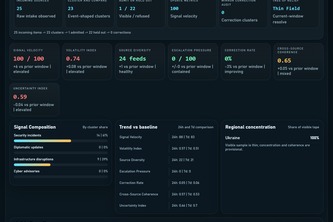
The description states that Live Signals is a non-predictive, correction-aware situational monitor built from the Myth-Tech Delta / MT-07 experimental architecture. It processes incoming information through a six-stage Signal Cycle:
- Incoming sources
- Cluster and compare
- Admit or hold out
- Update metrics
- Mirror correction audit
- Tree of Relief
It includes:
- A Visible Event Tape for clusters that pass visibility rules.
- A Held-Out Field for clusters that do not pass, showing their confidence, source support, and suppression reasons.
- Descriptive metrics such as Signal Velocity, Volatility Index, Source Diversity, Escalation Pressure, Correction Rate, Cross-Source Coherence, and Uncertainty Index.
- A Tree of Relief, summarizing what formed, held, resolves, and remains open.
The interface uses static HTML/JavaScript with a Node/Express backend and SQLite persistence. It supports Mock, Degraded, Empty, and Live API states for testing purposes.
Evidence
- The author's own write-up.
- Technology stack declared: CSS3, HTML5, JavaScript, Node.js, Express.js, SQLite, GDELT, OpenAI Codex, GPT-5.6, REST API, Server-Sent Events.
Inference This is a simulation-style tool designed to show how information might be filtered and presented under certain rules, not necessarily a live operational system.
Positioning & Claim Evolution
The author positions Live Signals as an instrument that does not merely extract signal from wording but governs how wording becomes visible signal. It emphasizes:
- A non-predictive approach, where the system does not forecast future events.
- Correction awareness, meaning it tracks and displays corrections made to data over time.
- Explainability at the metric level, with each metric having an explanation surface showing definition, inputs, contributing evidence, and limitations.
- Transparency in rejection, by keeping held-out information visible alongside accepted signals.
The project evolved from a prior "MT-07 experimental architecture" and was extended using AI tools like Codex and GPT-5.6 during the hackathon process.
Evidence
- The author's own write-up.
- Reference to MT-07 as “The Vector: direction, movement, and commitment.”
- Claim that GPT-5.6 helped translate governing ideas into software contracts.
Inference This is a conceptual tool aimed at demonstrating how transparency in filtering and correction can be implemented, rather than a commercial product or service.
Target Customer & ICP
Not evidenced.
The description does not identify any specific customer base or target user group. It refers to the system as an experimental instrument for monitoring information flows but does not name who would use it or how they would benefit.
Evidence
- No mention of end-users, clients, or stakeholders.
- No indication of industry verticals or application domains beyond general live data monitoring.
Business Model & Pricing Evidence
Not evidenced.
There is no mention of pricing models, monetization strategies, revenue streams, or business structure. The project is described as a hackathon submission with no indication of commercial intent or deployment.
Evidence
- No reference to sales, licensing, subscriptions, or fees.
- No indication of how the tool would generate value for users beyond its demonstration.
Technical & Delivery Signals
The system uses:
- Static HTML/JavaScript frontend
- Node.js/Express backend
- SQLite database for persistence
- GDELT as a first ingestion path
- REST API and Server-Sent Events
- Integration with OpenAI Codex and GPT-5.6 during development
Key features include:
- Six-stage Signal Cycle
- Held-Out Field with metadata
- Correction tracking
- Mock, Degraded, Empty, and Live API states
- Regression tests (11 passing)
- Deterministic correction fixture (9% Correction Rate)
Evidence
- Author's own write-up.
- Technology tags provided by the author.
Inference The tool appears to be a prototype built for demonstration rather than production use. It includes simulation capabilities and test states, suggesting it was not intended for real-time operational deployment.
Traction & Maturity Signals
Not evidenced.
There is no evidence of:
- Revenue
- Customers
- User adoption
- Product-market fit
- Deployment in live environments
- Iteration history or versioning beyond the hackathon submission
Evidence
- The project was submitted to a hackathon.
- No mention of usage, feedback, or performance metrics.
Competitive Context
Not evidenced.
The description does not reference any competitors or similar products. It does not discuss market positioning or competitive advantages relative to existing tools for data monitoring, filtering, or correction tracking.
Evidence
- No comparison with other systems.
- No discussion of prior art or market landscape.
Open Questions & Risks
- Unproven commercial viability: The project is described as a hackathon submission with no evidence of traction or monetization.
- Unclear operational status: There is no indication whether the system is running in production, tested with real data, or used by others.
- Limited scope and maturity: Built for demonstration only; lacks features like independent origin analysis, historical replay, or deep source-lineage visualization.
- AI dependency without runtime use: GPT-5.6 was used during development but not as a runtime engine, raising questions about long-term technical sustainability.
- Single-person team: The entire project is attributed to one developer (Nelson Williams), which may limit scalability or ongoing maintenance.
Evidence
- Self-reported nature of the description.
- No external validation or third-party sources.
- No mention of product use beyond the creator’s own testing.
Questions the description leaves open
- What is the actual purpose of this tool? Is it intended for internal use, demonstration, or as a foundation for further development?
- Has this system been tested with real-world data feeds or only simulated inputs?
- How does the Held-Out Field contribute to decision-making in practice?
- Are there plans to expand beyond the current mock and live states?
- What is the long-term vision for the project? Is it intended to evolve into a commercial product?
- Can you clarify how the correction logic works in practice, especially when dealing with real-time data?
- How does the system handle multilingual or non-English sources?
- What are the limitations of the current Signal Cycle and how might they be addressed?
Overall Assessment
Not evidenced.
There is no evidence to support any investment or partnership interest in this project. The description indicates it is a single-developer hackathon submission with no confirmed traction, revenue, or market validation. It appears to be an experimental tool for showcasing ideas rather than a viable business opportunity.
Evidence
- No financials, customers, or operational data.
- No indication of commercial intent or scalability beyond the prototype stage.
Inference This project likely has limited appeal for investment or partnership unless there is a clear path toward commercialization or integration into larger systems.
User Stories BotA demo video on every pull request
Get a demo video on every new feature
GitHub App that watches your pull requests and records a narrated, captioned demo.
Save time on demo prep and make informed decisions faster with a video walkthrough of every new feature.
Source
Submitted to the OpenAI 2026 hackathon on Devpost. Project home on Devpost. Back to the full gallery on Devpost.
This competitive analysis was produced by top-founders.com (opens in a new tab)
Generated by a language model from this project's public Devpost page — its tagline, the author's own write-up and any built-with tags listed there — as captured in August 2026. Short quotations are the author's words. It is an opinion on the idea as a business, not on the people behind it, and it reflects the description as published then. If the project has moved on, request a correction below. The analysis is not independent research and contains no verified traction, revenue or customer data.
An independent guide by KFG International LLC — not affiliated with, endorsed by, or connected to Devpost or OpenAI.