

Archive position — measured, not model output
1 like on Devpost
505 of the 7,850 archived projects have more likes, and 1,758 share exactly 1 — so this project's #1,485 place in the like-ranked listing is a tie-break inside that group, not a ranking.
Projects (log scale)
Likes on Devpost. ▲ marks this project's group.
Show the figures
| Likes | Projects | Share of archive |
|---|---|---|
| 0 | 5,587 | 71.2% |
| 1 | 1,758 | 22.4% |
| 2 | 284 | 3.6% |
| 3–4 | 132 | 1.7% |
| 5–9 | 75 | 1.0% |
| 10+ | 14 | 0.2% |
 User Stories BotA demo video on every pull request
Get a demo video on every new feature
GitHub App that watches your pull requests and records a narrated, captioned demo.
Save time on demo prep and make informed decisions faster with a video walkthrough of every new feature.
Executive Summary
What the company appears to be
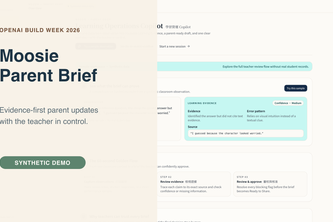
Moosie Learning Operations Copilot is a self-reported AI-powered tool designed for teachers in small tutoring centers. It transforms unstructured classroom observations into structured learning evidence and bilingual (English/Traditional Chinese) parent updates, with a strong emphasis on human-in-the-loop review and evidence traceability.
What changed
The project was submitted to the OpenAI 2026 hackathon. The author describes it as a vertical slice focused on one workflow: observation → evidence → parent brief → review → approval. It is built around a two-layer review model (Draft/Ready to Share, and blocking flags) and uses GPT-5.6 for content generation.
The single most important open question
Is there any evidence of real-world usage or testing with teachers beyond the synthetic demo? The description states no revenue, customers, or traction data are available — only a self-reported product vision and prototype.
What The Product Actually Is
The description states that Moosie is an AI-powered tool for teachers in small tutoring centers. It takes raw lesson notes and transforms them into:
- Structured learning evidence
- Identified strengths and error patterns
- A concise bilingual parent update (English and Traditional Chinese)
- A more detailed explanation for parents
- A recommended next-lesson objective and short practice activity
- Review flags for missing evidence, low confidence, sensitive content, or missing information
Every generated brief starts as a Draft. It cannot be shared until the teacher reviews it and resolves any blocking flags.
The product is built using GPT-5.6, with structured output validation via source_span contracts that link claims back to original input. The tool does not automatically send messages to parents.
Evidence
- Author states: “Moosie Parent Brief helps teachers transform lesson notes into…”
- Author states: “Every generated brief begins as a Draft… cannot become Ready to Share until a teacher reviews it and resolves any blocking flags.”
- Author states: “The application validates that quote === input[field].slice(start_char, end_char)”
- Author states: “Moosie does not automatically send messages to parents.”
Inference This is a workflow tool for teachers in small learning environments, focused on generating and reviewing parent-facing content.
Positioning & Claim Evolution
The author positions Moosie as a teacher-centered AI assistant, not a generic text generator. The core claim is that it preserves the teacher’s professional judgment by:
- Starting with an AI draft
- Requiring human review before sharing
- Providing evidence traceability and review flags
It is described as a tool to reduce time spent on parent updates while maintaining accuracy and trust.
Evidence
- Author states: “We did not want to build another generic AI text generator. We wanted to build a workflow that preserves the teacher’s professional judgment.”
- Author states: “The most meaningful automation was not ‘send a parent message automatically.’ It was reducing the time needed to turn raw notes into a strong first draft—while making exceptions visible for teacher review.”
Inference Moosie is positioned as an operational tool that enhances rather than replaces teacher workflows.
Target Customer & ICP
The description states that Moosie targets teachers in small tutoring centers. It is designed to support educators who take classroom observations and need to communicate them effectively to parents.
Evidence
- Author states: “Teachers in small tutoring centers often finish class with valuable but fragmented observations…”
- Author states: “Moosie is designed so that teachers remain responsible for high-impact communication.”
Inference The ICP appears to be small, teacher-led learning environments where parent trust and communication are critical.
Business Model & Pricing Evidence
Not evidenced. The description does not mention any pricing model, monetization strategy, or business model.
Evidence
- No mention of revenue, pricing, subscriptions, or customer acquisition.
Technical & Delivery Signals
The tool is built using:
- GPT-5.6 for content generation
- React frontend with TypeScript and Tailwind CSS
- Supabase backend
- Playwright for testing
- Zod for schema validation
- Structured output via JSON and source_span contracts
It uses a two-layer review model (Draft/Ready to Share, and blocking flags) to ensure that AI-generated content does not bypass teacher oversight.
Evidence
- Author states: “We designed Moosie as a focused vertical slice rather than a full school-management platform.”
- Author states: “source_span = { field: ..., start_char: number, end_char: number, quote: string }”
- Author states: “The product does not automatically send anything to parents.”
Inference The architecture is built for safety and traceability, with a focus on operational rigor over automation.
Traction & Maturity Signals
Not evidenced. There is no mention of real users, customers, or usage data beyond the synthetic demo.
Evidence
- Author states: “The public demo uses synthetic data only.”
- Author states: “Moosie does not automatically send messages to parents.”
- No mention of revenue, headcount, or adoption.
Competitive Context
Not evidenced. The description does not reference existing tools in the edtech or AI-assisted parent communication space.
Evidence
- No mention of competitors or market positioning beyond self-description.
Open Questions & Risks
- No real-world testing or user feedback: The product is described as a prototype with synthetic data only.
- No revenue, customers, or traction: The description makes no claims about monetization or adoption.
- Unproven market fit: The author does not state whether teachers in small centers actually need this tool or how it would be integrated into their workflows.
- Limited scope: It is a vertical slice and not a full platform — may not scale beyond its narrow use case.
Evidence
- Author states: “The public demo uses synthetic data only.”
- Author states: “Moosie does not automatically send messages to parents.”
- No mention of real users, revenue, or adoption.
Questions the description leaves open
- Have you tested this with actual teachers in tutoring centers? What were the results?
- How do you plan to validate that the AI-generated content is accurate and trusted by teachers?
- What are your plans for scaling beyond a single developer prototype?
- Are there any partnerships or pilot programs with real learning centers?
- How will you monetize this tool, and what pricing model do you envision?
Overall Assessment
Not evidenced. The description does not contain any information about funding, valuation, or investment interest.
Evidence
- No mention of funding rounds, investors, or partnership discussions.
Inference This is a prototype submitted to a hackathon. There is no evidence of commercial traction or investor interest at this time.
User Stories BotA demo video on every pull request
Get a demo video on every new feature
GitHub App that watches your pull requests and records a narrated, captioned demo.
Save time on demo prep and make informed decisions faster with a video walkthrough of every new feature.
Source
Submitted to the OpenAI 2026 hackathon on Devpost. Project home on Devpost. Back to the full gallery on Devpost.
This competitive analysis was produced by top-founders.com (opens in a new tab)
Generated by a language model from this project's public Devpost page — its tagline, the author's own write-up and any built-with tags listed there — as captured in August 2026. Short quotations are the author's words. It is an opinion on the idea as a business, not on the people behind it, and it reflects the description as published then. If the project has moved on, request a correction below. The analysis is not independent research and contains no verified traction, revenue or customer data.
An independent guide by KFG International LLC — not affiliated with, endorsed by, or connected to Devpost or OpenAI.