

Archive position — measured, not model output
1 like on Devpost
505 of the 7,850 archived projects have more likes, and 1,758 share exactly 1 — so this project's #1,482 place in the like-ranked listing is a tie-break inside that group, not a ranking.
Projects (log scale)
Likes on Devpost. ▲ marks this project's group.
Show the figures
| Likes | Projects | Share of archive |
|---|---|---|
| 0 | 5,587 | 71.2% |
| 1 | 1,758 | 22.4% |
| 2 | 284 | 3.6% |
| 3–4 | 132 | 1.7% |
| 5–9 | 75 | 1.0% |
| 10+ | 14 | 0.2% |
 User Stories BotA demo video on every pull request
Get a demo video on every new feature
GitHub App that watches your pull requests and records a narrated, captioned demo.
Save time on demo prep and make informed decisions faster with a video walkthrough of every new feature.
Executive Summary
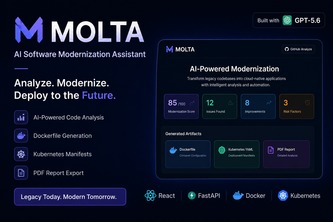
The company appears to be a two-person team building an AI-powered tool for software modernization that analyzes GitHub repositories and generates reports, Dockerfiles, and Kubernetes manifests. The project is self-reported as a hackathon submission with no verified traction or revenue.
The single most important open question is: What is the actual commercial viability of this tool, given its focus on public repository analysis and lack of evidence for adoption or monetization?
This analysis is based entirely on the author's own description — no third-party verification, archived data, or independent sources are available.
What The Product Actually Is
The description states that Molta is an AI-powered software modernization assistant that analyzes GitHub repositories. It claims to:
- Retrieve repository metadata
- Detect frameworks and technologies
- Read project READMEs
- Generate AI-powered modernization reports
- Suggest production-ready Dockerfiles
- Generate Kubernetes deployment manifests
- Create downloadable PDF reports
The tool is described as operating via a web interface where users paste a GitHub URL.
Inference: The product appears to be a developer tool that automates parts of software understanding and modernization planning. It is not a SaaS product with recurring revenue, but rather a utility or one-time-use service.
Positioning & Claim Evolution
The author states that Molta was inspired by the need for developers to spend less time understanding legacy code before making improvements. The positioning is:
- A tool for developers working with unfamiliar or legacy software
- AI-powered analysis of GitHub repositories
- Focused on modernization recommendations and deployment readiness
Inference: The product is positioned as a utility for developers, not an enterprise SaaS offering. It is described as a "simple" assistant that helps developers understand projects faster.
Target Customer & ICP
The description states that Molta targets developers who spend time understanding unfamiliar or legacy software before making improvements.
Inference: The primary customer segment appears to be individual developers or small teams working with legacy codebases, not enterprise customers. There is no evidence of a defined ICP beyond "developers".
Business Model & Pricing Evidence
The description does not mention any pricing model, monetization strategy, or business model. It describes the tool as a utility that generates reports and manifests.
Inference: No evidence of a commercial model exists in the self-reported description. The tool appears to be free to use for public repositories, but there is no indication of paid features or enterprise offerings.
Technical & Delivery Signals
The project was built using:
- Frontend: React, TypeScript, Vite, Tailwind CSS
- Backend: FastAPI, Python
- AI Integration: OpenAI Codex CLI
- Other Technologies: GitHub REST API, ReportLab for PDF generation
It integrates with GitHub to retrieve repository information and uses AI to analyze code and generate reports.
Inference: The tool is a full-stack application built with modern technologies. It demonstrates technical capability but lacks evidence of production deployment or scalability.
Traction & Maturity Signals
The project was submitted as a hackathon entry (OpenAI 2026). There is no evidence of:
- Revenue
- Customers
- User adoption
- Product-market fit
- Any form of traction beyond the author's own description
Inference: The tool is in an early stage, likely a prototype or proof-of-concept. No evidence of real-world usage or product maturity.
Competitive Context
The description does not mention competitors or a competitive landscape. It does not state whether similar tools exist or how Molta differentiates from them.
Inference: No competitive context is provided in the self-reported description. The tool may be unique, but there is no evidence to support this claim.
Open Questions & Risks
- No traction or revenue: The project is described as a hackathon submission with no verified adoption.
- Limited scope: It only works on public GitHub repositories.
- Unproven commercial viability: No monetization strategy, pricing, or customer base are evident.
- AI dependency: Relies heavily on OpenAI Codex, which may not be scalable or cost-effective.
- No enterprise focus: The tool is described for individual developers, not enterprise use cases.
Questions the description leaves open
- What is the actual use case for this tool in a business context?
- Are there any existing users or pilot customers?
- How do you plan to monetize this tool?
- What are the limitations of the AI analysis, and how accurate is it?
- Is there a plan to support private repositories or enterprise integrations?
- What is the long-term roadmap beyond the hackathon submission?
Overall Assessment
Not evidenced
There is no evidence of revenue, customers, traction, or a clear commercial strategy. The project is described as a hackathon submission with no verified adoption or monetization.
Inference: This tool is in an early stage and lacks the signals typically required for investment or partnership consideration. It may be a promising idea, but there is no evidence of viability or scalability at this time.
User Stories BotA demo video on every pull request
Get a demo video on every new feature
GitHub App that watches your pull requests and records a narrated, captioned demo.
Save time on demo prep and make informed decisions faster with a video walkthrough of every new feature.
Source
Submitted to the OpenAI 2026 hackathon on Devpost. Project home on Devpost. Back to the full gallery on Devpost.
This competitive analysis was produced by top-founders.com (opens in a new tab)
Generated by a language model from this project's public Devpost page — its tagline, the author's own write-up and any built-with tags listed there — as captured in August 2026. Short quotations are the author's words. It is an opinion on the idea as a business, not on the people behind it, and it reflects the description as published then. If the project has moved on, request a correction below. The analysis is not independent research and contains no verified traction, revenue or customer data.
An independent guide by KFG International LLC — not affiliated with, endorsed by, or connected to Devpost or OpenAI.