

Archive position — measured, not model output
0 likes on Devpost
2,263 of the 7,850 archived projects have more likes, and 5,587 share exactly 0 — so this project's #7,346 place in the like-ranked listing is a tie-break inside that group, not a ranking.
Projects (log scale)
Likes on Devpost. ▲ marks this project's group.
Show the figures
| Likes | Projects | Share of archive |
|---|---|---|
| 0 | 5,587 | 71.2% |
| 1 | 1,758 | 22.4% |
| 2 | 284 | 3.6% |
| 3–4 | 132 | 1.7% |
| 5–9 | 75 | 1.0% |
| 10+ | 14 | 0.2% |
 User Stories BotA demo video on every pull request
Get a demo video on every new feature
GitHub App that watches your pull requests and records a narrated, captioned demo.
Save time on demo prep and make informed decisions faster with a video walkthrough of every new feature.
Executive Summary
Company: TraceLearn
Self-reported basis: The description is entirely self-reported and unverified, as supplied by the project author. No external corroboration exists.
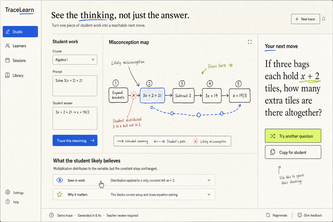
Commercial due-diligence read: TraceLearn appears to be a prototype educational AI tool designed to help teachers inspect student thinking by reconstructing reasoning paths from submitted work. It claims to offer structured outputs that reveal misconceptions without replacing teacher judgment. The product is built around GPT-5.6 and structured outputs, with a focus on privacy-preserving defaults and human review. There is no evidence of revenue, customers, or traction beyond the demo.
Key open question: Is there sufficient evidence in this self-report to suggest that TraceLearn has a viable commercial model or path to adoption in real classrooms?
What The Product Actually Is
The description states that TraceLearn:
- Takes a problem and student work as input.
- Reconstructs a sequence of observable reasoning moves.
- Marks the earliest likely misconception.
- Distinguishes downstream consequences from additional errors.
- Shows evidence and confidence for its hypothesis.
- Proposes one Socratic question to reveal or repair the mental model.
- Offers alternate questions and a concise teacher note.
- Requires teacher review for every result.
It is described as a tool that does not diagnose students or assign traits, but proposes a testable instructional hypothesis. The UI is built around an open reasoning canvas rather than a dashboard.
Inference: The product appears to be a prototype AI-powered educational tool focused on reasoning traceability in student work, with a strong emphasis on teacher control and interpretability.
Positioning & Claim Evolution
The description states:
- Teachers often see only the final wrong answer, while reasoning remains hidden.
- Existing AI tutoring tools jump directly to the correct solution, erasing teaching moments.
- TraceLearn asks: what if AI made student thinking inspectable without replacing teacher judgment?
Claim: The product positions itself as a tool that enhances teacher insight into student thinking, rather than automating instruction.
Inference: This is a shift from traditional AI tutoring tools to one focused on pedagogical reasoning and interpretability. It reflects an early-stage attempt to solve a perceived gap in educational AI.
Target Customer & ICP
The description states:
- The primary user is the teacher.
- The tool is designed for inspecting student thinking, not for automated grading or diagnosis.
Inference: The target customer is a teacher or educator using AI tools to better understand student reasoning. The ICP appears to be educators in K–12 or higher education who are interested in deeper insight into student understanding.
Business Model & Pricing Evidence
The description states:
- The public demo requires no login or API key.
- A README contains local setup, production deployment, testing, architecture, and notes on how Codex and GPT-5.6 were used.
- No pricing information is provided.
- No evidence of revenue streams or monetization strategy.
Inference: There is no evidence of a business model beyond the demo. The tool appears to be built for demonstration purposes with no stated path to monetization.
Technical & Delivery Signals
The description states:
- Built with React, Vite, Node.js, TypeScript, Zod Structured Outputs, OpenAI Responses API, and GPT-5.6.
- Uses structured outputs to enforce a stable contract for reasoning nodes, statuses, misconception index, evidence, confidence, coaching questions, and teacher notes.
- The server sends student work with
store: false, derives a privacy-preserving safety identifier from an anonymous session ID, and uses medium reasoning effort. - A deterministic demo mode keeps the judging flow runnable without credentials or external setup.
- Codex was used for product framing, architecture, API implementation, tests, documentation, and validation.
Inference: The tool is built with modern web technologies and structured AI outputs. It includes privacy-conscious defaults and a deterministic demo path, suggesting early-stage development with an emphasis on usability and reproducibility.
Traction & Maturity Signals
The description states:
- The project was submitted to the OpenAI 2026 hackathon.
- A public demo is available without login or API key.
- The README contains local setup, production deployment, testing, architecture, and detailed notes on how Codex and GPT-5.6 were used.
Inference: There is no evidence of customer adoption, revenue, or usage beyond the demo. The project appears to be a prototype with no traction data.
Competitive Context
The description does not mention any competitors. It only describes the tool’s positioning as distinct from existing AI tutoring tools that jump directly to correct answers.
Inference: No competitive landscape is described. The tool may be positioned in a niche space of reasoning-inspecting educational AI, but there is no evidence of existing or direct competitors.
Open Questions & Risks
- No revenue or customer data: The description provides no evidence of traction, adoption, or monetization.
- Prototype-only status: The product appears to be a hackathon submission with no commercial deployment or scalability evidence.
- Unverified claims: The self-reported nature of the description means all claims are unverified.
- No pricing or business model: No indication of how this would be monetized in a real-world setting.
- Limited technical depth: While structured outputs and privacy defaults are mentioned, there is no evidence of robustness or scalability.
Questions the description leaves open
- What is the intended path to market for TraceLearn?
- How do you plan to monetize this tool in a real-world educational setting?
- Are there any early adopters or pilot users of this product?
- What are the technical and operational challenges in scaling this beyond the demo?
- How does TraceLearn differentiate from existing AI tools that already attempt to analyze student work?
Overall Assessment
The description is entirely self-reported, unverified, and lacks any evidence of traction, revenue, or customer data.
Assessment: Not evidenced. The product appears to be a prototype built for demonstration purposes with no indication of commercial viability or adoption. It may have potential as an educational AI tool, but there is no basis in the description to support investment or partnership interest at this time.
User Stories BotA demo video on every pull request
Get a demo video on every new feature
GitHub App that watches your pull requests and records a narrated, captioned demo.
Save time on demo prep and make informed decisions faster with a video walkthrough of every new feature.
Source
Submitted to the OpenAI 2026 hackathon on Devpost. Project home on Devpost. Back to the full gallery on Devpost.
This competitive analysis was produced by top-founders.com (opens in a new tab)
Generated by a language model from this project's public Devpost page — its tagline, the author's own write-up and any built-with tags listed there — as captured in August 2026. Short quotations are the author's words. It is an opinion on the idea as a business, not on the people behind it, and it reflects the description as published then. If the project has moved on, request a correction below. The analysis is not independent research and contains no verified traction, revenue or customer data.
An independent guide by KFG International LLC — not affiliated with, endorsed by, or connected to Devpost or OpenAI.