

Archive position — measured, not model output
0 likes on Devpost
2,263 of the 7,850 archived projects have more likes, and 5,587 share exactly 0 — so this project's #3,422 place in the like-ranked listing is a tie-break inside that group, not a ranking.
Projects (log scale)
Likes on Devpost. ▲ marks this project's group.
Show the figures
| Likes | Projects | Share of archive |
|---|---|---|
| 0 | 5,587 | 71.2% |
| 1 | 1,758 | 22.4% |
| 2 | 284 | 3.6% |
| 3–4 | 132 | 1.7% |
| 5–9 | 75 | 1.0% |
| 10+ | 14 | 0.2% |
 User Stories BotA demo video on every pull request
Get a demo video on every new feature
GitHub App that watches your pull requests and records a narrated, captioned demo.
Save time on demo prep and make informed decisions faster with a video walkthrough of every new feature.
Executive Summary
What the company appears to be
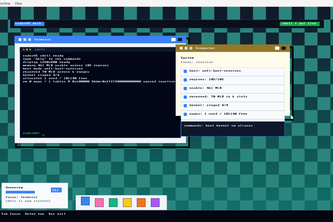
codexOS is a self-reported bootable Rust GUI operating system built for x86-64 architecture, designed to run under QEMU/UEFI. It includes a custom kernel, desktop environment, filesystem (CodexFS), networking stack, and secure A/B update mechanism.
What changed
The project description indicates this is an ongoing development effort by one individual (jun he) submitted as part of the OpenAI 2026 hackathon. No prior version or commercial product is evidenced; it is a self-contained technical demonstration with no external validation or traction.
Single most important open question
Is there any evidence that codexOS has moved beyond a proof-of-concept stage, or whether it will ever be deployed in production environments?
Note: This analysis is based entirely on the author's own description and self-reported claims. No independent verification, revenue data, customer base, or traction metrics are available.
What The Product Actually Is
The description states that codexOS is a bootable Rust GUI operating system that runs under QEMU/UEFI. It includes:
- A UEFI loader that stages a standalone
KERNEL.ELFand chainloads into a resident kernel. - An interactive framebuffer desktop with keyboard focus, mouse dragging, and a terminal shell.
- Memory management features such as reclaiming heap, physical pages, HHDM, and W^X page permissions.
- Isolated Ring 3 processes with syscalls, preemptive scheduling, and address-space reclamation.
- A filesystem called CodexFS with snapshots, CRC checks, and dual superblocks.
- Networking capabilities including virtio-net, DHCP, DNS, TCP/HTTP, and ICMP.
- Signed A/B kernel updates, GPT/ESP images, and automatic fallback recovery.
It is built using Rust and tools like cargo, QEMU, OVMF, and UEFI.
Inference: The product appears to be a technical prototype or educational project focused on low-level systems programming. It does not appear to have any commercial or consumer-facing functionality at this stage.
Positioning & Claim Evolution
The author positions codexOS as a complete, bootable OS with full GUI and system services — not just a kernel or bootloader demo. The goal was to create an end-to-end system story from UEFI firmware through a resident kernel to a live desktop environment.
Key claims:
- It boots via UEFI and supports a full interactive GUI.
- It handles memory management, process isolation, filesystem integrity, networking, and secure updates.
- It is built entirely in Rust with a repeatable build → image → QEMU → debug loop.
Claim vs Fact: These are self-reported claims about functionality. There is no evidence of external testing, adoption, or validation beyond the author’s own account.
Target Customer & ICP
Not evidenced. The description does not identify any target customer segment or ideal customer profile (ICP). It describes a technical prototype for personal or educational use, with no indication of market targeting or user personas.
Absence of evidence: No mention of who would use this OS, what their needs are, or how it fits into existing workflows.
Business Model & Pricing Evidence
Not evidenced. There is no information in the description about pricing models, monetization strategies, or business structure. The project is presented as a personal or hackathon effort with no commercial intent stated.
Absence of evidence: No indication of revenue streams, licensing terms, or customer acquisition plans.
Technical & Delivery Signals
The author reports:
- A layered Rust workspace architecture.
- Use of UEFI loader,
KERNEL.ELF, and chainloading into a resident kernel. - Support for framebuffer rendering, PS/2 input, PCI inventory, virtio-blk/net drivers.
- Memory management with W^X permissions and reclaiming heaps.
- Process isolation with Ring 3 support and syscall ABI.
- Filesystem (CodexFS) with integrity checks and snapshots.
- Networking stack supporting TCP/IP, DHCP, DNS, ICMP.
- Secure A/B updates with signed slots and automatic recovery.
Inference: The technical depth suggests a strong understanding of systems programming. However, the delivery is limited to QEMU/UEFI simulation and lacks real-world deployment or hardware integration.
Traction & Maturity Signals
Not evidenced. There is no mention of:
- Customers
- Revenue
- Adoption
- Product usage metrics
- Release history or versioning beyond the current state
- Feedback from users or testers
Absence of evidence: No signs of traction, growth, or maturity beyond a single developer’s work.
Competitive Context
Not evidenced. The description does not reference competitors, similar projects, or market positioning within the OS development space.
Absence of evidence: No competitive landscape or differentiation strategy is described.
Open Questions & Risks
- Single Developer Scope: Only one team member (jun he) is listed; no indication of scalability or team capacity.
- Limited Deployment Context: Runs only in QEMU/UEFI; no mention of physical hardware support or real-world compatibility.
- No Commercial Viability: No evidence of monetization, customer base, or product-market fit.
- Unverified Claims: All features are self-reported without independent validation or testing.
- Hackathon Origin: Submitted to a hackathon, suggesting this is an experimental or exploratory project.
Inference: The project lacks commercial viability and real-world applicability. It may be a learning exercise or prototype with no clear path to production use.
Questions the description leaves open
- What specific hardware platforms will codexOS support beyond QEMU?
- Are there plans to integrate physical drivers (e.g., USB, SATA)?
- How does the project plan to evolve from a technical demo into a usable OS?
- Has the system been tested on actual hardware or only in simulation?
- What are the intended use cases for codexOS beyond academic or experimental purposes?
- Is there any interest from third parties (e.g., developers, partners) in using or contributing to this project?
Overall Assessment
Not evidenced. No information is provided regarding:
- Financials
- Valuation
- Funding history
- Strategic fit for investors or partners
Assessment: Based on the self-reported description alone, there is no evidence of a viable business opportunity or investment case. The project remains a technical demonstration with no demonstrated traction, revenue, or commercial intent.
User Stories BotA demo video on every pull request
Get a demo video on every new feature
GitHub App that watches your pull requests and records a narrated, captioned demo.
Save time on demo prep and make informed decisions faster with a video walkthrough of every new feature.
Source
Submitted to the OpenAI 2026 hackathon on Devpost. Project home on Devpost. Back to the full gallery on Devpost.
This competitive analysis was produced by top-founders.com (opens in a new tab)
Generated by a language model from this project's public Devpost page — its tagline, the author's own write-up and any built-with tags listed there — as captured in August 2026. Short quotations are the author's words. It is an opinion on the idea as a business, not on the people behind it, and it reflects the description as published then. If the project has moved on, request a correction below. The analysis is not independent research and contains no verified traction, revenue or customer data.
An independent guide by KFG International LLC — not affiliated with, endorsed by, or connected to Devpost or OpenAI.