

Archive position — measured, not model output
0 likes on Devpost
2,263 of the 7,850 archived projects have more likes, and 5,587 share exactly 0 — so this project's #7,348 place in the like-ranked listing is a tie-break inside that group, not a ranking.
Projects (log scale)
Likes on Devpost. ▲ marks this project's group.
Show the figures
| Likes | Projects | Share of archive |
|---|---|---|
| 0 | 5,587 | 71.2% |
| 1 | 1,758 | 22.4% |
| 2 | 284 | 3.6% |
| 3–4 | 132 | 1.7% |
| 5–9 | 75 | 1.0% |
| 10+ | 14 | 0.2% |
 User Stories BotA demo video on every pull request
Get a demo video on every new feature
GitHub App that watches your pull requests and records a narrated, captioned demo.
Save time on demo prep and make informed decisions faster with a video walkthrough of every new feature.
Executive Summary
What the company appears to be
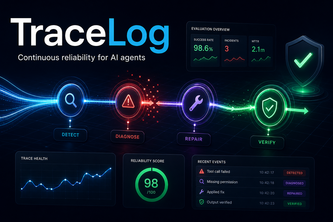
TraceLog is a self-reported AI reliability tool for AI agents, built as a hackathon project. The author states it supervises AI agent traces through Arize Phoenix and uses GPT-5.6 for diagnosis, remediation, and patch generation. It claims to create regression assets, evaluate prompt fixes, and prove safer changes before human approval.
What changed
The project is described as a single-person hackathon effort submitted to the OpenAI 2026 hackathon. No prior version or evolution is described. The author states it was built using Python/FastAPI, React/TypeScript, and various AI/observability tools.
Single most important open question
Is there any evidence of real-world adoption, revenue, or customer traction beyond the author's own description?
What The Product Actually Is
The description states that TraceLog is a GPT-5.6 meta-agent designed to monitor AI agents in production and catch failures. It uses Arize Phoenix for trace observability and integrates with tools like Docker, FastAPI, React, and Playwright.
It claims to:
- Capture and deduplicate failing traces.
- Diagnose failures with severity and confidence.
- Build causal chains.
- Generate typed remediation plans.
- Create adversarial regression cases.
- Evaluate baseline vs. candidate fixes.
- Prepare versioned prompt patches.
- Replay incidents.
- Red-team candidates with holdouts.
It is described as a CI prompt gate for developer workflows, and includes an MCP server and SSE cockpit UI.
Inference The product appears to be a prototype or proof-of-concept built for a hackathon. It is not evidenced to have been deployed in production or used by customers.
Positioning & Claim Evolution
The author positions TraceLog as:
- A reliability engineer for AI agents, watching traces and explaining failures.
- A tool that catches production-agent failures that uptime monitoring misses.
- A system that proves safer prompt fixes before human approval.
- A meta-agent that supervises other agents.
The tagline states:
“A GPT-5.6 meta-agent that catches production-agent failures, creates regression assets, and proves safer prompt fixes before human approval.”
This positioning is self-reported and claims to address a gap in AI agent reliability — specifically around hallucinations or broken tool calls in production.
Inference The product is positioned as a reliability and governance tool for AI agents, but no evidence of prior market validation, customer feedback, or commercial traction is provided.
Target Customer & ICP
The description does not name specific customers or target segments. It implies the tool is for:
- AI agent developers.
- Reliability engineers.
- Teams using AI agents in production.
It is described as a CI prompt gate, suggesting it targets developer workflows and deployment pipelines.
Inference The ICP appears to be AI developers or engineering teams working with LLM-powered agents, but no evidence of customer interviews, usage data, or personas is provided.
Business Model & Pricing Evidence
No business model or pricing information is stated in the description. The author does not describe:
- Revenue streams.
- Subscription tiers.
- Licensing models.
- Paid features or freemium options.
The project is described as a hackathon submission, and no commercialization plan or monetization strategy is evident.
Inference There is no evidence of a business model or pricing structure. The tool appears to be open-source or demo-only, with no indication of how it would be sold or used commercially.
Technical & Delivery Signals
The project uses:
- Python/FastAPI
- React/TypeScript/Vite
- GPT-5.6 models
- Arize Phoenix
- Docker
- Playwright
- Pydantic
- OpenAI Responses API
- MCP server
- GitHub Actions
It is built with a CI prompt gate and integrates with observability tools to support trace capture, evaluation, and remediation.
The author states that:
- The system uses structured outputs via Pydantic.
- It enforces semantic separation between development cases and holdouts using embeddings.
- It includes unit, integration, and Playwright tests.
- It uses GitHub Pages for deployment.
Inference The technical stack is modern and aligned with AI agent development, but no evidence of production-grade delivery or scalability is provided. The system appears to be a prototype.
Traction & Maturity Signals
There is no evidence of traction:
- No customers.
- No revenue.
- No user base.
- No product usage metrics.
- No live deployment or public adoption.
The project is described as a hackathon submission, and the author notes that the public demo uses an offline fixture, not live API calls.
Inference The tool is at a very early stage, likely a prototype or proof-of-concept. There are no signs of product-market fit or real-world usage.
Competitive Context
No competitive landscape is described. The author does not reference:
- Competitors.
- Market size.
- Alternative solutions in the AI reliability space.
The project appears to address a gap in AI agent reliability, but no evidence of existing tools or market players is provided.
Inference There is no evidence of competitive positioning or awareness. The tool may be novel, but its place in the market is unknown.
Open Questions & Risks
- No traction or revenue: The project is a hackathon submission with no commercial use.
- Unverified claims: The author makes strong claims about GPT-5.6 and AI reliability without evidence.
- Single-person team: Only one member listed, which may limit execution capacity.
- Offline demo only: The public demo uses a fixture, not live API calls — this limits real-world validation.
- No commercialization plan: No pricing, monetization or go-to-market strategy is evident.
Inference The project is highly speculative, with no evidence of viability or scalability. It may be an idea in early development, but lacks any proof of concept or traction.
Questions the description leaves open
- What real-world use cases have you identified for TraceLog?
- How do you plan to monetize this tool?
- Have you validated the need for this with potential customers?
- What is the roadmap beyond the hackathon version?
- How does TraceLog integrate into existing AI agent workflows?
- Are there any live deployments or pilot users of the system?
Overall Assessment
Not evidenced.
The project is described as a single-person hackathon submission, with no evidence of traction, revenue, customers, or commercial viability. The author makes strong claims about AI reliability and GPT-5.6 integration, but these are unverified.
Confidence level Very low.
There is no basis for investment or partnership at this stage. Any potential value would need to be demonstrated through further development, traction, or market validation.
User Stories BotA demo video on every pull request
Get a demo video on every new feature
GitHub App that watches your pull requests and records a narrated, captioned demo.
Save time on demo prep and make informed decisions faster with a video walkthrough of every new feature.
Source
Submitted to the OpenAI 2026 hackathon on Devpost. Project home on Devpost. Back to the full gallery on Devpost.
This competitive analysis was produced by top-founders.com (opens in a new tab)
Generated by a language model from this project's public Devpost page — its tagline, the author's own write-up and any built-with tags listed there — as captured in August 2026. Short quotations are the author's words. It is an opinion on the idea as a business, not on the people behind it, and it reflects the description as published then. If the project has moved on, request a correction below. The analysis is not independent research and contains no verified traction, revenue or customer data.
An independent guide by KFG International LLC — not affiliated with, endorsed by, or connected to Devpost or OpenAI.