

Archive position — measured, not model output
0 likes on Devpost
2,263 of the 7,850 archived projects have more likes, and 5,587 share exactly 0 — so this project's #3,424 place in the like-ranked listing is a tie-break inside that group, not a ranking.
Projects (log scale)
Likes on Devpost. ▲ marks this project's group.
Show the figures
| Likes | Projects | Share of archive |
|---|---|---|
| 0 | 5,587 | 71.2% |
| 1 | 1,758 | 22.4% |
| 2 | 284 | 3.6% |
| 3–4 | 132 | 1.7% |
| 5–9 | 75 | 1.0% |
| 10+ | 14 | 0.2% |
 User Stories BotA demo video on every pull request
Get a demo video on every new feature
GitHub App that watches your pull requests and records a narrated, captioned demo.
Save time on demo prep and make informed decisions faster with a video walkthrough of every new feature.
Executive Summary
What the company appears to be
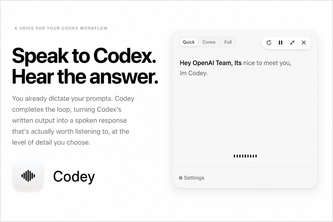
Codey is a self-reported native macOS application that integrates with Codex (a coding agent) to provide spoken summaries of code generation outputs. It offers three modes—Quick, Convo, and Full—to deliver varying levels of detail from AI-generated responses.
What changed
The author states they built Codey during a hackathon as a personal solution to reduce time spent reading long AI outputs while continuing to work. The product evolved into a complete macOS app with UI controls, audio playback, transcript highlighting, and secure API key handling.
Single most important open question
Is there evidence of user adoption or feedback beyond the author’s own use? The description does not indicate any external users or data on how others interact with Codey.
What The Product Actually Is
The description states that Codey is a native macOS companion app designed to read aloud responses from Codex. It connects via a local completion hook, uses GPT-5.6 Terra for summarizing outputs, and GPT-4o mini TTS for speech synthesis.
It supports three modes:
- Quick: shortest useful takeaway
- Convo: explains important points like a teammate catching you up
- Full: reads the complete response
The app does not have its own backend; it uses the user’s own OpenAI API key to communicate directly with OpenAI services. It was built using SwiftUI, AppKit, and AVFoundation, and integrates with Codex throughout development.
Inference: The product is described as a tool for developers who use Codex, but no evidence exists that it has been adopted by others beyond the author.
Positioning & Claim Evolution
The author claims Codey addresses a workflow gap where users dictate prompts to Codex but still must manually read lengthy outputs. They frame this as an issue of "productive laziness" — wanting to hear what matters without interrupting their flow.
They describe it as solving half the workflow: dictating prompts, now also hearing results. This suggests a positioning around voice-enabled AI interaction, aiming to improve developer productivity through hands-free output consumption.
Claim: “Codey gives your Codex a voice, so you can hear what matters instead of spending precious time reading every line.”
Not evidenced: No mention of market positioning beyond personal use or user feedback.
Target Customer & ICP
The description states that the author is a heavy user of Codex and coding agents, and that Codey was built for developers who work with these tools. It implies a target audience of technical professionals using AI-assisted development environments.
Inference: The product targets developers working in macOS environments, but there is no evidence of specific customer segments or personas beyond the creator’s own usage.
Business Model & Pricing Evidence
The description does not contain any information about pricing, monetization strategy, or business model. It states that Codey has no backend, and users connect their own OpenAI API keys directly to the service.
Not evidenced: No indication of revenue streams, subscription models, or paid features.
Technical & Delivery Signals
Codey is described as a native macOS app built with:
- SwiftUI
- AppKit
- AVFoundation
- Swift
It connects to Codex through a local completion hook, and uses GPT-5.6 Terra for summarization and GPT-4o mini TTS for speech.
Key technical features include:
- Secure local storage of API keys
- Playback controls
- Transcript highlighting synced with audio
- Onboarding flow
- Automated testing (384 tests passed)
- Apple notarization and approval
Inference: The app appears to be a polished, functional prototype built in a short timeframe, but no evidence exists regarding scalability or long-term technical architecture.
Traction & Maturity Signals
The author reports:
- A full macOS app with UI controls and audio features
- 384 automated tests passed
- Signed, notarized, and approved by Apple
- Built during a hackathon (Build Week)
- Used personally by the creator
Not evidenced: No external users, customer feedback, or adoption metrics. No mention of downloads, usage data, or product iteration beyond the initial build.
Competitive Context
The description does not reference any competitors or existing solutions in this space. It focuses solely on how Codey improves upon the user’s own workflow with Codex.
Not evidenced: No competitive analysis or awareness of similar tools for voice-enabled AI output consumption.
Open Questions & Risks
- Single-person team: The project is built by one individual, which raises questions about long-term maintenance and scalability.
- No external adoption: There is no evidence that others are using Codey beyond the author’s personal use.
- Limited scope: The app only works with Codex and macOS; it does not support other coding agents or platforms.
- Unverified claims: All descriptions are self-reported and unverified.
Inference: If the product were to scale, it would need to address platform limitations and build a user base beyond one developer.
Questions the description leaves open
- How many other developers are currently using Codey?
- Have you received any feedback from users outside of yourself?
- What is your plan for expanding support beyond macOS or Codex?
- Do you have a roadmap for monetization or product evolution?
- Are there plans to integrate with other AI coding agents or platforms?
Overall Assessment
The description indicates that Codey is a personal project built during a hackathon, with no evidence of traction, revenue, or external adoption.
Not evidenced: No data on user engagement, market demand, or commercial viability. The product appears to be a proof-of-concept rather than a scalable business.
Assessment This is a self-reported prototype with strong technical execution but no demonstrated commercial traction or market validation. It should be considered a personal tool or early-stage idea, not a viable investment or partnership opportunity without further evidence of adoption or growth.
User Stories BotA demo video on every pull request
Get a demo video on every new feature
GitHub App that watches your pull requests and records a narrated, captioned demo.
Save time on demo prep and make informed decisions faster with a video walkthrough of every new feature.
Source
Submitted to the OpenAI 2026 hackathon on Devpost. Project home on Devpost. Back to the full gallery on Devpost.
This competitive analysis was produced by top-founders.com (opens in a new tab)
Generated by a language model from this project's public Devpost page — its tagline, the author's own write-up and any built-with tags listed there — as captured in August 2026. Short quotations are the author's words. It is an opinion on the idea as a business, not on the people behind it, and it reflects the description as published then. If the project has moved on, request a correction below. The analysis is not independent research and contains no verified traction, revenue or customer data.
An independent guide by KFG International LLC — not affiliated with, endorsed by, or connected to Devpost or OpenAI.