

Archive position — measured, not model output
0 likes on Devpost
2,263 of the 7,850 archived projects have more likes, and 5,587 share exactly 0 — so this project's #3,426 place in the like-ranked listing is a tie-break inside that group, not a ranking.
Projects (log scale)
Likes on Devpost. ▲ marks this project's group.
Show the figures
| Likes | Projects | Share of archive |
|---|---|---|
| 0 | 5,587 | 71.2% |
| 1 | 1,758 | 22.4% |
| 2 | 284 | 3.6% |
| 3–4 | 132 | 1.7% |
| 5–9 | 75 | 1.0% |
| 10+ | 14 | 0.2% |
 User Stories BotA demo video on every pull request
Get a demo video on every new feature
GitHub App that watches your pull requests and records a narrated, captioned demo.
Save time on demo prep and make informed decisions faster with a video walkthrough of every new feature.
Executive Summary
The description states that Codify — QR & Barcode Toolkit is a mobile application built with React Native and Expo for Android. The author describes it as a privacy-first toolkit to create, scan, organize and export QR codes and barcodes—individually or in batches—through a fast, accessible and multilingual experience. It includes features such as batch generation, customization of QR codes, scanning from camera or gallery, history management, and export options.
The project is presented as a real mobile product under development for Google Play distribution. The author reports having used AI tools like OpenAI Codex to assist in refactoring and improving performance without destabilizing existing functionality.
There is no evidence of revenue, customers, or traction beyond the self-reported description. The company has not yet launched publicly or demonstrated adoption. The single most important open question is whether the described features and architecture will translate into a commercially viable product with sufficient user demand to justify further investment or development.
What The Product Actually Is
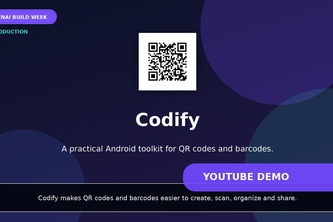
The description states that Codify is a mobile toolkit for creating, scanning, organizing and exporting QR codes and barcodes—individually or in batches. It allows users to:
- create QR codes for text, URLs, email, phone calls, SMS, Wi-Fi networks, contacts, events and locations;
- generate common barcode formats including Code 128, EAN-13, EAN-8, UPC, Code 39 and ITF-14;
- scan codes using the device camera or an image from the gallery;
- customize QR codes with colors, module styles and logos;
- import CSV or TXT data and generate multiple codes in batches;
- export generated items as images, PDF files or ZIP archives;
- save, pin, reuse and manage previously generated or scanned codes;
- quickly perform contextual actions such as opening a link, calling a number, sending an email or viewing a location;
- use the application through a multilingual interface.
The project is described as designed as a real mobile product rather than a temporary prototype and is being prepared and tested for distribution through Google Play.
Positioning & Claim Evolution
The description states that Codify positions itself as a privacy-first mobile toolkit. It claims to offer a fast, accessible and multilingual experience for creating, scanning, organizing and exporting QR codes and barcodes—individually or in batches.
The author notes that the project evolved from an initial monolithic implementation into a layered architecture that separates various components such as controllers, navigation, presentation screens, domain logic, storage adapters, reusable interface components, translations and theme configuration. This evolution suggests a claim of improving product quality and maintainability over time.
The author also states that the application was built with JavaScript, React Native and Expo for Android, indicating a technical positioning toward cross-platform mobile development.
Target Customer & ICP
The description does not explicitly identify specific customer segments or personas. It implies a general audience interested in QR and barcode creation, scanning, and management tasks. The features described suggest potential users may include individuals who need to generate codes for personal use, small businesses managing inventory or marketing materials, or professionals working with digital information systems.
There is no evidence of segmentation beyond the general use case of QR/barcode tools. No specific customer types are named or described in terms of their needs, behaviors or purchasing patterns.
Business Model & Pricing Evidence
The description does not provide any evidence of a business model or pricing strategy. It does not state whether the application will be free-to-use, subscription-based, ad-supported, or otherwise monetized. There is no mention of revenue streams, pricing tiers, or commercial arrangements.
Technical & Delivery Signals
The description states that Codify was developed with JavaScript, React Native and Expo for Android. The application evolved from an initial monolithic implementation into a layered architecture that separates:
- application controllers and navigation;
- presentation screens and ViewModels;
- QR, barcode, scanner, history and export domain logic;
- storage, camera, file-system and sharing adapters;
- reusable interface components;
- translations and theme configuration.
OpenAI Codex supported the engineering workflow by helping inspect the codebase, identify oversized or tightly coupled components, propose incremental refactoring plans, trace potential regressions and improve performance-sensitive areas. Instead of replacing the development process, Codex acted as a technical collaborator: each proposed change was reviewed, applied incrementally and tested on the application.
The author reports that the project followed a low-risk, incremental approach with verification after each meaningful change. Performance challenges were addressed through memoization, more stable callbacks, smaller ViewModels and reduced memory pressure during exports.
Traction & Maturity Signals
The description states that Codify is designed as a real mobile product rather than a temporary prototype and is being prepared and tested for distribution through Google Play. The author reports having completed several accomplishments including:
- Turning a simple QR and barcode utility into an integrated mobile toolkit;
- Supporting both individual and batch workflows in the same application;
- Building reusable history and quick-action features;
- Adding QR styling and logo support while preserving readability;
- Improving the architecture without changing the public behavior of stable features;
- Reducing memory pressure in batch ZIP exports;
- Preparing a functioning application for real Google Play users rather than producing only a demonstration.
However, there is no evidence of actual user adoption, downloads, revenue or market traction beyond these self-reported claims. No data on usage metrics, retention rates, or customer feedback is provided.
Competitive Context
The description does not provide any information about competitive landscape or direct competitors. It does not name other QR/barcode applications in the market or describe how Codify differentiates itself from existing solutions. No evidence of competitive positioning or market analysis is available.
Open Questions & Risks
Key risks and open questions include:
- The project is described as a single-person effort (team size: 1), which raises concerns about scalability, maintenance and long-term viability;
- There is no evidence of revenue, customers or traction beyond the author's own claims;
- The application is presented as being prepared for Google Play distribution but there is no evidence of actual launch or market presence;
- The author states that device testing remained essential, suggesting potential issues with mobile performance, camera behavior and touch interactions that may not have been fully resolved;
- The use of AI tools like OpenAI Codex in development raises questions about the extent to which human oversight was maintained and whether this approach could lead to technical debt or quality issues.
Questions the description leaves open
- What is your specific plan for monetization, and how do you intend to generate revenue from this tool?
- How do you plan to scale beyond a single developer's capacity, especially given the current team size of one?
- Have you conducted any user research or market testing with potential customers before beginning development?
- What are your plans for ongoing maintenance, updates and feature enhancements post-launch?
- How do you intend to compete against established QR/barcode applications in the marketplace?
- What is your timeline for launching on Google Play, and what has been done to prepare for this launch?
Overall Assessment
The description states that Codify — QR & Barcode Toolkit is a privacy-first mobile toolkit designed as a real product rather than a prototype. It includes features such as batch generation, customization of QR codes, scanning from camera or gallery, history management and export options.
However, there is no evidence of revenue, customers or traction beyond the author's own claims. The project appears to be in early development stages with no public presence or market validation. The single-person team size raises concerns about scalability and long-term sustainability.
Given the lack of commercial evidence, user adoption or financial data, it is not possible to assess whether this represents a viable investment opportunity or partnership prospect at this time. The described features are functional but unproven in the marketplace. The author's claims about performance improvements and architectural enhancements remain unsubstantiated by external validation.
User Stories BotA demo video on every pull request
Get a demo video on every new feature
GitHub App that watches your pull requests and records a narrated, captioned demo.
Save time on demo prep and make informed decisions faster with a video walkthrough of every new feature.
Source
Submitted to the OpenAI 2026 hackathon on Devpost. Project home on Devpost. Back to the full gallery on Devpost.
This competitive analysis was produced by top-founders.com (opens in a new tab)
Generated by a language model from this project's public Devpost page — its tagline, the author's own write-up and any built-with tags listed there — as captured in August 2026. Short quotations are the author's words. It is an opinion on the idea as a business, not on the people behind it, and it reflects the description as published then. If the project has moved on, request a correction below. The analysis is not independent research and contains no verified traction, revenue or customer data.
An independent guide by KFG International LLC — not affiliated with, endorsed by, or connected to Devpost or OpenAI.