

Archive position — measured, not model output
0 likes on Devpost
2,263 of the 7,850 archived projects have more likes, and 5,587 share exactly 0 — so this project's #3,427 place in the like-ranked listing is a tie-break inside that group, not a ranking.
Projects (log scale)
Likes on Devpost. ▲ marks this project's group.
Show the figures
| Likes | Projects | Share of archive |
|---|---|---|
| 0 | 5,587 | 71.2% |
| 1 | 1,758 | 22.4% |
| 2 | 284 | 3.6% |
| 3–4 | 132 | 1.7% |
| 5–9 | 75 | 1.0% |
| 10+ | 14 | 0.2% |
 User Stories BotA demo video on every pull request
Get a demo video on every new feature
GitHub App that watches your pull requests and records a narrated, captioned demo.
Save time on demo prep and make informed decisions faster with a video walkthrough of every new feature.
Executive Summary
What the company appears to be
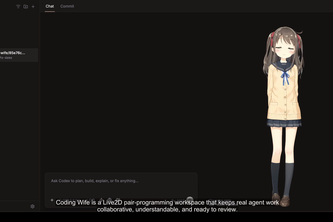
Coding Wife is a self-reported desktop application that integrates a live2D character with an AI-powered coding agent (Codex) to visualize and structure code changes during development sessions. The product aims to make long-running AI-assisted coding sessions more reviewable, traceable, and human-readable by separating roles among different GPT models, using Live2D for emotional presence, and presenting final commits in a GitHub-style interface.
What changed
The project was submitted as part of the OpenAI 2026 hackathon. It is described as a prototype built over a short timeframe (a "Build Week"), with no revenue, customers or traction data provided beyond its own self-reporting.
Single most important open question
Is there any evidence that this product has moved beyond a proof-of-concept stage, or whether it will be able to scale beyond the current hackathon-level implementation?
What The Product Actually Is
The description states that Coding Wife is a desktop workspace combining:
- A GPT-5.6 Sol model (with coding tools and write authority) that performs actual repository edits.
- A GPT-5.6 Luna model (isolated, zero-tool presence director) that reacts to completed Sol messages with captions, Live2D expressions/motions, and optional text-to-speech.
- A GPT-5.6 Terra model (commit explainer), which receives only read-only evidence from verified commits and never joins the write-capable session.
These roles are orchestrated through deterministic TypeScript/Rust contracts that route inputs, validate outputs, deduplicate events, and fail closed on unsupported data.
The interface includes:
- A React/Tauri-based UI with Live2D character interaction.
- Git review experience styled like GitHub.
- Semantic timeline and event model to reduce metadata noise.
- Native trust boundary via Tauri/Rust for local Codex App Server, IPC, process supervision, redacted SQLite recovery, and optional speech.
The system is designed to reduce developer review burden by structuring AI sessions into bounded decisions, reviewable commits, and human-readable evidence.
Note: The author states this is a hackathon project built in "Build Week". No revenue, customers or traction data are provided.
Positioning & Claim Evolution
The description claims that Coding Wife:
- Addresses the problem of long-running AI coding sessions becoming hard to inspect and review.
- Combines rigor with warmth, offering both a structured workflow and emotional presence via Live2D.
- Separates model roles by authority, input boundary, and latency, rather than just personality.
It positions itself as:
- A reviewable local development workflow enhanced with AI.
- A bilingual native workspace where Codex does real work, a character makes it feel present, and the resulting commit remains inspectable.
- An alternative to log-viewers or chat-heavy interfaces, focusing on structured output and Git-based evidence.
The author describes this as an experiment in agent supervision and multi-model orchestration. No claims about market positioning, competitive differentiation or adoption are made.
Target Customer & ICP
The description does not explicitly name a target customer segment or define an Ideal Customer Profile (ICP). However, it implies:
- Developers working with AI-assisted coding tools.
- Teams seeking to reduce review burden in AI-augmented workflows.
- Users who value structured commit history, traceability, and human-readable evidence.
It is implied that the product targets developers using local development environments, particularly those interacting with Git repositories and AI agents like Codex.
No explicit customer names, personas or usage data are provided. The ICP remains inferred from the stated use case.
Business Model & Pricing Evidence
There is no evidence of a business model or pricing structure in the description.
The project is described as:
- A hackathon submission.
- Built with Codex as implementation partner, but not as a commercial product.
- Not yet released for public distribution beyond a judge build.
- Not claimed to be monetized or sold.
No revenue model, pricing plans, or monetization strategy are evident.
Technical & Delivery Signals
The project is built using:
- Frontend: React 19, TypeScript, TailwindCSS, shadcn-ui, Radix UI
- Backend/Native Layer: Tauri 2, Rust, Node.js
- AI Tools: OpenAI Codex (gpt-5.6-sol), gpt-5.6-luna, gpt-5.6-terra
- Live2D Integration: Live2DCubismSDK, hiyorilive2dmodel
- Other Tech Stack: SQLite, Vitest, WebDriverIO, pnpm
Key technical features include:
- Bounded model inputs and outputs.
- Deterministic contracts enforcing role separation.
- Typed IPC between components.
- Process supervision and recovery mechanisms.
- Privacy-screened data flow (e.g., Luna’s output is redacted).
- Fail-closed behavior for unsupported provider events.
The system is described as intentionally quiet, minimal UI, and focused on reducing metadata noise.
Traction & Maturity Signals
There is no evidence of traction or maturity beyond the hackathon submission:
- The project was submitted to the OpenAI 2026 hackathon.
- A public macOS judge build exists, but not a full release.
- The final version (v0.1.6) is still undergoing PR and release checks.
- No user base, adoption metrics, or performance data are reported.
The product remains in early prototype form with no commercial traction.
Competitive Context
No competitive landscape or direct competitors are mentioned in the description.
It does not reference:
- Existing AI coding tools (e.g., GitHub Copilot, Tabnine).
- Similar live2D or agent presence products.
- Prior art in structured AI workflows or commit review systems.
The competitive context is not described; no comparison to existing solutions is evident.
Open Questions & Risks
Several risks and open questions are present based on the self-reported description:
- Prototype-only status: The product is a hackathon submission, not a commercial offering.
- No revenue or monetization strategy.
- Unproven scalability: No evidence of how it would scale beyond a single developer or small team.
- Limited distribution: Only a judge build available; no public release or installer claimed yet.
- High technical complexity without verification: The system relies on deterministic contracts and role separation, but no independent validation is provided.
- No user feedback or testing beyond internal demos.
The project lacks commercial viability indicators, traction, or scalability evidence.
Questions the description leaves open
- What are the key assumptions about developer workflows that this product challenges?
- How does the multi-model orchestration handle edge cases or failures in real-world usage?
- Has there been any external testing or feedback from developers using the prototype?
- Is there a plan to move beyond the current macOS Apple Silicon target?
- What are the long-term goals for monetization, distribution, and feature expansion?
- How does this product differ from other AI coding tools currently on the market?
Overall Assessment
Not evidenced
The description provides no information about:
- Revenue or ARR
- Customer base or adoption
- Funding rounds or valuation
- Team size beyond one person
- Product roadmap or go-to-market strategy
This is a self-reported hackathon prototype, not a commercial product. It shows technical ambition and design clarity, but lacks any evidence of traction, scalability, or business model.
No investment or partnership recommendation can be made based solely on this description.
User Stories BotA demo video on every pull request
Get a demo video on every new feature
GitHub App that watches your pull requests and records a narrated, captioned demo.
Save time on demo prep and make informed decisions faster with a video walkthrough of every new feature.
Source
Submitted to the OpenAI 2026 hackathon on Devpost. Project home on Devpost. Back to the full gallery on Devpost.
This competitive analysis was produced by top-founders.com (opens in a new tab)
Generated by a language model from this project's public Devpost page — its tagline, the author's own write-up and any built-with tags listed there — as captured in August 2026. Short quotations are the author's words. It is an opinion on the idea as a business, not on the people behind it, and it reflects the description as published then. If the project has moved on, request a correction below. The analysis is not independent research and contains no verified traction, revenue or customer data.
An independent guide by KFG International LLC — not affiliated with, endorsed by, or connected to Devpost or OpenAI.