

Archive position — measured, not model output
0 likes on Devpost
2,263 of the 7,850 archived projects have more likes, and 5,587 share exactly 0 — so this project's #3,428 place in the like-ranked listing is a tie-break inside that group, not a ranking.
Projects (log scale)
Likes on Devpost. ▲ marks this project's group.
Show the figures
| Likes | Projects | Share of archive |
|---|---|---|
| 0 | 5,587 | 71.2% |
| 1 | 1,758 | 22.4% |
| 2 | 284 | 3.6% |
| 3–4 | 132 | 1.7% |
| 5–9 | 75 | 1.0% |
| 10+ | 14 | 0.2% |
 User Stories BotA demo video on every pull request
Get a demo video on every new feature
GitHub App that watches your pull requests and records a narrated, captioned demo.
Save time on demo prep and make informed decisions faster with a video walkthrough of every new feature.
Executive Summary
What the company appears to be
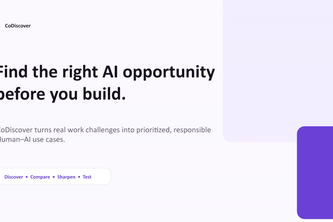
CoDiscover is a self-reported AI-powered tool designed to help users turn real work challenges into prioritized, responsible, and testable Human-AI use cases. It is described as an installable ChatGPT and Codex plugin that supports three core actions: Discover, Compare, and Sharpen.
What changed
The project was submitted to the OpenAI 2026 hackathon by a single founder (Chanon Phajunda), who describes it as a prototype built using Codex and GPT-5.6. It is positioned as an evolution from generic AI adoption approaches toward more structured, inclusive, and responsible use-case discovery.
Single most important open question
Is there evidence that the described product has been used or tested in real-world settings beyond the hackathon prototype?
What The Product Actually Is
The description states that CoDiscover is:
- An installable ChatGPT and Codex plugin.
- A tool for turning a real work challenge into a prioritized, responsible, and testable Human-AI use case.
- Capable of performing three actions: Discover, Compare, and Sharpen.
- Designed to produce a Minimum Testable Use Case (MTUC) with defined human roles, AI boundaries, approval checkpoints, and Go/Revise/Stop criteria.
It also claims to include:
- Nine machine-checkable responsibility gates.
- A structured output contract.
- Synthetic examples.
- Automated QA via GitHub Actions.
Inference The product is described as a prototype built for the OpenAI Build Week hackathon. It is not evidenced to have been deployed or used beyond this context.
Positioning & Claim Evolution
The author states that CoDiscover:
- Starts from a different question than typical AI adoption: “where should people and AI work together—and why?”
- Combines problem discovery experience with AI implementation capabilities.
- Focuses on responsible, inclusive, and testable use cases rather than generic idea generation.
- Aims to move beyond time-saving value to include productivity, impact, inclusion, and innovation.
Inference The positioning is that of a Human-AI collaboration framework, not just an AI tool. It seeks to shift the conversation from “what can AI do?” to “where should humans and AI collaborate?”
Target Customer & ICP
The description states:
- CoDiscover supports individuals, teams, and emerging Human–AI organizations.
- It is intended for use in real work challenges, including roles, KPIs, workflows, decisions, or documents.
Inference The target customer appears to be professionals working in environments where AI integration is being considered but lacks structure or governance. However, no specific persona or segment is named.
Business Model & Pricing Evidence
The description does not state:
- Whether CoDiscover has a business model.
- If it charges for access or use.
- How pricing would be structured.
Not evidenced.
Technical & Delivery Signals
The author states that CoDiscover was built with:
- ChatGPT, Codex, GitHub Actions, GPT-5.6, JavaScript, JSON Schema, MCP, Node.js, Python.
- A clean-room implementation.
- An installable plugin and reusable skill.
- Structured output contract and automated QA.
- Synthetic examples and judge testing guide.
Inference The technical stack suggests a prototype built for demonstration purposes, not production-grade software. No evidence of scalability or delivery beyond the hackathon.
Traction & Maturity Signals
The description states:
- This is a prototype built for the OpenAI 2026 hackathon.
- It includes a working plugin but no mention of user adoption, revenue, or usage metrics.
- The team size is listed as one (Chanon Phajunda).
- No evidence of pilot programs, customer feedback, or product iteration beyond the initial build.
Not evidenced.
Competitive Context
The description does not state:
- Who CoDiscover competes with.
- Whether similar tools exist in the market.
- How it differentiates from existing AI use-case discovery or Human-AI collaboration platforms.
Not evidenced.
Open Questions & Risks
- Prototype-only: The product is described as a hackathon prototype, not a tested or deployed tool.
- No traction evidence: No users, customers, or usage data are provided.
- Single founder: Team size is one, which raises questions about execution and scalability.
- Unverified claims: All descriptions are self-reported and unverified.
- Unclear commercial viability: No pricing, monetization, or business model described.
Questions the description leaves open
- Has the plugin been tested in real-world settings beyond the hackathon?
- What specific workflows or domains have you piloted it with?
- How do you plan to scale from a single-person prototype to a product that can serve teams or organizations?
- What is your roadmap for moving from MTUC generation to actual implementation or design?
- Are there any early adopters or partners interested in using this tool?
- How do you intend to monetize or commercialize the product?
Overall Assessment
Not evidenced.
The project description is self-reported and unverified, with no evidence of traction, revenue, customers, or business model. It is described as a hackathon prototype built by one person, without any indication of market validation or product-market fit.
The author claims the tool supports responsible AI use-case discovery, but there is no evidence that it has been used beyond its initial build. The lack of data on adoption, usage, or commercial viability makes it difficult to assess potential for investment or partnership.
Confidence level Low — based entirely on self-reported information with no external corroboration.
User Stories BotA demo video on every pull request
Get a demo video on every new feature
GitHub App that watches your pull requests and records a narrated, captioned demo.
Save time on demo prep and make informed decisions faster with a video walkthrough of every new feature.
Source
Submitted to the OpenAI 2026 hackathon on Devpost. Project home on Devpost. Back to the full gallery on Devpost.
This competitive analysis was produced by top-founders.com (opens in a new tab)
Generated by a language model from this project's public Devpost page — its tagline, the author's own write-up and any built-with tags listed there — as captured in August 2026. Short quotations are the author's words. It is an opinion on the idea as a business, not on the people behind it, and it reflects the description as published then. If the project has moved on, request a correction below. The analysis is not independent research and contains no verified traction, revenue or customer data.
An independent guide by KFG International LLC — not affiliated with, endorsed by, or connected to Devpost or OpenAI.