

Archive position — measured, not model output
0 likes on Devpost
2,263 of the 7,850 archived projects have more likes, and 5,587 share exactly 0 — so this project's #5,391 place in the like-ranked listing is a tie-break inside that group, not a ranking.
Projects (log scale)
Likes on Devpost. ▲ marks this project's group.
Show the figures
| Likes | Projects | Share of archive |
|---|---|---|
| 0 | 5,587 | 71.2% |
| 1 | 1,758 | 22.4% |
| 2 | 284 | 3.6% |
| 3–4 | 132 | 1.7% |
| 5–9 | 75 | 1.0% |
| 10+ | 14 | 0.2% |
 User Stories BotA demo video on every pull request
Get a demo video on every new feature
GitHub App that watches your pull requests and records a narrated, captioned demo.
Save time on demo prep and make informed decisions faster with a video walkthrough of every new feature.
Executive Summary
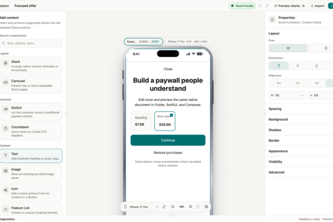
What the company appears to be: Mosaic is a self-reported open paywall platform for native mobile apps (iOS, Android, Flutter) that allows developers to design a single paywall once and render it natively across platforms without WebView or vendor lock-in. It includes a local-first Studio editor with canvas-based design and cross-platform rendering capabilities.
What changed: The author states they built Mosaic using Codex and GPT-5.6 as an agentic engineering team, coordinating specialized subagents for different technical components (Flutter, SwiftUI, Compose, protocol design, UX, etc.) to create a unified product model across languages and platforms.
Single most important open question: Is there any evidence of actual developer adoption or traction beyond the author's own development work? The description contains no data on users, customers, revenue, or usage metrics — only claims about functionality and architecture.
What The Product Actually Is
The description states that Mosaic is an "open, local-first paywall platform" that enables developers to design a single paywall once and render it natively across Flutter, iOS, and Android using three first-party renderers (Flutter widgets, SwiftUI views, Jetpack Compose components). It does not use WebViews.
It includes:
- A canvas-first Studio for designing paywalls
- Support for templates, layer trees, inline editing, component reordering, device previews
- Local-first workspace features: resizable panels, undo/redo, autosave, JSON import/export
- Protocol validation and compatibility diagnostics
- Native accessibility support (text scaling, RTL layouts, animations)
- Billing-provider independence through stable product references rather than embedding vendor-specific concepts
The author claims the Studio is local-first, meaning no account or backend connection is required to begin designing.
Evidence: Self-reported. No independent verification of product functionality or performance.
Positioning & Claim Evolution
The description positions Mosaic as:
- An alternative to existing closed paywall platforms
- A solution for developers who must build the same monetization interface three times (Flutter, SwiftUI, Compose)
- A tool that preserves native UI behavior and accessibility while offering flexibility in billing providers
It claims Mosaic reduces the gap between “app is ready” and “app has a polished native paywall.”
The author also states that Mosaic is designed to remain billing-provider independent, allowing integration with RevenueCat, StoreKit 2, Google Play Billing, or custom commerce providers through adapters.
Inference: The positioning suggests a shift toward open-source, developer-centric monetization tools that avoid vendor lock-in and support multi-platform development workflows.
Target Customer & ICP
The description states Mosaic targets:
- Mobile developers building apps for iOS and Android
- Independent developers and mobile teams seeking speed in paywall creation
- Teams wanting native rendering without WebViews or vendor lock-in
It implies a focus on developers who are already working with Flutter, SwiftUI, or Jetpack Compose.
Evidence: Self-reported. No data on actual customer segments, personas, or market size.
Business Model & Pricing Evidence
The description does not state anything about pricing models, monetization strategies, or business model details.
It mentions that Mosaic is "open" and supports billing-provider independence but does not elaborate on how it intends to generate revenue.
Evidence: Not evidenced.
Technical & Delivery Signals
The project was built using:
- Codex with GPT-5.6 as an agentic engineering team
- Specialized subagents for product scope, UX, protocol design, dashboard development, Flutter, SwiftUI, Compose, integration quality, etc.
- A root orchestrator coordinating agents with explicit file ownership, architectural constraints, testing requirements, and acceptance criteria
Key technical elements:
- Platform-neutral protocol defining layout, components, localization, commerce references, actions, accessibility metadata
- Shared fixtures and conformance tests for consistency across platforms
- Local-first Studio with features like live native previews via WebSockets, JSON import/export, undo/redo, etc.
Evidence: Self-reported. No independent verification of technical implementation or performance.
Traction & Maturity Signals
The description states that this is a Build Week project submitted to the OpenAI 2026 hackathon on Devpost.
It includes:
- A working Studio with full-screen canvas-first interface
- Cross-platform rendering capabilities across Flutter, SwiftUI, and Compose
- Protocol design, SDK implementation, fixture creation, and conformance testing
However, there is no evidence of:
- Revenue
- Customers
- User adoption
- Product usage metrics
- Market traction or feedback
Evidence: Not evidenced.
Competitive Context
The description does not mention any competitors directly. It implies Mosaic is positioned against existing closed paywall platforms that tie developers to specific vendors and require building the same UI multiple times.
It suggests Mosaic offers a more flexible, open approach compared to such systems.
Inference: The competitive landscape likely includes platforms like RevenueCat, Apple’s StoreKit, Google Play Billing, or other monetization tooling for native apps. However, no direct comparison or competitor identification is provided.
Open Questions & Risks
- No traction evidence: No users, customers, revenue, or adoption data.
- Unverified claims: The entire description is self-reported and unverified.
- Unclear commercial viability: No indication of monetization strategy or business model.
- Developer-centric but unclear market demand: While targeting developers, no evidence of market need or developer interest beyond the author's own work.
- Agentic engineering process: Reliance on AI tools (Codex + GPT-5.6) raises questions about scalability and long-term maintainability without human oversight.
Inference: The project appears to be a proof-of-concept or prototype, not yet validated in production environments or with real users.
Questions the description leaves open
- What is the current stage of development beyond the Build Week prototype?
- Have you tested Mosaic with actual developers or teams? If so, what feedback have you received?
- How do you plan to monetize this platform?
- Are there any existing partnerships or integrations with billing providers like RevenueCat or Apple?
- What is your roadmap for expanding beyond the current protocol and rendering capabilities?
- Can you demonstrate a working version of the Studio or renderers in action?
- Do you have any plans to open-source Mosaic or make it available under an open license?
Overall Assessment
Not evidenced.
The description provides no evidence of revenue, customers, traction, or commercial viability beyond the author's own development work. It is a self-reported account of a prototype built during a hackathon, with no indication that Mosaic has moved past concept or early-stage prototyping.
This project appears to be an experimental tool developed by one person using AI-assisted engineering techniques. There is no evidence of market demand, adoption, or sustainable business model.
Confidence level: Low. The analysis is based entirely on self-reported information with zero corroboration or external validation.
User Stories BotA demo video on every pull request
Get a demo video on every new feature
GitHub App that watches your pull requests and records a narrated, captioned demo.
Save time on demo prep and make informed decisions faster with a video walkthrough of every new feature.
Source
Submitted to the OpenAI 2026 hackathon on Devpost. Project home on Devpost. Back to the full gallery on Devpost.
This competitive analysis was produced by top-founders.com (opens in a new tab)
Generated by a language model from this project's public Devpost page — its tagline, the author's own write-up and any built-with tags listed there — as captured in August 2026. Short quotations are the author's words. It is an opinion on the idea as a business, not on the people behind it, and it reflects the description as published then. If the project has moved on, request a correction below. The analysis is not independent research and contains no verified traction, revenue or customer data.
An independent guide by KFG International LLC — not affiliated with, endorsed by, or connected to Devpost or OpenAI.