

Archive position — measured, not model output
0 likes on Devpost
2,263 of the 7,850 archived projects have more likes, and 5,587 share exactly 0 — so this project's #3,430 place in the like-ranked listing is a tie-break inside that group, not a ranking.
Projects (log scale)
Likes on Devpost. ▲ marks this project's group.
Show the figures
| Likes | Projects | Share of archive |
|---|---|---|
| 0 | 5,587 | 71.2% |
| 1 | 1,758 | 22.4% |
| 2 | 284 | 3.6% |
| 3–4 | 132 | 1.7% |
| 5–9 | 75 | 1.0% |
| 10+ | 14 | 0.2% |
 User Stories BotA demo video on every pull request
Get a demo video on every new feature
GitHub App that watches your pull requests and records a narrated, captioned demo.
Save time on demo prep and make informed decisions faster with a video walkthrough of every new feature.
Executive Summary
What the company appears to be
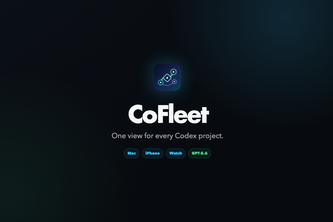
CoFleet is a native Apple companion application for users of Codex, designed to provide project visibility and task continuity across Mac, iPhone, and Apple Watch. It interfaces with Codex hosts running on Mac or Linux machines, presenting canonical Codex task states in Apple-native UIs.
What changed
The author describes CoFleet as a response to the fragmentation of context when using Codex across multiple devices. The product aims to make Codex feel less like a collection of tabs and more like a fleet that can be monitored and steered from Apple devices.
Single most important open question
Is there any evidence of actual usage, adoption or integration with real Codex users beyond the author’s own development loop?
What The Product Actually Is
The description states that CoFleet is a native Apple application built using Swift 6 and SwiftUI. It pairs directly with Mac or Linux hosts running Codex and brings task state into Apple apps. It includes features such as:
- A dashboard combining host health, active turns, approvals, recent sessions, and account limits.
- Agent Bay for resuming tasks with Markdown, reasoning, tool activity, attachments, questions, approvals, model controls, and session history.
- Active workspace that keeps a selected project and its live conversation together.
- SceneKit-based progress view for todos and pets.
- Apple Watch support via widgets and complications.
It uses Tailscale HTTPS for secure pairing between hosts and clients. The backend includes a Python service (cofleet-host) that translates Codex app-server JSONL into a REST/SSE surface for Apple clients.
Evidence
- The author states CoFleet is built with Swift 6, SwiftUI, SceneKit, WidgetKit, WatchConnectivity, and native platform navigation.
- It uses a Python service (
cofleet-host) to interface with Codex app-server. - Pairing uses one-use codes and per-device tokens; host data stored in SQLite.
- Live turn changes arrive via event streams with replay/reconnect support.
Inference CoFleet appears to be an Apple-focused companion tool for managing Codex tasks, not a replacement or alternative to Codex itself.
Positioning & Claim Evolution
The author positions CoFleet as a "project-control layer" that complements Codex rather than replacing it. It is described as a way to keep Codex context visible and manageable across Apple devices without duplicating task history or copying credentials.
Claims made
- CoFleet keeps goals, current work, and conversation visible across the fleet.
- It allows users to open exact threads in Codex Desktop from Mac or iPhone.
- The app does not read or copy
~/.codex/auth.json. - It supports multi-host access without sharing credentials.
Evidence
- The author says CoFleet pairs with each Mac or Linux host running Codex.
- It uses private Tailscale HTTPS for secure communication.
- Host-scoped task IDs prevent accidental resolution across machines.
Inference The positioning is that of a lightweight, secure, and contextual companion app to enhance the Codex experience on Apple platforms.
Target Customer & ICP
The description indicates CoFleet targets users who use Codex across multiple devices and want continuity in their workflow. It is aimed at developers or teams using Codex for project management or task execution.
Claims made
- Users who work with Codex across several projects and machines.
- Those who value context continuity when stepping away from their Mac.
Evidence
- The author says they use Codex across multiple projects and machines.
- The product is designed to reduce the fragmentation of context.
Inference The ICP likely includes developers or technical teams using Codex for AI-assisted development, particularly those working in environments where switching between devices is common.
Business Model & Pricing Evidence
There is no evidence provided about pricing, monetization, or business model. The project is described as a hackathon submission and does not mention any commercial offering.
Evidence
- No mention of pricing tiers, subscriptions, or revenue streams.
- The product is presented as a personal development tool for Codex users.
Inference It is unclear whether CoFleet intends to become a paid product or if it remains a prototype or hobby project.
Technical & Delivery Signals
The technical architecture described includes:
- Native Apple apps built with Swift 6 and SwiftUI.
- A Python service (
cofleet-host) running alongside Codex app-server. - Secure pairing using Tailscale HTTPS, one-use codes, and per-device tokens.
- Event-driven updates via REST/SSE instead of polling.
- Host-scoped canonical IDs to avoid conflicts.
- SQLite for local storage.
Evidence
- The author describes how the backend translates JSONL into REST/SSE.
- Uses SceneKit for visualizations.
- Implements event replay, idempotent turn starts, and reconciliation logic.
Inference The technical approach suggests a secure, low-overhead integration with Codex that avoids credential exposure. It is built to handle concurrency and state consistency across multiple clients.
Traction & Maturity Signals
There is no evidence of traction, customers, or adoption beyond the author’s own use case. The project is described as a hackathon submission and does not include any data on usage, user feedback, or market validation.
Evidence
- The project was submitted to an OpenAI 2026 hackathon.
- No mention of users, downloads, or real-world deployment.
- The author dogfooded the product during development.
Inference The product is at a very early stage—likely a prototype or proof-of-concept—and lacks any measurable traction or market feedback.
Competitive Context
There is no evidence of competitors mentioned in the description. The project does not reference existing tools or platforms that might compete with it, nor does it describe how it fits into a broader ecosystem.
Evidence
- No mention of competing products or services.
- No comparison to similar tools or workflows.
Inference It is unclear whether CoFleet operates in a competitive space or if it is a standalone solution. The lack of context makes it difficult to assess its positioning relative to others.
Open Questions & Risks
Several risks and open questions are present based on the self-reported description:
- No commercial traction or adoption — This is a major concern for any investment or partnership consideration.
- Unverified claims about security and privacy — While the author states that credentials are not copied, this has no independent verification.
- Limited scope of use case — The product only works with Codex and assumes a specific environment (Mac/Linux + Codex).
- Hackathon origin — Suggests it may be incomplete or experimental in nature.
Evidence
- No mention of users, revenue, or market validation.
- No evidence of independent testing or verification of claims.
- The project is described as a hackathon submission.
Inference The lack of traction and commercial viability raises questions about scalability and long-term potential.
Questions the description leaves open
- What is the actual adoption rate among Codex users beyond your own use?
- How does CoFleet handle edge cases like network disconnections or host failures?
- Are there any plans to support other AI platforms beyond Codex?
- Has the product been tested with real users outside of the development loop?
- What are the technical limitations of integrating with Codex, and how might those evolve?
Overall Assessment
There is no evidence of commercial traction, user adoption, or financial viability to support an investment or partnership decision at this time.
Evidence
- The project is a hackathon submission.
- No revenue, customers, or market data provided.
- The author’s own use case is the only context for development.
Inference While the concept shows promise as a companion tool for Codex users, there is insufficient evidence to assess its commercial potential or readiness for investment or partnership. It appears to be an early-stage prototype with no demonstrated product-market fit or scalability.
User Stories BotA demo video on every pull request
Get a demo video on every new feature
GitHub App that watches your pull requests and records a narrated, captioned demo.
Save time on demo prep and make informed decisions faster with a video walkthrough of every new feature.
Source
Submitted to the OpenAI 2026 hackathon on Devpost. Project home on Devpost. Back to the full gallery on Devpost.
This competitive analysis was produced by top-founders.com (opens in a new tab)
Generated by a language model from this project's public Devpost page — its tagline, the author's own write-up and any built-with tags listed there — as captured in August 2026. Short quotations are the author's words. It is an opinion on the idea as a business, not on the people behind it, and it reflects the description as published then. If the project has moved on, request a correction below. The analysis is not independent research and contains no verified traction, revenue or customer data.
An independent guide by KFG International LLC — not affiliated with, endorsed by, or connected to Devpost or OpenAI.