

Archive position — measured, not model output
0 likes on Devpost
2,263 of the 7,850 archived projects have more likes, and 5,587 share exactly 0 — so this project's #3,432 place in the like-ranked listing is a tie-break inside that group, not a ranking.
Projects (log scale)
Likes on Devpost. ▲ marks this project's group.
Show the figures
| Likes | Projects | Share of archive |
|---|---|---|
| 0 | 5,587 | 71.2% |
| 1 | 1,758 | 22.4% |
| 2 | 284 | 3.6% |
| 3–4 | 132 | 1.7% |
| 5–9 | 75 | 1.0% |
| 10+ | 14 | 0.2% |
 User Stories BotA demo video on every pull request
Get a demo video on every new feature
GitHub App that watches your pull requests and records a narrated, captioned demo.
Save time on demo prep and make informed decisions faster with a video walkthrough of every new feature.
Executive Summary
What the company appears to be
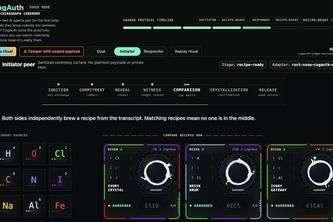
CogAuth - The Chirograph Ceremony is a self-reported proof-of-concept project that describes an authentication system for AI agents. It uses cryptographic protocols (Noise XX, encrypted commit/reveal exchange) and visual elements to enable two peers to independently verify a structured artifact called a CogPack before it is released.
What changed
The author states that the project emerged from discomfort with how trust is established in agent-to-agent interactions — particularly the invisibility of the process behind a simple green checkmark. The solution involves creating a "ceremony" where both agents must confirm matching results before an artifact is unlocked, using both cryptographic and visual verification.
Single most important open question
Is there any evidence that this system has been tested beyond the author's own demo? The description makes no claims about real-world deployment or adoption.
Note: This analysis is based entirely on self-reported information from the project description. No external corroboration, revenue data, customer names, or traction metrics are available.
What The Product Actually Is
- The description states that CogAuth enables two peers to authenticate a structured artifact called a CogPack.
- It uses a "Noise XX session" for secure communication and implements an encrypted commit/reveal exchange.
- The system involves three-part comparison recipes, which both parties independently derive.
- A visual interface translates the underlying cryptographic process into elements like "Element Sources", "Comparison Reactors", and "Fluid Ink".
- If both sides match and confirm, the exact CogPack is recovered; otherwise, decryption fails and nothing is released.
Inference: The product appears to be a prototype for secure agent handoff with human-auditable verification. It is not described as a commercial offering or production-ready tool.
Positioning & Claim Evolution
- The author claims that CogAuth turns the invisible moment of trust into something inspectable without pretending the visualization itself is security.
- The project uses the metaphor of a "Chirograph" — medieval documents cut apart and matched later — to represent how neither half alone means enough, mirroring the need for dual confirmation in AI agent interactions.
- The system is positioned as an alternative to traditional trust mechanisms where users rely on a single green checkmark.
Claim: CogAuth aims to make trust in AI agent handoffs visible and auditable.
Not evidenced: There are no claims about market positioning, competitive differentiation, or strategic intent beyond the demo.
Target Customer & ICP
- Not evidenced.
- The description does not identify specific customer segments, use cases, or personas.
- It is unclear whether this targets developers, enterprises, or end users of AI systems.
Absence of evidence: No indication of who would actually use CogAuth in practice.
Business Model & Pricing Evidence
- Not evidenced.
- There are no mentions of pricing models, monetization strategies, or commercial plans.
- The project is described as a hackathon submission and prototype.
Absence of evidence: No business model or pricing information provided.
Technical & Delivery Signals
- Built with Node.js, Python, Rust, HTML5, CSS3, JavaScript.
- Uses the Noise XX protocol for secure communication.
- Implements encrypted commit/reveal exchange and deterministic witnesses.
- Communicates over local TCP; exposes sanitized metadata via HTTP/SSE.
- Integrates upstream projects such as Pliny the Liberator's GLOSSOPETRAE, Jesse Gelders' Fluoddity, and React Bits' GlassSurface.
- The interface includes keyboard confirmation, reduced-motion mode, forced-color mode, persistent controls, and observatory features.
Inference: The technical stack suggests a focus on secure peer-to-peer communication with visual feedback. It is not described as scalable or production-ready.
Traction & Maturity Signals
- Not evidenced.
- No data about users, customers, revenue, ARR, or adoption rates are mentioned.
- The project is presented as a hackathon submission and demo.
Absence of evidence: No signs of traction or maturity beyond the prototype stage.
Competitive Context
- Not evidenced.
- There is no mention of competitors or existing solutions in this space.
- The author does not reference similar tools or systems for secure agent authentication.
Absence of evidence: No competitive analysis or positioning relative to other tools.
Open Questions & Risks
- The project is described as a prototype, not a production system.
- It relies on self-reported claims about security and usability without independent verification.
- Visual elements are explicitly stated to be non-authoritative — but risk becoming misleading if not carefully managed.
- No evidence of testing with real users or formal security review.
- The author notes that the visual system had to be simplified to avoid conflating theater with proof.
Risk: Lack of external validation, user testing, and security auditing raises concerns about readiness for real-world deployment.
Questions the description leaves open
- What specific threats or attack vectors does the system defend against?
- Has the cryptographic protocol been formally analyzed or reviewed by third parties?
- How was the visual design validated to ensure it accurately reflects the underlying security process?
- Are there any plans for integrating CogAuth into real AI agent workflows (e.g., MCP, A2A)?
- What are the performance implications of running this system in production environments?
- Have you tested how users interpret the visual cues and whether they correctly distinguish between proof and presentation?
Overall Assessment
- Not evidenced.
- No financial data, funding history, or partnership opportunities are described.
- The project is presented as a proof-of-concept with no indication of commercial viability or scalability.
Assessment: Based on the self-reported description alone, CogAuth appears to be an experimental prototype. There is insufficient evidence to assess its potential for investment or strategic partnership.
User Stories BotA demo video on every pull request
Get a demo video on every new feature
GitHub App that watches your pull requests and records a narrated, captioned demo.
Save time on demo prep and make informed decisions faster with a video walkthrough of every new feature.
Source
Submitted to the OpenAI 2026 hackathon on Devpost. Project home on Devpost. Back to the full gallery on Devpost.
This competitive analysis was produced by top-founders.com (opens in a new tab)
Generated by a language model from this project's public Devpost page — its tagline, the author's own write-up and any built-with tags listed there — as captured in August 2026. Short quotations are the author's words. It is an opinion on the idea as a business, not on the people behind it, and it reflects the description as published then. If the project has moved on, request a correction below. The analysis is not independent research and contains no verified traction, revenue or customer data.
An independent guide by KFG International LLC — not affiliated with, endorsed by, or connected to Devpost or OpenAI.