

Archive position — measured, not model output
0 likes on Devpost
2,263 of the 7,850 archived projects have more likes, and 5,587 share exactly 0 — so this project's #7,358 place in the like-ranked listing is a tie-break inside that group, not a ranking.
Projects (log scale)
Likes on Devpost. ▲ marks this project's group.
Show the figures
| Likes | Projects | Share of archive |
|---|---|---|
| 0 | 5,587 | 71.2% |
| 1 | 1,758 | 22.4% |
| 2 | 284 | 3.6% |
| 3–4 | 132 | 1.7% |
| 5–9 | 75 | 1.0% |
| 10+ | 14 | 0.2% |
 User Stories BotA demo video on every pull request
Get a demo video on every new feature
GitHub App that watches your pull requests and records a narrated, captioned demo.
Save time on demo prep and make informed decisions faster with a video walkthrough of every new feature.
Executive Summary
TradePath AI is a self-reported diagnostic tool for algorithmic trading, built as a standalone C#/.NET command-line analyzer. The project analyzes structured logs from cTrader backtests to detect high-risk trade paths and explain when drawdown turns into a dangerous “tooth.” It does not currently parse raw cTrader reports or generate Pain12 records itself; it only processes pre-existing structured diagnostic data.
The author states that the tool was developed using private diagnostic instrumentation inside a cTrader cBot, with Codex and GPT-5.6 used for engineering and analysis. The public prototype is deterministic and does not call AI models during execution. It separates observation from decision-making, treating Pain12 as a diagnostic alarm rather than an automatic trigger.
Key commercial due-diligence question: Is there evidence of traction or adoption beyond the author’s own backtest?
The description states that TradePath AI is a research and developer tool, not a trading signal or financial advice provider. No revenue, customer base, or market validation are evidenced.
What The Product Actually Is
- The product is a standalone C#/.NET command-line analyzer.
- It reads structured PAIN12 RECOVERY DIAG records generated by private diagnostic instrumentation inside a cTrader cBot.
- It does not parse report.html, reconstruct trades from raw history, or generate Pain12 records itself.
- It analyzes:
- Position ID
- Trade direction and status
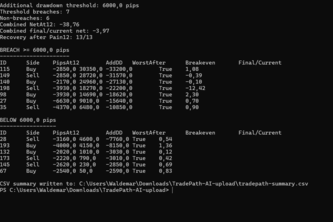
- Pips and net result at Pain12
- Worst and best movement after Pain12
- Additional drawdown after Pain12
- Whether the position returned to breakeven
- Time to breakeven and worst drawdown
- Final or current net result
- It separates records by an additional-drawdown threshold (default 6,000 pips) and reports breaches/non-breaches.
- It calculates combined NetAt12 and final results, prints detailed tables, and exports analysis to CSV.
- The tool is deterministic and does not call AI models during runtime.
Positioning & Claim Evolution
- The description states that TradePath AI is an “AI-assisted diagnostic tool.”
- It claims to analyze cTrader backtests, detect high-risk trade paths, and explain when drawdown turns into a dangerous “tooth.”
- The author notes that the tool does not provide financial advice or guarantee profits.
- It is positioned as a research and developer tool, not a trading signal or automated system.
- AI was used during engineering, analysis, and documentation but not in real-time execution.
Target Customer & ICP
- Not evidenced. No stated target customer or ideal customer profile (ICP) is provided.
- The tool appears to be aimed at algorithmic traders or developers using cTrader.
- It is not described as a commercial product for end-users, but rather as an internal diagnostic tool used by developers.
Business Model & Pricing Evidence
- Not evidenced. No business model or pricing information is stated.
- The project is described as a research and developer tool, not a commercial offering.
- No indication of monetization strategy, licensing, or sales channels.
Technical & Delivery Signals
- Built with .NET, C#, algorithmic, analytics, automate, backtesting, cTrader, data, OpenAI, trading.
- Uses Codex for engineering support and GPT-5.6 for analysis and documentation.
- The tool is deterministic and does not call AI models during runtime.
- Private diagnostic instrumentation was added to an existing cTrader cBot without changing its behavior.
- Control backtest results were preserved after adding diagnostics (Net Profit: 68.83 EUR, Ending Balance: 1081.25 EUR).
- The public analyzer is a standalone executable that safely processes exported Pain12 records.
Traction & Maturity Signals
- Not evidenced. No customer data, usage metrics, or adoption indicators are provided.
- The project is described as a prototype submitted to a hackathon.
- A demonstration dataset of 13 Pain12 records was included.
- Future versions may include GUI, timelines, and AI-assisted explanations, but these are not part of the current prototype.
Competitive Context
- Not evidenced. No competitive landscape or market positioning is described.
- The tool is focused on cTrader backtesting diagnostics.
- It does not appear to compete with existing trading platforms or tools directly; it is a diagnostic add-on for algorithmic traders.
Open Questions & Risks
- The tool is described as a research and developer tool, not a commercial product — this raises questions about its market readiness or scalability.
- No evidence of revenue, customers, or traction beyond the author’s own backtest.
- The project was submitted to a hackathon, suggesting it may be early-stage or experimental.
- The tool does not currently parse raw cTrader logs or generate diagnostics itself; it only processes pre-existing structured data.
- The use of AI in engineering and documentation (Codex, GPT-5.6) is noted, but not in real-time execution.
Questions the description leaves open
- What is the actual commercial strategy for monetizing this tool?
- Has it been tested or used by others beyond the author’s own backtests?
- Are there any plans to integrate with trading platforms beyond cTrader?
- How does the diagnostic instrumentation affect performance or execution in live trading?
- Is there a roadmap for moving from command-line to GUI or web-based interface?
- What is the long-term vision for this tool — is it intended as a standalone product or part of a larger suite?
Overall Assessment
- Not evidenced. No financial data, valuation, funding rounds, or partnership opportunities are provided.
- The project is described as a prototype submitted to a hackathon and is not yet a commercial offering.
- It appears to be in an early stage of development with no demonstrated traction or revenue.
- The tool is positioned as a diagnostic research tool for algorithmic traders, not a product for end-users or investors.
- Given the lack of evidence for traction, customers, or business model, there is insufficient basis to recommend investment or partnership at this time.
User Stories BotA demo video on every pull request
Get a demo video on every new feature
GitHub App that watches your pull requests and records a narrated, captioned demo.
Save time on demo prep and make informed decisions faster with a video walkthrough of every new feature.
Source
Submitted to the OpenAI 2026 hackathon on Devpost. Project home on Devpost. Back to the full gallery on Devpost.
This competitive analysis was produced by top-founders.com (opens in a new tab)
Generated by a language model from this project's public Devpost page — its tagline, the author's own write-up and any built-with tags listed there — as captured in August 2026. Short quotations are the author's words. It is an opinion on the idea as a business, not on the people behind it, and it reflects the description as published then. If the project has moved on, request a correction below. The analysis is not independent research and contains no verified traction, revenue or customer data.
An independent guide by KFG International LLC — not affiliated with, endorsed by, or connected to Devpost or OpenAI.