

Archive position — measured, not model output
1 like on Devpost
505 of the 7,850 archived projects have more likes, and 1,758 share exactly 1 — so this project's #1,461 place in the like-ranked listing is a tie-break inside that group, not a ranking.
Projects (log scale)
Likes on Devpost. ▲ marks this project's group.
Show the figures
| Likes | Projects | Share of archive |
|---|---|---|
| 0 | 5,587 | 71.2% |
| 1 | 1,758 | 22.4% |
| 2 | 284 | 3.6% |
| 3–4 | 132 | 1.7% |
| 5–9 | 75 | 1.0% |
| 10+ | 14 | 0.2% |
 User Stories BotA demo video on every pull request
Get a demo video on every new feature
GitHub App that watches your pull requests and records a narrated, captioned demo.
Save time on demo prep and make informed decisions faster with a video walkthrough of every new feature.
Executive Summary
What the company appears to be
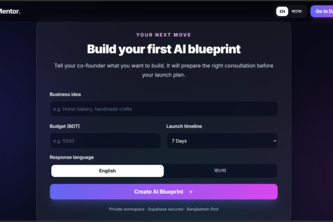
MicroMentor is a self-reported SaaS product built for micro-business owners in regions like Rajshahi, Bangladesh. It claims to offer bilingual (English/Bengali) agentic AI workflows that simulate high-level business intelligence—such as financial planning, legal support and crisis management—for small entrepreneurs who otherwise lack access to such resources.
What changed
The project was built over a hackathon period using OpenAI Codex and GPT-5.6 models with a Hub-and-Spoke architecture on Next.js 14 and Supabase. It includes features like an AI Board of Directors, SOS Crisis Manager, and localized tools such as AI Khata (voice-to-ledger) and Smart SMS.
The single most important open question
Is there any evidence that micro-businesses in Rajshahi or similar regions actually exist, or are they a fictional construct used to justify the product's positioning?
What The Product Actually Is
The description states that MicroMentor is a SaaS platform built using:
- Next.js 14
- Supabase
- OpenAI Codex & GPT-5.6
- A Hub-and-Spoke architecture
It uses:
- Pre-planned Prompt Architecture for development
- Dynamic Model Routing between $GPT\text{-}5.6\text{-}Luna$ (for deep reasoning) and $GPT\text{-}5.6\text{-}Mini$ (for fast execution)
- A utility function to decide which model to use based on task complexity, latency, and cost
Features include:
- AI Board of Directors (multi-agent War Room)
- SOS Crisis Manager
- Legal Desk
- AI Khata (Voice-to-Ledger)
- Smart SMS
- Agentic Streaming UI for masking latency
Not evidenced:
- Whether any of these features are live or functional beyond the hackathon prototype.
- Whether the product has been tested with actual users.
Positioning & Claim Evolution
The author claims that MicroMentor aims to:
- Democratize high-level business intelligence
- Provide access to Fortune 500-level Board of Directors for free
- Help micro-businesses avoid an 80% failure rate in their first year
It positions itself as a solution for:
- Micro-entrepreneurs in developing regions (e.g., Rajshahi, Bangladesh)
- Those lacking strategic foresight, financial literacy, and crisis management support
The narrative evolves from:
- A problem (micro-businesses failing due to lack of resources)
- To a solution (AI-powered business intelligence)
- To a mission (democratizing access to expert-level tools)
Inference: The positioning is heavily aspirational and rooted in a self-described market need, not verified adoption or demand.
Target Customer & ICP
The description states that the target customer is:
- Micro-entrepreneurs
- In regions like Rajshahi, Bangladesh
- Including seasonal mango orchard owners and local boutique operators
- Who lack access to CFOs, legal teams, or market analysts
Not evidenced:
- Whether these micro-businesses actually exist in sufficient numbers to support a scalable product.
- Whether the described entrepreneurs have internet access or use smartphones.
- Whether there is any customer validation beyond the author’s own assumptions.
Business Model & Pricing Evidence
The description does not state:
- Any pricing model
- Revenue streams
- Monetization strategy
- Subscription tiers or usage-based billing
Inference: The business model remains undefined, though it is implied to be SaaS-based due to its architecture and tagline.
Technical & Delivery Signals
The project was built using:
- Next.js 14
- Supabase
- OpenAI Codex & GPT-5.6
- React, TypeScript, Tailwind CSS, Node.js, PostgreSQL
It includes:
- A Hub-and-Spoke architecture
- Dynamic model routing based on task complexity
- Pre-planned Prompt Architecture
- Agentic Streaming UI for latency masking
Not evidenced:
- Whether the system is production-ready or has been deployed.
- Whether the model routing logic is implemented in a live environment.
- Whether the product supports real-time interaction or is limited to prototype-level functionality.
Traction & Maturity Signals
The description states:
- The project was built during a hackathon
- It includes features like AI Khata, Smart SMS, and an AI Board of Directors
- It uses advanced prompting techniques and model routing
Not evidenced:
- Any user base or customer data
- Any revenue or monetization
- Any real-world testing or feedback from micro-businesses
- Any deployment in production or live use
Competitive Context
The description does not mention:
- Competitors
- Existing solutions in the market for micro-business support
- How MicroMentor differentiates from other AI tools or business advisory platforms
Inference: The competitive landscape is unknown, but it appears to be positioned as a niche solution for underserved markets with limited AI-based business tools.
Open Questions & Risks
- Unverified market assumptions: The description assumes that micro-businesses in Rajshahi exist and are in need of the described services, without any evidence.
- No traction or revenue: No data on users, customers, or monetization is provided.
- Prototype-level implementation: Built during a hackathon; no indication of production readiness.
- Unclear delivery mechanism: The product is described as SaaS but lacks details on how it would be delivered to users beyond the prototype.
- Bilingual precision claims: The description mentions challenges in bilingual context, but does not show evidence of successful localization or accuracy.
Questions the description leaves open
- What is the actual user base for this product? Are there real micro-businesses using it?
- How do you plan to scale beyond a hackathon prototype?
- What are your assumptions about the demand and willingness to pay among micro-entrepreneurs in Rajshahi?
- Can you demonstrate any working functionality of the AI Board of Directors or other key features?
- How do you intend to integrate with local logistics or communication systems (e.g., WhatsApp, SMS)?
- What is your go-to-market strategy for reaching micro-businesses in Bangladesh?
Overall Assessment
The description states that MicroMentor is a self-reported SaaS product built during a hackathon, using AI technologies to simulate expert-level business support for micro-entrepreneurs.
Not evidenced:
- Any real traction or revenue
- Any validated customer demand
- Any production-ready features or deployment
- Any competitive differentiation
Inference: The project is in an early conceptual stage with no evidence of commercial viability or market validation. It is not ready for investment or partnership unless further development and user testing are demonstrated.
User Stories BotA demo video on every pull request
Get a demo video on every new feature
GitHub App that watches your pull requests and records a narrated, captioned demo.
Save time on demo prep and make informed decisions faster with a video walkthrough of every new feature.
Source
Submitted to the OpenAI 2026 hackathon on Devpost. Project home on Devpost. Back to the full gallery on Devpost.
This competitive analysis was produced by top-founders.com (opens in a new tab)
Generated by a language model from this project's public Devpost page — its tagline, the author's own write-up and any built-with tags listed there — as captured in August 2026. Short quotations are the author's words. It is an opinion on the idea as a business, not on the people behind it, and it reflects the description as published then. If the project has moved on, request a correction below. The analysis is not independent research and contains no verified traction, revenue or customer data.
An independent guide by KFG International LLC — not affiliated with, endorsed by, or connected to Devpost or OpenAI.