

Archive position — measured, not model output
1 like on Devpost
505 of the 7,850 archived projects have more likes, and 1,758 share exactly 1 — so this project's #1,462 place in the like-ranked listing is a tie-break inside that group, not a ranking.
Projects (log scale)
Likes on Devpost. ▲ marks this project's group.
Show the figures
| Likes | Projects | Share of archive |
|---|---|---|
| 0 | 5,587 | 71.2% |
| 1 | 1,758 | 22.4% |
| 2 | 284 | 3.6% |
| 3–4 | 132 | 1.7% |
| 5–9 | 75 | 1.0% |
| 10+ | 14 | 0.2% |
 User Stories BotA demo video on every pull request
Get a demo video on every new feature
GitHub App that watches your pull requests and records a narrated, captioned demo.
Save time on demo prep and make informed decisions faster with a video walkthrough of every new feature.
Executive Summary
What the company appears to be
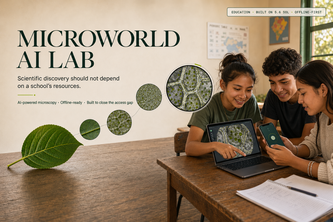
MicroWorld AI LAB is a self-reported educational tool that uses generative AI to simulate microscopy experiences on everyday devices like phones and computers. It targets students aged 9–16 in underserved schools, offering an offline-first, bilingual interface for inquiry-based learning.
What changed
The project was built as part of the OpenAI 2026 hackathon. The description indicates a focus on solving access gaps in science education through AI and existing hardware, with no evidence of prior commercial traction or product history.
Single most important open question
Is there any evidence that MicroWorld AI LAB has been piloted in real classrooms, or tested with actual students? Without such data, the claims about impact and usability remain unvalidated.
What The Product Actually Is
The description states that MicroWorld AI LAB is an offline-first generative microscope designed for learners aged 9 to 16. It allows users to photograph objects (e.g., leaves, salt, clothing) and use GPT-5.6 Sol to simulate what those objects would look like under various magnifications (4×, 10×, 40×, 100×). The simulation is presented through a tactile UI mimicking real lab instruments.
Key features include:
- A mechanical objective turret for switching magnifications.
- Coarse and fine focus dials.
- Adjustable lighting and movable stage.
- Tools to mark evidence.
- A lab notebook for predictions and conclusions (via typing or voice dictation).
- Bilingual support.
- QR-pairing between phone and PC for collaborative use.
The system distinguishes between the original photo and AI-generated views, labeling simulations as educational estimates.
Inference The product is described as a PWA (Progressive Web App) built with Next.js, React, TypeScript, and integrated with OpenAI APIs. It uses IndexedDB for local storage and Cloudflare services for session pairing and media sharing.
Positioning & Claim Evolution
The description positions MicroWorld AI LAB as an alternative to traditional microscopes, especially in underserved communities where access to lab equipment is limited. The authors claim it bridges a technology gap by turning everyday devices into interactive science labs.
They emphasize:
- Not replacing real microscopes.
- Providing a practical, offline-first solution.
- Supporting inquiry-based learning.
- Teaching students how to separate observation from simulation.
The project’s positioning evolves from a tech demo to a complete educational tool, with the authors stating they shipped ten bilingual expeditions and built a full prediction-to-conclusion cycle.
Inference The positioning reflects an intent to democratize access to scientific inquiry, not just provide a digital version of a microscope. It is framed as a pedagogical innovation rather than a replacement for physical tools.
Target Customer & ICP
The description identifies the primary user group as students aged 9 to 16, particularly those in underserved or rural schools lacking basic scientific instruments.
It also mentions:
- Teachers who can use the app with students.
- A collaborative mode allowing a teacher to control a PC while a student uses a phone.
There is no mention of:
- Specific school types (public, private, charter).
- Geographic focus beyond “rural or economically vulnerable communities.”
- Age brackets outside 9–16.
- Any segmentation by income level or region.
Inference The ICP appears to be educators and learners in low-resource environments where traditional lab tools are scarce or unaffordable. However, the lack of explicit targeting data makes this a claim rather than a fact.
Business Model & Pricing Evidence
There is no evidence in the description of:
- Revenue streams.
- Pricing models.
- Monetization strategy.
- Customer acquisition plans.
- Any commercial relationships or partnerships.
The project is described as a hackathon submission, with no indication that it has moved beyond prototype or pilot stage.
Inference The business model remains undefined. It may be intended for non-commercial use or future monetization through grants, educational institutions, or partnerships—none of which are detailed.
Technical & Delivery Signals
The description includes:
- Use of Next.js, React, TypeScript.
- Integration with GPT-5.6 Sol, OpenAI APIs, and multimodal image generation.
- Offline-first architecture using IndexedDB, localStorage, service workers, PWA manifests.
- QR-pairing system between devices without exposing API keys.
- Cloudflare D1 and R2 for session pairing and media sharing.
It also mentions:
- Bilingual support.
- Accessibility features (voice dictation).
- Support for low-vision and motor-impaired learners in future plans.
Inference The technical stack suggests a modern, scalable web-based solution with offline capabilities. However, no evidence of performance metrics, scalability testing, or deployment history is provided.
Traction & Maturity Signals
The description states:
- Ten bilingual, offline-ready expeditions were shipped.
- A full prediction-to-conclusion cycle was implemented.
- A QR-pairing system was built and tested.
- The app supports a deeply tactile UI that mimics lab instruments.
However, there is no evidence of:
- Real-world usage or classroom piloting.
- User feedback or engagement data.
- Customer acquisition or retention metrics.
- Product iteration history or version control.
- Any form of revenue or monetization.
Inference The product appears to be a functional prototype with some maturity in UI/UX and offline functionality, but lacks any evidence of real-world traction or adoption.
Competitive Context
The description does not mention:
- Direct competitors.
- Market size or growth trends.
- Existing solutions in the educational microscopy space.
- Any competitive advantages claimed by the authors.
Inference The competitive landscape is unknown. The project may be positioned as a novel approach to combining AI with low-resource science education, but no comparison to existing tools or platforms is made.
Open Questions & Risks
Key risks and open questions include:
- Unvalidated claims: The description makes strong assertions about impact and pedagogy without evidence of testing or real-world use.
- No revenue or traction data: No indication that the product has moved beyond prototype or pilot stage.
- Unclear commercial viability: No pricing, monetization, or customer model described.
- Dependency on AI hallucination: The reliance on GPT-5.6 Sol for simulations raises concerns about accuracy and educational value if not carefully curated.
- Limited team size (2 members): May limit execution capacity in scaling or improving the product.
Inference While the idea has potential, the lack of real-world validation, traction, or commercialization signals raises significant uncertainty about its readiness for market entry or investment.
Questions the description leaves open
- Has MicroWorld AI LAB been piloted in any classrooms? If so, what were the results?
- What specific educational outcomes have you observed from students using the app?
- How do you plan to scale beyond a hackathon prototype?
- Are there any partnerships with schools or educational institutions already in place?
- What is your long-term vision for monetization and sustainability?
- How do you ensure that AI-generated content does not mislead students about scientific facts?
- Have you considered how the app will be maintained and updated post-hackathon?
Overall Assessment
Not evidenced.
There is no evidence of:
- Revenue or ARR.
- Customer base or adoption metrics.
- Funding rounds or valuation.
- Product-market fit or traction data.
The project is described as a hackathon submission, with no indication that it has progressed beyond prototype or pilot stage. The authors claim to have shipped ten expeditions and built a functional app, but these claims are unverified and lack supporting data.
Inference While the concept shows promise in addressing an educational access gap, there is insufficient evidence to assess commercial viability or investment potential at this time. A follow-up with real-world usage data would be necessary before making any strategic decisions.
User Stories BotA demo video on every pull request
Get a demo video on every new feature
GitHub App that watches your pull requests and records a narrated, captioned demo.
Save time on demo prep and make informed decisions faster with a video walkthrough of every new feature.
Source
Submitted to the OpenAI 2026 hackathon on Devpost. Project home on Devpost. Back to the full gallery on Devpost.
This competitive analysis was produced by top-founders.com (opens in a new tab)
Generated by a language model from this project's public Devpost page — its tagline, the author's own write-up and any built-with tags listed there — as captured in August 2026. Short quotations are the author's words. It is an opinion on the idea as a business, not on the people behind it, and it reflects the description as published then. If the project has moved on, request a correction below. The analysis is not independent research and contains no verified traction, revenue or customer data.
An independent guide by KFG International LLC — not affiliated with, endorsed by, or connected to Devpost or OpenAI.