

Archive position — measured, not model output
1 like on Devpost
505 of the 7,850 archived projects have more likes, and 1,758 share exactly 1 — so this project's #1,464 place in the like-ranked listing is a tie-break inside that group, not a ranking.
Projects (log scale)
Likes on Devpost. ▲ marks this project's group.
Show the figures
| Likes | Projects | Share of archive |
|---|---|---|
| 0 | 5,587 | 71.2% |
| 1 | 1,758 | 22.4% |
| 2 | 284 | 3.6% |
| 3–4 | 132 | 1.7% |
| 5–9 | 75 | 1.0% |
| 10+ | 14 | 0.2% |
 User Stories BotA demo video on every pull request
Get a demo video on every new feature
GitHub App that watches your pull requests and records a narrated, captioned demo.
Save time on demo prep and make informed decisions faster with a video walkthrough of every new feature.
Executive Summary
The company appears to be a solo project (1 person) named MigrationOps, self-described as a Codex-powered platform for guiding teams through legacy app modernization to cloud-ready migration. The author states that the platform supports discovery, planning, execution, and verification of migrations using GPT-5.6 Terra agents and a React/TypeScript UI with live agent visibility.
There is no evidence of revenue, customers, or traction beyond the project's submission to a hackathon. The description is self-reported and unverified — no third-party validation exists for any claims made.
The single most important open question is: What is the actual commercial viability of this platform? The author describes a vision but provides no evidence that teams are willing or able to pay for such a tool, nor does it appear to be in production or even a working prototype beyond a hackathon submission.
What The Product Actually Is
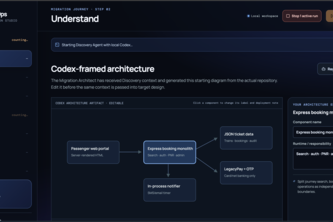
The description states that MigrationOps is a platform built as a React and TypeScript web application with a local backend, using GPT-5.6 Terra to orchestrate Codex agents for migration workflows. It supports:
- Legacy app discovery
- Architecture visualization (with editable diagrams)
- Migration planning (including cost/performance comparisons)
- Execution of migration tasks
- Verification of outcomes
The UI is described as a step-by-step command center, with live agent activity visibility, stop controls, and token consumption tracking.
It is built using technologies including:
- Frontend: React, TypeScript, CSS, Vite
- Backend: Node.js, Express.js, REST APIs
- AI/ML: OpenAI, Codex, GPT-5.6 Terra
Inference: The product appears to be a proof-of-concept or hackathon prototype, not a production-ready SaaS offering.
Positioning & Claim Evolution
The author states that MigrationOps was inspired by the frustration of legacy modernization being treated as a collection of disconnected documents and spreadsheets, and aims to provide a guided, transparent journey from discovery to verification.
It positions itself as:
- A platform for cloud migration workflows
- Using AI agents (Codex-powered)
- With live visibility into agent actions
- Supporting editable decisions and approval points
The platform is described as “codex-powered”, suggesting it uses AI-generated code or guidance to support migration.
Inference: The positioning is early-stage, conceptual, focused on solving a problem in legacy modernization through AI orchestration. It does not yet appear to have evolved into a commercial product or service offering.
Target Customer & ICP
The description states that MigrationOps is intended for teams working with legacy applications looking to migrate them to the cloud.
It references a legacy Indian railway ticket-booking application as an example, suggesting it targets:
- Organizations with legacy systems
- Teams needing cloud migration guidance
- Users who want transparency and control over migration decisions
There is no evidence of:
- Specific customer segments
- Named customers or use cases beyond the hackathon demo
- Target industries or company sizes
Inference: The ICP appears to be enterprise teams working on legacy modernization, but there is no evidence of market validation or customer feedback.
Business Model & Pricing Evidence
The description does not state:
- Any pricing model
- Revenue streams
- Subscription tiers
- Licensing or usage fees
It only describes the platform as a self-contained web application with local backend orchestration and Codex-powered agents.
Inference: No business model is evident from the description. The project appears to be a conceptual prototype, not a monetized product.
Technical & Delivery Signals
The author states that:
- The platform is built using React, TypeScript, Node.js, Express.js
- It uses GPT-5.6 Terra for orchestration
- It includes editable diagrams, approval points, and live agent visibility
- It supports step-by-step workflows with token consumption tracking
It also mentions that the UI was redesigned to be responsive and easy to follow, and that it uses specialized migration-agent definitions and skills for each stage.
Inference: The technical stack is modern and well-suited for a web-based AI tool, but there is no evidence of:
- Production deployment
- Scalability or performance data
- Real-world integration with cloud platforms
Traction & Maturity Signals
The project was submitted to the OpenAI 2026 hackathon on Devpost.
There is no evidence of revenue, customers, or adoption beyond this submission. The author states that it’s a hackathon project, not a product in production.
Inference: The platform is at a very early stage — likely a prototype or proof-of-concept. No traction or maturity signals are evident.
Competitive Context
The description does not mention:
- Competitors
- Existing tools in the legacy modernization or cloud migration space
- Market positioning relative to other platforms
It is unclear whether MigrationOps is intended to replace or complement existing tools like AWS Migration Services, Azure Migrate, or similar.
Inference: No competitive context is provided. The project does not appear to be part of an existing market or ecosystem.
Open Questions & Risks
- Solo team: Only one member (Pavithran KB) is listed.
- Hackathon prototype: No evidence of production use, traction, or commercial viability.
- No pricing or monetization model: No indication of how the platform would be sold or funded.
- Unverified claims: All descriptions are self-reported and unverified.
- AI agent complexity: The use of GPT-5.6 Terra agents is described but not validated for real-world utility or scalability.
Inference: The project is highly speculative, with no evidence of commercial viability, traction, or market fit.
Questions the description leaves open
- What specific legacy systems are you targeting, and how do you plan to validate your solution with real users?
- How does the platform handle edge cases in migration workflows (e.g., data integrity, downtime)?
- Are there any existing partnerships or pilot customers for this tool?
- What is the roadmap for monetization, if any?
- How do you plan to scale beyond a single-person hackathon project?
Overall Assessment
Not evidenced.
The description provides no evidence of:
- Revenue
- Customers
- Product-market fit
- Commercial traction
- Team experience or track record
This is a self-reported, unverified prototype, likely built for a hackathon. It does not yet demonstrate any commercial viability or investment-ready potential.
Inference: The project is not ready for investment or partnership at this stage. It may be an early-stage idea or proof-of-concept with no demonstrated traction or business model.
User Stories BotA demo video on every pull request
Get a demo video on every new feature
GitHub App that watches your pull requests and records a narrated, captioned demo.
Save time on demo prep and make informed decisions faster with a video walkthrough of every new feature.
Source
Submitted to the OpenAI 2026 hackathon on Devpost. Project home on Devpost. Back to the full gallery on Devpost.
This competitive analysis was produced by top-founders.com (opens in a new tab)
Generated by a language model from this project's public Devpost page — its tagline, the author's own write-up and any built-with tags listed there — as captured in August 2026. Short quotations are the author's words. It is an opinion on the idea as a business, not on the people behind it, and it reflects the description as published then. If the project has moved on, request a correction below. The analysis is not independent research and contains no verified traction, revenue or customer data.
An independent guide by KFG International LLC — not affiliated with, endorsed by, or connected to Devpost or OpenAI.