

Archive position — measured, not model output
1 like on Devpost
505 of the 7,850 archived projects have more likes, and 1,758 share exactly 1 — so this project's #1,466 place in the like-ranked listing is a tie-break inside that group, not a ranking.
Projects (log scale)
Likes on Devpost. ▲ marks this project's group.
Show the figures
| Likes | Projects | Share of archive |
|---|---|---|
| 0 | 5,587 | 71.2% |
| 1 | 1,758 | 22.4% |
| 2 | 284 | 3.6% |
| 3–4 | 132 | 1.7% |
| 5–9 | 75 | 1.0% |
| 10+ | 14 | 0.2% |
 User Stories BotA demo video on every pull request
Get a demo video on every new feature
GitHub App that watches your pull requests and records a narrated, captioned demo.
Save time on demo prep and make informed decisions faster with a video walkthrough of every new feature.
Executive Summary
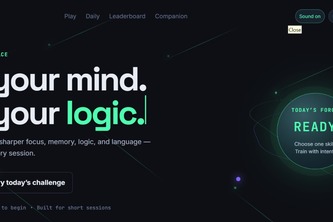
The company appears to be a solo developer project named MindForge, an AI-powered cognitive training platform built as a hackathon submission. The description states it features adaptive games, voice interaction, and practical coaching to strengthen focus, memory, logic, and language. It is described as a "calm, motivating mental gym" where users can train without creating an account.
The author reports building the product with Next.js, React, TypeScript, Tailwind CSS, and OpenAI APIs, deploying on Vercel. The platform includes local storage for progress, voice controls, and AI companions. It is positioned as a sustainable daily practice tool that avoids repetition or clinical feel.
What changed
This is a self-reported hackathon project with no evidence of prior development, funding, or traction. It represents an early-stage idea from one individual developer.
The single most important open question
Is there any evidence of user adoption, revenue, or customer feedback beyond the author's own description?
What The Product Actually Is
- The description states that MindForge is an AI-powered cognitive training platform.
- It includes eight short games, such as:
- Colors Challenge (attention and focus)
- Memory Match (visual working memory)
- Number Guessing and Chess (logic)
- Liar's Duel and Voice Spelling Chat (language)
- Shuttle Table (visual sequencing)
- Reverse Count (concentration and mental calculation)
- The platform offers:
- AI Companion for cognitive-wellness conversations
- AI session feedback with practical training recommendations
- Daily Forge challenges, streaks, achievements, sound controls, calm-motion settings, and shareable challenges
- Wellness-aware reminders encouraging short breaks
- It supports touch, keyboard, or voice controls, with fallbacks for accessibility.
- Progress is saved locally in the browser without requiring an account.
- Built using:
- Next.js 14
- TypeScript
- React
- Tailwind CSS
- OpenAI APIs
- Web Speech API
- Deployed on Vercel
This is a self-reported, unverified account of the product. No independent verification or evidence of actual use exists.
Positioning & Claim Evolution
- The author states that MindForge began with the question: “what if cognitive training felt less like a test and more like a sustainable daily practice?”
- It positions itself as:
- A calm, motivating mental gym
- Where users can begin immediately
- Choose their own pace
- Feel challenged without being overwhelmed
- The platform is described as aiming to avoid repetition, clinical feel, and disconnection from real life.
- It is framed as a tool for improving:
- Focus
- Memory
- Logic
- Language
These are claims about intent and positioning, not proof of traction or adoption.
Target Customer & ICP
- The description does not name specific customer segments or personas.
- It implies the platform targets individuals who:
- Want to improve focus, memory, logic, and language
- Prefer a sustainable daily practice
- Value calm, motivating environments
- Are open to using voice interaction but also support for touch/keyboard controls
No evidence of defined target customers or ICP beyond general user motivations.
Business Model & Pricing Evidence
- The description does not mention any pricing model or monetization strategy.
- It states that guest progress and preferences are saved locally in the browser, so no account creation is required.
- Future features include:
- Optional Google/email/password accounts
- Cross-device progress syncing
- Friend challenges
- Multiplayer rooms
- Account-based leaderboards
No evidence of a business model or pricing structure. The current version appears free to use with no paid tiers.
Technical & Delivery Signals
- Built using:
- Next.js 14
- TypeScript
- React
- Tailwind CSS
- OpenAI APIs
- Web Speech API
- Deployed on Vercel
- Uses local browser storage for guest progress
- Supports voice input/output, with fallbacks
- Mobile-first design with adaptive game setup screens and animated neural background
- Games are designed to be compact on mobile devices
These are technical details reported by the author. No evidence of scalability, performance metrics, or production-grade infrastructure.
Traction & Maturity Signals
- The project is described as a hackathon submission (OpenAI 2026 hackathon).
- It was built by one developer: Yves Alain Izere.
- No mention of:
- Users
- Customers
- Revenue
- Downloads
- Engagement metrics
- Product usage data
Not evidenced. This is a solo-developer prototype with no traction.
Competitive Context
- The description does not reference competitors or market positioning.
- It implies that existing brain-training tools are:
- Repetitive
- Clinical
- Disconnected from real life
No evidence of competitive landscape, market analysis, or differentiation from other platforms.
Open Questions & Risks
- Solo developer project: No team, no funding, no external validation.
- No revenue or user data: The platform is described as a prototype with no evidence of adoption or monetization.
- Unproven AI integration: While AI is used for companion and feedback, the description does not show how it adds value beyond basic prompts.
- Limited scope: Only eight games are mentioned; no roadmap or feature expansion beyond the hackathon version.
- No security or privacy disclosures: The use of local storage and OpenAI APIs raises questions about data handling that are not addressed.
These are inferred risks from the lack of evidence, not confirmed facts.
Questions the description leaves open
- What is your definition of "sustainable daily practice" in this context?
- How do you plan to monetize or scale this platform beyond a hackathon prototype?
- Have you tested voice interaction with real users? What were the results?
- Is there any user feedback or data on engagement or retention?
- What are your plans for expanding beyond the current set of games?
- Do you have any experience in cognitive training, mental wellness, or education?
- How do you plan to handle data privacy and compliance with local regulations?
Overall Assessment
- This is a self-reported hackathon project by one developer.
- No evidence of:
- Revenue
- Customers
- Traction
- Product-market fit
- Business model
- Team or funding
Not evidenced. The description is a self-reporting account of an early-stage idea, not a product with commercial viability or traction.
User Stories BotA demo video on every pull request
Get a demo video on every new feature
GitHub App that watches your pull requests and records a narrated, captioned demo.
Save time on demo prep and make informed decisions faster with a video walkthrough of every new feature.
Source
Submitted to the OpenAI 2026 hackathon on Devpost. Project home on Devpost. Back to the full gallery on Devpost.
This competitive analysis was produced by top-founders.com (opens in a new tab)
Generated by a language model from this project's public Devpost page — its tagline, the author's own write-up and any built-with tags listed there — as captured in August 2026. Short quotations are the author's words. It is an opinion on the idea as a business, not on the people behind it, and it reflects the description as published then. If the project has moved on, request a correction below. The analysis is not independent research and contains no verified traction, revenue or customer data.
An independent guide by KFG International LLC — not affiliated with, endorsed by, or connected to Devpost or OpenAI.