

Archive position — measured, not model output
0 likes on Devpost
2,263 of the 7,850 archived projects have more likes, and 5,587 share exactly 0 — so this project's #5,388 place in the like-ranked listing is a tie-break inside that group, not a ranking.
Projects (log scale)
Likes on Devpost. ▲ marks this project's group.
Show the figures
| Likes | Projects | Share of archive |
|---|---|---|
| 0 | 5,587 | 71.2% |
| 1 | 1,758 | 22.4% |
| 2 | 284 | 3.6% |
| 3–4 | 132 | 1.7% |
| 5–9 | 75 | 1.0% |
| 10+ | 14 | 0.2% |
 User Stories BotA demo video on every pull request
Get a demo video on every new feature
GitHub App that watches your pull requests and records a narrated, captioned demo.
Save time on demo prep and make informed decisions faster with a video walkthrough of every new feature.
Executive Summary
What the company appears to be
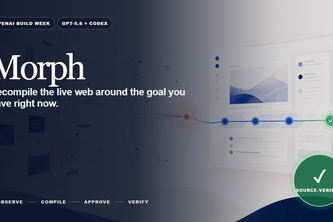
Morph is a self-reported Chrome extension that uses an AI model (GPT-5.6) to observe live web pages, compile task-specific interfaces, and execute actions on original sites while maintaining strict separation between generated content and source truth. It claims to operate within a "trusted control plane" where user actions are verified before execution.
What changed
The project description is a self-reported submission for the OpenAI 2026 hackathon. There is no evidence of prior development, funding, or commercial traction beyond this prototype demonstration.
Single most important open question
Is there any evidence that Morph has moved beyond a single prototype or demo, and whether it has been tested in real-world usage scenarios outside of the hackathon environment?
What The Product Actually Is
The description states that Morph is a Chrome extension built with Manifest V3, using TypeScript and Node.js. It operates as an AI accessibility compiler that:
- Observes semantic structure of web pages
- Compiles task-relevant experiences using GPT-5.6
- Executes actions on the original site only after user confirmation and verification
- Keeps generated presentation separate from source truth
- Uses a trusted runtime to manage observation, validation, and execution
It is described as a "bounded working prototype", not a production-ready product.
The description states: "Morph is a TypeScript Manifest V3 extension using explicit activeTab admission."
The description states: "The model has no browser tools or action authority. An accepted ExperienceSpec cannot contain JavaScript, selectors, URLs, browser commands, credentials, forms, or executable instructions."
Positioning & Claim Evolution
The author positions Morph as an alternative to:
- Chat assistants, which answer beside the page without changing it
- Browser agents, which can act on pages but lack transparency and control
Morph claims to offer a third model: one that generates better experiences from the live web while keeping source truth, user authority, and verified actions separate from model generation.
It starts with accessibility as its first proof cohort, but positions itself more broadly as a tool for anyone needing the current web to become a better interface for their task.
The description states: "We wanted a third model: Generate a better experience from the live web while keeping source truth, user authority, and verified actions separate from model generation."
The description states: "Accessibility was our first proof cohort because interface mismatch is especially costly there, but Morph is designed for anyone who needs the current web to become a better interface for the task in front of them."
Target Customer & ICP
The author does not name specific customers or personas. However, it is implied that:
- The initial use case is people with accessibility needs
- The broader target is anyone needing adaptive interfaces on the web
- The tool is designed for users who want to interact with live websites in a safer, more controlled way
The description states: "Accessibility was our first proof cohort because interface mismatch is especially costly there."
The description states: "Morph is designed for anyone who needs the current web to become a better interface for the task in front of them."
Business Model & Pricing Evidence
There is no evidence of pricing, monetization or business model. The project is described as a prototype submitted to a hackathon.
The description states: "Morph is a bounded working prototype, not a universal-site, release-readiness, multi-browser, or WCAG/ADA compliance claim."
Technical & Delivery Signals
The system uses:
- GPT-5.6 as the core AI model
- Manifest V3 Chrome extension
- Node.js runtime for trusted control plane
- Playwright, React, TypeScript, and OpenAI API integrations
- A sandboxed rendering environment to isolate generated content
It includes:
- Schema validation
- Sanitization of HTML/CSS
- Re-observation and verification
- Machine-readable receipts
The description states: "The final real-provider submission proof is deliberately narrower: three isolated executions of the public-search task hero."
The description states: "Generated reading HTML and CSS are treated as untrusted presentation data. They are schema-validated, sanitized, and rendered inside an opaque, networkless sandbox without forms, scripts, navigation, popups, downloads, or same-origin access."
Traction & Maturity Signals
There is no evidence of traction, customers, revenue, or adoption beyond the hackathon submission.
The project is described as a prototype, with:
- 132 unit tests
- 16 architectural boundary tests
- 10 browser E2E tests
- A five-case metamorphic corpus
- Zero violations of selector/domain hardcoding
The description states: "Morph is a bounded working prototype, not a universal-site, release-readiness, multi-browser, or WCAG/ADA compliance claim."
The description states: "The final real-provider submission proof covers one public Wikipedia task journey."
Competitive Context
No direct competitors are named. However, the positioning implies it competes with:
- Chat assistants (e.g., ChatGPT, Claude)
- Browser automation tools (e.g., Puppeteer, Playwright, browser agents)
- Accessibility tools (e.g., screen readers, assistive interfaces)
It differentiates itself by emphasizing user control, source verification, and separation of generated content from live site actions.
The description states: "Chat assistants usually answer beside the page without changing the experience. Browser agents can act on the page, but their authority and success can be difficult to inspect."
Open Questions & Risks
- Prototype-only status: No evidence of production use or real-world adoption
- Single developer team: Only one member (EE H) is mentioned
- Limited scope: The demo only covers one Wikipedia task journey
- No commercialization path: No pricing, monetization, or distribution strategy described
- High technical risk: Relies on GPT-5.6 and complex runtime verification
- No third-party validation: All evidence is self-reported
The description states: "Morph fails closed when a control is missing, ambiguous, stale, unsupported, or unverifiable."
The description states: "The final real-provider submission proof covers one public Wikipedia task journey. Other experience families have deterministic evidence but are not represented as additional real-provider submission claims."
Questions the description leaves open
- What is the current status of Morph beyond this prototype? Is it being tested or used in any real-world scenarios?
- How does Morph handle edge cases like CAPTCHA, DRM, or cross-origin frames?
- Are there plans to expand beyond Chrome or support other browsers?
- What are the technical limitations that prevent full-scale deployment?
- Has the team considered scalability of the runtime and model execution?
- Is there any plan for monetization or commercial distribution?
Overall Assessment
Not evidenced.
There is no evidence of revenue, customers, traction, or a clear path to market. The project is described as a single-prototype hackathon submission, with no indication of prior development, funding, or commercial viability.
The description states: "Everything above is the authors' own account. It is not independently verified, and no revenue, customer or traction data is available beyond what they state."
This is a preliminary technical demonstration with no commercial due-diligence signals. Any investment or partnership decision would require further evidence of traction, scalability, and business model viability.
User Stories BotA demo video on every pull request
Get a demo video on every new feature
GitHub App that watches your pull requests and records a narrated, captioned demo.
Save time on demo prep and make informed decisions faster with a video walkthrough of every new feature.
Source
Submitted to the OpenAI 2026 hackathon on Devpost. Project home on Devpost. Back to the full gallery on Devpost.
This competitive analysis was produced by top-founders.com (opens in a new tab)
Generated by a language model from this project's public Devpost page — its tagline, the author's own write-up and any built-with tags listed there — as captured in August 2026. Short quotations are the author's words. It is an opinion on the idea as a business, not on the people behind it, and it reflects the description as published then. If the project has moved on, request a correction below. The analysis is not independent research and contains no verified traction, revenue or customer data.
An independent guide by KFG International LLC — not affiliated with, endorsed by, or connected to Devpost or OpenAI.