

Archive position — measured, not model output
0 likes on Devpost
2,263 of the 7,850 archived projects have more likes, and 5,587 share exactly 0 — so this project's #7,347 place in the like-ranked listing is a tie-break inside that group, not a ranking.
Projects (log scale)
Likes on Devpost. ▲ marks this project's group.
Show the figures
| Likes | Projects | Share of archive |
|---|---|---|
| 0 | 5,587 | 71.2% |
| 1 | 1,758 | 22.4% |
| 2 | 284 | 3.6% |
| 3–4 | 132 | 1.7% |
| 5–9 | 75 | 1.0% |
| 10+ | 14 | 0.2% |
 User Stories BotA demo video on every pull request
Get a demo video on every new feature
GitHub App that watches your pull requests and records a narrated, captioned demo.
Save time on demo prep and make informed decisions faster with a video walkthrough of every new feature.
Executive Summary
What the company appears to be
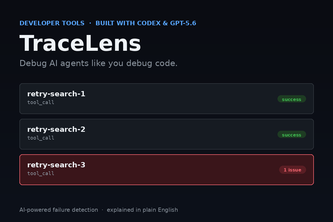
TraceLens — AI Agent Debugger is a self-reported observability and debugging tool for AI agent workflows. The author states it captures every step of an agent run, flags failures (loops, bad tool calls, timeouts), and uses GPT-5.6 to explain what went wrong.
What changed
The project was built in under two days using OpenAI Codex, with a focus on rapid prototyping and end-to-end functionality. It includes ingestion of trace events, failure detection logic, AI-powered explanations, and a browser-based replay UI.
Single most important open question
Is there any evidence that this tool has been adopted or used beyond the hackathon context? The description states no revenue, customers, or traction data are available — only self-reported claims about functionality and architecture.
Note
This analysis is based entirely on the author’s own description. No external verification, archived data, or third-party sources were provided. All findings reflect what was stated by the author and not independently confirmed.
What The Product Actually Is
The description states that TraceLens is an observability and debugging tool for AI agent workflows. It ingests every step of an agent run through a defined event schema (agent_id, step_id, step_type, input, output, status, latency, parent_step_id). It automatically detects three failure patterns: retry loops, tool-call errors, and silent timeouts.
It explains failures in plain English using an LLM, grounded strictly in trace data. The system replays runs visually in a browser-based timeline with flagged steps expandable to show explanations and suggested actions.
The tool ships with three demo scenarios including one distinct from typical research-agent examples to prove detection logic generalizes.
Inference Based on the author's description, TraceLens appears to be a lightweight debugging layer for AI agents that provides structured logging, failure detection, and explanation capabilities. It is not described as a full-fledged platform or SaaS offering but rather a prototype built for demonstration purposes.
Positioning & Claim Evolution
The author positions TraceLens as a tool that allows developers to debug AI agents like they debug code — emphasizing clarity, visual replay, and automated failure analysis.
Key claims:
- “Debug AI agents like you debug code.”
- “Captures every step of an agent run”
- “Flags failures (loops, bad tool calls, timeouts)”
- “Uses GPT-5.6 to explain what went wrong”
- “Replays the run visually in a browser-based timeline”
The project evolved from a personal need — the author says he kept running into problems with logs alone not telling the full story when AI agents fail.
Claim vs Fact
These are self-reported claims about intent, functionality, and design choices. There is no evidence of prior usage, customer feedback, or market validation beyond the hackathon submission.
Target Customer & ICP
The author does not explicitly define a target customer or ideal customer profile (ICP). However, based on the description, it seems aimed at developers building AI agents — particularly those working with frameworks like LangGraph or CrewAI who may struggle with agent failures and lack of visibility into execution paths.
Inference The likely ICP includes developers or engineering teams building agentic systems in enterprise or startup environments where debugging complex workflows is a challenge. But no explicit segmentation, persona, or use case data is provided.
Business Model & Pricing Evidence
No business model or pricing information is stated in the description. The tool is described as being deployed live on Render with demo data seeding, but there’s no indication of monetization strategy, subscription tiers, or licensing models.
Not evidenced No evidence of any revenue streams, pricing plans, or commercial arrangements.
Technical & Delivery Signals
The system was built using:
- OpenAI Codex (GPT-5.6)
- FastAPI
- Python
- SQLAlchemy/SQLite
- HTML/CSS/JS for UI
- Groq for LLM inference
- Pydantic for schema validation
- Render for deployment
Key technical features include:
- Event schema-based ingestion
- Three failure detectors (retry loop, tool-call error, timeout)
- Provider-agnostic explainer interface with fallback rule-based logic
- Browser-based timeline UI without build steps
- Resilient architecture design
Inference The delivery approach suggests a rapid development cycle using AI-assisted coding tools. The architecture shows deliberate attention to modularity and resilience, which may indicate scalability thinking even in prototype form.
Traction & Maturity Signals
There is no evidence of traction or adoption beyond the hackathon submission. The author notes that:
- It was built in under two days
- It includes demo scenarios
- It has a live deployment on Render with auto-seeded data
- All claims were manually verified by the author
Absence of evidence
No customer base, usage metrics, or product-market fit indicators are reported.
Competitive Context
The description does not mention any direct competitors. However, it implies a space around AI agent observability and debugging — an emerging area where tools like LangSmith, LlamaIndex, or custom logging solutions might exist.
Inference The tool fits into a broader category of AI agent monitoring/debugging platforms, but no competitive landscape is described.
Open Questions & Risks
- Unproven market demand: No evidence of real-world usage or customer interest beyond the author’s own testing.
- Prototype nature: Built in a hackathon setting; lacks production-grade features like persistent storage (PostgreSQL), streaming ingestion, or framework integrations.
- Dependency on AI providers: Relies heavily on LLMs (GPT-5.6, Groq) and may be brittle if those services change or become unavailable.
- Limited scalability assumptions: The current architecture uses SQLite; no mention of scaling considerations beyond demo use cases.
Not evidenced No evidence of competitive positioning, pricing strategy, or long-term roadmap beyond stated future plans.
Questions the description leaves open
- What specific problems do you see in the current AI agent debugging landscape that TraceLens addresses?
- Have you tested TraceLens with real-world agents from actual users or clients?
- How would you scale this beyond the current demo setup (e.g., persistent storage, streaming ingestion)?
- What are your thoughts on integrating with popular frameworks like LangGraph or CrewAI?
- Are there any known limitations in how well the failure detectors generalize across different agent types?
- What is the plan for monetization or commercial viability?
Overall Assessment
This is a self-reported prototype built during a hackathon, not a commercial product with traction or revenue. The author describes a functional tool that demonstrates core ideas but offers no evidence of adoption, market validation, or business model.
Confidence level Low — based on thin evidence and lack of external validation.
Assessment Not ready for investment or partnership consideration at this stage. This represents an early-stage idea with potential, but requires further development, testing, and proof of concept before any strategic move can be justified.
User Stories BotA demo video on every pull request
Get a demo video on every new feature
GitHub App that watches your pull requests and records a narrated, captioned demo.
Save time on demo prep and make informed decisions faster with a video walkthrough of every new feature.
Source
Submitted to the OpenAI 2026 hackathon on Devpost. Project home on Devpost. Back to the full gallery on Devpost.
This competitive analysis was produced by top-founders.com (opens in a new tab)
Generated by a language model from this project's public Devpost page — its tagline, the author's own write-up and any built-with tags listed there — as captured in August 2026. Short quotations are the author's words. It is an opinion on the idea as a business, not on the people behind it, and it reflects the description as published then. If the project has moved on, request a correction below. The analysis is not independent research and contains no verified traction, revenue or customer data.
An independent guide by KFG International LLC — not affiliated with, endorsed by, or connected to Devpost or OpenAI.