

Archive position — measured, not model output
0 likes on Devpost
2,263 of the 7,850 archived projects have more likes, and 5,587 share exactly 0 — so this project's #7,343 place in the like-ranked listing is a tie-break inside that group, not a ranking.
Projects (log scale)
Likes on Devpost. ▲ marks this project's group.
Show the figures
| Likes | Projects | Share of archive |
|---|---|---|
| 0 | 5,587 | 71.2% |
| 1 | 1,758 | 22.4% |
| 2 | 284 | 3.6% |
| 3–4 | 132 | 1.7% |
| 5–9 | 75 | 1.0% |
| 10+ | 14 | 0.2% |
 User Stories BotA demo video on every pull request
Get a demo video on every new feature
GitHub App that watches your pull requests and records a narrated, captioned demo.
Save time on demo prep and make informed decisions faster with a video walkthrough of every new feature.
Executive Summary
What the company appears to be
TraceForge is a self-reported tool for modernizing undocumented legacy workflows using AI-assisted experimentation and verification. It operates as an experimental system that observes behavior, generates hypotheses, challenges them with counterexamples, builds fixes in isolation, and verifies outcomes within a controlled boundary.
What changed
The project description indicates this is a hackathon submission (OpenAI 2026) with no evidence of prior development or commercial traction. It represents an early-stage proof-of-concept built around AI-assisted workflow modernization using GPT-5.6 Sol, Codex, and structured experimentation.
Single most important open question
Is there any evidence that this system has been used in production or scaled beyond a single developer's prototype?
Note
This analysis is based entirely on the self-reported description provided by the author. No independent verification, revenue data, customer information, or traction metrics are available. All claims are stated by the author and not independently confirmed.
What The Product Actually Is
The description states that TraceForge:
- Runs one bounded legacy workflow through five server-owned stages: Observe, Infer, Challenge, Build, and Verify.
- Uses GPT-5.6 Sol for read-only archaeology turns (Trace Archaeologist, Counterexample Hunter, Contract Critic).
- Employs OpenAI Codex SDK to edit a single workflow file in an isolated detached Git worktree.
- Maintains strict separation between the AI writer and the host verifier.
- Operates with deterministic assertions comparing decision, return status, refund amount, sellable inventory, quarantine inventory, and failure atomicity.
- Uses SHA-256 digests for provenance tracking across model inputs/outputs, repair inputs, candidate source and diff, commands, artifacts, evidence, scenario sets, and proof bodies.
Inference The system appears to be a structured experimentation framework designed to modernize legacy workflows by generating and testing behavioral contracts. It is not a general-purpose AI tool but a specific architecture for controlled workflow migration.
Positioning & Claim Evolution
The author states:
- "Modernize undocumented workflows without guessing."
- Focuses on proving correctness rather than just generating interfaces.
- Positions itself as a tool that treats migration as an experiment, exposing uncertainty and choosing the next counterexample.
- Claims to avoid silent invention of unsupported behavior by enforcing a narrow evidence boundary.
Inference The positioning evolved from a general AI-assisted workflow modernization tool toward a more precise, controlled, and verifiable approach. It emphasizes trustworthiness over speed or ease-of-use.
Target Customer & ICP
The description does not explicitly name target customers or personas. However, it implies:
- Developers working with legacy systems where behavior is undocumented.
- Teams seeking to migrate workflows while maintaining correctness guarantees.
- Organizations that value reproducible and auditable software transformations.
Inference The likely ICP includes internal engineering teams or DevOps engineers dealing with complex, undocumented business logic in legacy applications. No evidence of external customers or use cases beyond the demo scenario.
Business Model & Pricing Evidence
The description does not contain any information about:
- Revenue streams
- Pricing models
- Monetization strategy
- Customer acquisition plans
Not evidenced
Technical & Delivery Signals
The author reports:
- Built with: express.js, git-worktrees, gpt-5.6-sol, json-schema, node.js, openai-codex-sdk, playwright, pnpm, react, server-sent-events, sha-256, sqlite, typescript, vite, vitest
- Uses a detached Git worktree for code editing
- Host executes all scenarios and validates evidence IDs
- Enforces policy through one-file allowlists preventing edits to verifier or deployment
- Implements deterministic assertions across multiple fields
- Tracks provenance via SHA-256 digests
Inference The system shows technical sophistication in enforcing separation of powers, ensuring reproducibility, and managing AI-generated code safely. It reflects a strong understanding of software engineering principles around correctness and auditability.
Traction & Maturity Signals
The description states:
- This is a hackathon submission (OpenAI 2026)
- Built by one person (Duning Ouyang)
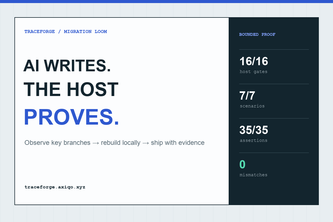
- Demonstrates a controlled workflow with 7/7 scenarios, 35/35 assertions, zero mismatches
- Includes live product and source code repositories
Not evidenced No evidence of revenue, customers, or adoption beyond the demo. No data on usage frequency, performance metrics, or long-term viability.
Competitive Context
The description does not mention:
- Competitors
- Market positioning relative to existing tools
- Prior art in workflow modernization or AI-assisted refactoring
Not evidenced
Open Questions & Risks
Key risks and open questions based on the self-reported account:
- Single developer team (no evidence of scaling beyond prototype)
- Limited scope: only one controlled Web returns workflow in a TypeScript process
- No evidence of production use or integration with enterprise systems
- Relies heavily on GPT-5.6 Sol and Codex, which may not be available for broader deployment
- No mention of security, scalability, or maintainability beyond the demo
- The system is explicitly designed to prevent self-grading; however, this also limits its ability to scale without human intervention
Inference The project lacks commercial viability indicators. It appears to be a proof-of-concept rather than a scalable product.
Questions the description leaves open
- What are the actual limitations of this system in terms of workflow complexity or data types it can handle?
- Has there been any testing beyond the demo scenario, and if so, what were the results?
- How would you scale this approach to support multiple workflows or teams?
- Are there plans to integrate with CI/CD pipelines or other operational tools?
- What is the long-term vision for monetization or commercialization?
- Can you provide evidence of how the system handles edge cases beyond those shown in the demo?
- How does this compare to existing tools in the workflow modernization space?
Overall Assessment
Based on the self-reported description:
- The project is a hackathon submission with no demonstrated traction or commercial viability.
- It shows technical depth and an innovative approach to workflow modernization.
- There is no evidence of revenue, customers, or scalability beyond a single developer's prototype.
- The system is highly experimental and not yet ready for production use.
Assessment Not suitable for investment or partnership at this stage. A follow-up evaluation would require evidence of real-world usage, customer feedback, or product development beyond the demo level.
User Stories BotA demo video on every pull request
Get a demo video on every new feature
GitHub App that watches your pull requests and records a narrated, captioned demo.
Save time on demo prep and make informed decisions faster with a video walkthrough of every new feature.
Source
Submitted to the OpenAI 2026 hackathon on Devpost. Project home on Devpost. Back to the full gallery on Devpost.
This competitive analysis was produced by top-founders.com (opens in a new tab)
Generated by a language model from this project's public Devpost page — its tagline, the author's own write-up and any built-with tags listed there — as captured in August 2026. Short quotations are the author's words. It is an opinion on the idea as a business, not on the people behind it, and it reflects the description as published then. If the project has moved on, request a correction below. The analysis is not independent research and contains no verified traction, revenue or customer data.
An independent guide by KFG International LLC — not affiliated with, endorsed by, or connected to Devpost or OpenAI.