

Archive position — measured, not model output
0 likes on Devpost
2,263 of the 7,850 archived projects have more likes, and 5,587 share exactly 0 — so this project's #3,419 place in the like-ranked listing is a tie-break inside that group, not a ranking.
Projects (log scale)
Likes on Devpost. ▲ marks this project's group.
Show the figures
| Likes | Projects | Share of archive |
|---|---|---|
| 0 | 5,587 | 71.2% |
| 1 | 1,758 | 22.4% |
| 2 | 284 | 3.6% |
| 3–4 | 132 | 1.7% |
| 5–9 | 75 | 1.0% |
| 10+ | 14 | 0.2% |
 User Stories BotA demo video on every pull request
Get a demo video on every new feature
GitHub App that watches your pull requests and records a narrated, captioned demo.
Save time on demo prep and make informed decisions faster with a video walkthrough of every new feature.
Executive Summary
What the company appears to be
CodexFlow Framework is a self-reported project that describes itself as a "Codex-focused project bootstrap framework for AI-assisted software development." The author states it aims to structure and organize AI-assisted coding workflows, reduce context loss, and improve token efficiency. It is presented as a documentation-first approach to managing AI-driven development tasks.
What changed
The description indicates this is a hackathon submission (OpenAI 2026) and the author has not yet demonstrated any product traction or commercial adoption. The framework is described as a conceptual or early-stage tool, with no evidence of revenue, customers, or market deployment.
Single most important open question
Is there evidence that CodexFlow Framework has been adopted by developers or teams beyond its creator, and does it have a viable path to product-market fit in the AI-assisted development space?
What The Product Actually Is
The description states:
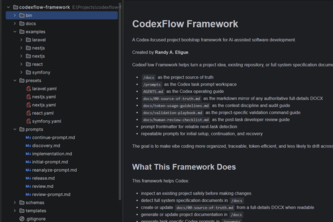
- CodexFlow Framework is a "Codex-focused project bootstrap framework" for AI-assisted software development.
- It organizes project documentation under
/docs, AI task workspaces under/prompts, and operating guides inAGENTS.md. - It generates task-specific prompts, tracks implementation progress, recommends next tasks, and helps recover context after interrupted sessions.
- It introduces prompt frontmatter, validation playbooks, human review checklists, and Context Usage Reports to make AI-assisted development more reliable and scalable.
- The framework includes reusable prompt templates, project scaffolding, documentation standards, validation guides, review workflows, and an optional lightweight Node.js CLI for initialization and validation.
Inference The product appears to be a developer tool aimed at structuring AI-assisted workflows, with a focus on reducing context loss and improving traceability in AI coding sessions. It is not a commercial SaaS offering but rather a framework or set of tools that could be used by developers or teams.
Positioning & Claim Evolution
The description states:
- The framework was built to solve "context loss" in AI-assisted development, where developers must repeatedly explain requirements and recover from interruptions.
- It positions itself as a structured, repeatable workflow that keeps AI coding organized, traceable, and token-efficient.
- It emphasizes documentation-first workflows, structured prompts, and task tracking to make AI-assisted development more reliable and scalable.
Inference The positioning is that CodexFlow Framework is a developer tool for improving the consistency and efficiency of AI-assisted software engineering. The author frames it as a solution to common pain points in AI coding, such as context drift and lack of traceability.
Target Customer & ICP
The description states:
- The framework is aimed at developers or teams working with AI coding assistants.
- It targets those who want to reduce context loss and improve token efficiency during AI-assisted development.
Inference The target customer appears to be individual developers or small engineering teams using AI coding tools, particularly those working in environments where context management and traceability are important. No specific industry or use case is mentioned beyond general AI-assisted software development.
Business Model & Pricing Evidence
The description states:
- There is no mention of pricing, licensing, or monetization strategy.
- The framework is described as a set of tools and templates, not a commercial product.
- It includes an optional Node.js CLI for project initialization and validation but does not describe how it would be sold or distributed.
Inference No evidence of a business model or pricing structure is provided. The framework appears to be open-source or self-hosted, with no indication of revenue generation or commercialization plans.
Technical & Delivery Signals
The description states:
- The framework is built around a documentation-first workflow.
- It uses structured documentation that AI can reference across sessions.
- It includes reusable prompt templates, project scaffolding, documentation standards, validation guides, and review workflows.
- It has an optional lightweight Node.js CLI for initialization and validation.
Inference The technical approach is based on structured documentation and prompt engineering, with a focus on minimizing context drift and improving scalability. The use of a CLI suggests a developer-oriented delivery mechanism.
Traction & Maturity Signals
The description states:
- This is a hackathon submission (OpenAI 2026).
- The team size is listed as one person (Randy Eligue).
- No evidence of revenue, customers, or adoption beyond the author's own account.
- There is no mention of product usage, user feedback, or market traction.
Inference There are no signs of traction or maturity. The project is in an early stage and has not yet been adopted by users or teams beyond its creator.
Competitive Context
The description states:
- No direct competitors are named.
- The framework addresses challenges common to AI-assisted development, such as context loss and token efficiency.
- It is positioned as a tool for structuring workflows in AI coding environments.
Inference The competitive landscape includes other tools or frameworks that aim to improve AI-assisted development workflows, but no specific names or products are mentioned. The framework appears to be a new or emerging concept within this space.
Open Questions & Risks
- Lack of traction or adoption: No evidence of users, customers, or market validation.
- Single-person team: Limited resources for product development and scaling.
- No commercialization strategy: No pricing, licensing, or monetization model is described.
- Early-stage concept: The framework is presented as a hackathon submission with no production-ready features.
- Unverified claims: All statements are self-reported and unverified.
Questions the description leaves open
- Has the framework been tested or used by other developers beyond yourself?
- What specific problems in AI-assisted development does it solve, and how do you validate that it works?
- Are there any plans to monetize or commercialize this framework?
- How does CodexFlow Framework integrate with existing AI coding tools (e.g., ChatGPT, GitHub Copilot)?
- What is the roadmap for expanding beyond the current scope?
Overall Assessment
The description states:
- The project is a hackathon submission and has no evidence of commercial traction or adoption.
Inference There is insufficient evidence to support an investment or partnership decision at this time. The framework is in an early conceptual stage, with no demonstrated product-market fit, revenue, or user base. It may be a promising idea for future development but lacks the signals needed for due-diligence evaluation.
User Stories BotA demo video on every pull request
Get a demo video on every new feature
GitHub App that watches your pull requests and records a narrated, captioned demo.
Save time on demo prep and make informed decisions faster with a video walkthrough of every new feature.
Source
Submitted to the OpenAI 2026 hackathon on Devpost. Project home on Devpost. Back to the full gallery on Devpost.
This competitive analysis was produced by top-founders.com (opens in a new tab)
Generated by a language model from this project's public Devpost page — its tagline, the author's own write-up and any built-with tags listed there — as captured in August 2026. Short quotations are the author's words. It is an opinion on the idea as a business, not on the people behind it, and it reflects the description as published then. If the project has moved on, request a correction below. The analysis is not independent research and contains no verified traction, revenue or customer data.
An independent guide by KFG International LLC — not affiliated with, endorsed by, or connected to Devpost or OpenAI.