

Archive position — measured, not model output
0 likes on Devpost
2,263 of the 7,850 archived projects have more likes, and 5,587 share exactly 0 — so this project's #7,345 place in the like-ranked listing is a tie-break inside that group, not a ranking.
Projects (log scale)
Likes on Devpost. ▲ marks this project's group.
Show the figures
| Likes | Projects | Share of archive |
|---|---|---|
| 0 | 5,587 | 71.2% |
| 1 | 1,758 | 22.4% |
| 2 | 284 | 3.6% |
| 3–4 | 132 | 1.7% |
| 5–9 | 75 | 1.0% |
| 10+ | 14 | 0.2% |
 User Stories BotA demo video on every pull request
Get a demo video on every new feature
GitHub App that watches your pull requests and records a narrated, captioned demo.
Save time on demo prep and make informed decisions faster with a video walkthrough of every new feature.
Executive Summary
What the company appears to be
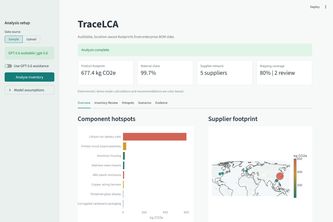
TraceLCA is a Python-based application built with Streamlit that processes enterprise Bill of Materials (BOM), supplier, and emissions-factor CSVs to calculate material and inbound transport emissions. It maps component descriptions to bounded factor IDs, validates inputs, and exposes audit trails, hotspots, and scenario comparisons. The tool supports deterministic calculations with optional GPT-5.6 assistance for semantic matching and recommendations.
What changed
The project was submitted as a hackathon entry (Devpost) and is described as a no-key demo path that runs fully in deterministic mode. It includes validation of input files, structured AI integration, and downloadable audit records. No evidence of commercial traction or revenue exists beyond the author's self-report.
Single most important open question
Is there any evidence of real-world adoption or usage by sustainability teams, or has this remained a prototype?
What The Product Actually Is
The description states that TraceLCA is a Python and Streamlit application using pandas for data processing, RapidFuzz for deterministic matching, Plotly for charts, Pydantic for structured contracts, and the OpenAI Responses API for optional GPT-5.6 assistance.
It processes enterprise BOM, supplier, and emissions-factor CSVs to calculate material and inbound transport emissions.
The app runs fully in deterministic Demo Mode, with GPT-5.6 used only for unresolved semantic matches and evidence-grounded recommendations — not for changing the calculation engine.
Evidence
- Built using: Python, Streamlit, pandas, RapidFuzz, Plotly, Pydantic, OpenAI Responses API
- Input data types: BOM, supplier, emissions-factor CSVs
- Output features: component hotspots, supplier geography, review flags, audit records
- AI role: optional assistance for semantic matching and recommendations only
Inference The tool appears to be a data validation and calculation engine for carbon footprinting in product lifecycle analysis.
Positioning & Claim Evolution
The tagline states: “From enterprise BOMs to auditable, location-aware product carbon footprints.”
The author claims the hard part of sustainability work is not displaying a carbon number but preserving a defensible chain from each BOM row to its factor, location, transport assumption, uncertainty, and reduction opportunity.
They also state that TraceLCA validates inputs, maps enterprise descriptions to bounded factor IDs, and exposes component hotspots and audit trails.
Evidence
- Tagline: “From enterprise BOMs to auditable, location-aware product carbon footprints.”
- Claim: The hard part is not showing a number but preserving traceability.
- Functionality: Input validation, mapping, emissions calculation, audit trail exposure
Inference The positioning appears to be that of a tool for enterprise sustainability teams, focused on traceability and defensibility rather than just carbon reporting.
Target Customer & ICP
The description states that product sustainability teams often begin with fragmented supplier data, BOMs, and emissions factors using different vocabularies.
It implies the tool is aimed at enterprise users who are working on product lifecycle assessments and need to manage uncertainty and traceability in carbon footprinting.
Evidence
- Target: Product sustainability teams
- Use case: Enterprise BOMs, fragmented supplier data, emissions factors
Inference The ICP likely includes large enterprises with complex supply chains, especially those in manufacturing or product design sectors where sustainability compliance is a concern.
Business Model & Pricing Evidence
There is no evidence of pricing, monetization, or business model in the description. The tool is described as a demo-only application that runs fully in deterministic mode and includes optional GPT-5.6 assistance only with user opt-in.
Evidence
- No mention of pricing
- No mention of revenue streams
- Tool is described as a demo path with no key required
Inference The tool appears to be not yet commercialized, possibly intended for early-stage testing or hackathon use. It does not appear to have a monetization strategy at this time.
Technical & Delivery Signals
The project was built using Python, Streamlit, pandas, RapidFuzz, Plotly, Pydantic, and OpenAI Responses API.
It includes:
- Input validation for all three CSV types
- Deterministic calculations with optional GPT-5.6 assistance
- Structured outputs from AI with deterministic fallbacks
- Five working views: overview, review, hotspots, scenarios, evidence
- 87 passing automated tests and responsive browser QA
Evidence
- Built with: Python, Streamlit, pandas, RapidFuzz, Plotly, Pydantic, OpenAI API
- Features: validation, deterministic calculations, AI-assisted matching, audit trails
- Testing: 87 automated tests, responsive QA
Inference The technical stack and features suggest a well-structured prototype, possibly with testability and scalability in mind.
Traction & Maturity Signals
There is no evidence of traction or adoption beyond the author’s own description. The tool is described as a demo path, and no customer data, revenue, or usage metrics are provided.
Evidence
- No mention of customers
- No mention of revenue
- Tool is described as a demo with no key required
Inference The project remains in an early-stage prototype phase, likely not yet adopted by any enterprise users.
Competitive Context
There is no evidence of competitors or market positioning beyond the author’s own description. The tool does not appear to be part of an existing product ecosystem or platform.
Evidence
- No mention of competitors
- No indication of market presence
Inference The competitive context is unclear, but it likely operates in a niche space within sustainability software, possibly overlapping with lifecycle assessment (LCA) tools or carbon accounting platforms.
Open Questions & Risks
- No commercial traction: The tool is described as a demo-only prototype.
- AI dependency without clear governance: While AI is used only for semantic matching, the risk of misalignment in outputs remains.
- Limited team size: Only one member (Guangcan Su) is listed.
- Unverified claims: All statements are self-reported and unverified.
Evidence
- No revenue or customer data
- Only one developer
- Tool is a demo path
Inference The project lacks commercial viability or traction, and its long-term sustainability as a product is uncertain.
Questions the description leaves open
- What specific enterprise use cases have you tested this tool with?
- How do you plan to transition from a demo-only prototype to a scalable SaaS offering?
- Are there any early adopters or pilot users of the tool in real-world settings?
- What is your roadmap for integrating with existing LCA or carbon accounting platforms?
- How do you intend to manage uncertainty propagation and factor versioning in future versions?
Overall Assessment
The project is described as a hackathon submission and is not evidenced to have any commercial traction, revenue, or customer adoption.
It appears to be an early-stage prototype with strong technical execution but no clear path to monetization or market entry.
Evidence
- No revenue or customers
- No pricing or business model
- Tool is demo-only
Inference This project is not ready for investment or partnership, unless there are plans to commercialize it beyond the prototype stage. It may be a preliminary idea with potential, but lacks evidence of viability or traction.
User Stories BotA demo video on every pull request
Get a demo video on every new feature
GitHub App that watches your pull requests and records a narrated, captioned demo.
Save time on demo prep and make informed decisions faster with a video walkthrough of every new feature.
Source
Submitted to the OpenAI 2026 hackathon on Devpost. Project home on Devpost. Back to the full gallery on Devpost.
This competitive analysis was produced by top-founders.com (opens in a new tab)
Generated by a language model from this project's public Devpost page — its tagline, the author's own write-up and any built-with tags listed there — as captured in August 2026. Short quotations are the author's words. It is an opinion on the idea as a business, not on the people behind it, and it reflects the description as published then. If the project has moved on, request a correction below. The analysis is not independent research and contains no verified traction, revenue or customer data.
An independent guide by KFG International LLC — not affiliated with, endorsed by, or connected to Devpost or OpenAI.