

Archive position — measured, not model output
1 like on Devpost
505 of the 7,850 archived projects have more likes, and 1,758 share exactly 1 — so this project's #1,456 place in the like-ranked listing is a tie-break inside that group, not a ranking.
Projects (log scale)
Likes on Devpost. ▲ marks this project's group.
Show the figures
| Likes | Projects | Share of archive |
|---|---|---|
| 0 | 5,587 | 71.2% |
| 1 | 1,758 | 22.4% |
| 2 | 284 | 3.6% |
| 3–4 | 132 | 1.7% |
| 5–9 | 75 | 1.0% |
| 10+ | 14 | 0.2% |
 User Stories BotA demo video on every pull request
Get a demo video on every new feature
GitHub App that watches your pull requests and records a narrated, captioned demo.
Save time on demo prep and make informed decisions faster with a video walkthrough of every new feature.
Executive Summary
What the company appears to be
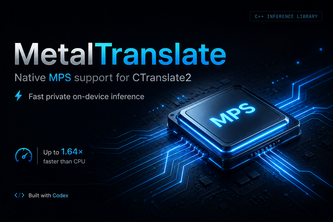
MetalTranslate: CTranslate2 Unleashed on Apple Silicon is a self-reported technical project that adds native Metal Performance Shaders (MPS) support to CTranslate2, an open-source C++ inference library for Transformer models. The author states it enables fast, private Apple Silicon inference with performance improvements up to 1.64× faster than CPU.
What changed
The author reports adding a new backend to CTranslate2 that leverages Apple's Metal framework and Metal Performance Shaders (MPS) for GPU acceleration on Apple Silicon devices. This change allows users of CTranslate2 to utilize the integrated GPU without rewriting their applications or switching frameworks.
Single most important open question — the commercial due-diligence read
Is there any evidence of adoption, traction, revenue, or customer usage beyond the author’s own development and testing? The description contains no information about real-world deployment, user base, or monetization strategy. It is a self-reported technical implementation with no commercial signals.
What The Product Actually Is
The description states that MetalTranslate adds native Apple Metal and Metal Performance Shaders support to CTranslate2. It works through the standard CTranslate2 API, enabling users to specify device="mps" for GPU acceleration. The backend supports FP32, FP16, BF16, and INT8 inference and includes operations required for Transformer models such as matrix multiplication, softmax, LayerNorm, RMSNorm, quantization, and decoding.
It is described as a real device backend integrated directly into the CTranslate2 runtime, not a Python wrapper around another framework. It supports asynchronous Metal execution, persistent command buffers, batched operations, transposed layouts, and unaligned tensor shapes.
Evidence
- The author states: “MetalTranslate adds native Apple Metal and Metal Performance Shaders support to CTranslate2.”
- “It works through the normal CTranslate2 API...”
- “This is not a Python wrapper around another framework. MPS is integrated directly into the CTranslate2 runtime as a real device backend.”
Inference The product is an open-source software extension that enhances performance for local AI inference on Apple Silicon devices.
Positioning & Claim Evolution
The author positions MetalTranslate as an enhancement to CTranslate2, enabling it to run efficiently on Apple Silicon hardware. The project is framed as solving a known limitation in CTranslate2 — lack of native MPS support — and improving inference speed on Macs with Apple Silicon chips.
Evidence
- “CTranslate2 is a fast and easy-to-use C++ inference library for Transformer models...”
- “The problem was that CTranslate2 supported optimized CPU inference and NVIDIA CUDA, but it had no native Apple Metal or MPS backend.”
- “MetalTranslate adds native Apple Metal and Metal Performance Shaders support to CTranslate2.”
Inference This is a developer tool aimed at improving performance for local AI workloads on macOS. It does not appear to be positioned as a commercial product or service.
Target Customer & ICP
The description implies that the target customer group includes developers working with CTranslate2, particularly those using local AI models on Apple Silicon Macs. The author mentions using it for “local translation and speech projects,” especially for low-resource languages like Pashto.
Evidence
- “I regularly use CTranslate2 for local translation and speech projects...”
- “The model used during development was a Roman Pashto translation model.”
- “Many transcription, translation, and local AI tools are built on top of CTranslate2.”
Inference The primary users are likely developers building or deploying local AI inference pipelines on Apple Silicon hardware. The use case is technical and niche — focused on performance optimization for specific language models.
Business Model & Pricing Evidence
Not evidenced.
There is no mention of pricing, licensing, monetization, or business model in the description. It is a self-reported open-source project with no indication of commercial intent or revenue generation.
Technical & Delivery Signals
The author reports that MetalTranslate supports FP32, FP16, BF16, and INT8 inference, and includes operations like matrix multiplication, softmax, LayerNorm, RMSNorm, quantization, decoding, and memory management. It uses C++, Objective-C++, Metal Performance Shaders, and custom kernels.
It also implements specialized paths for autoregressive decoding (e.g., FP16 GEMV), asynchronous execution with persistent command buffers, and reduced synchronization to improve performance.
Evidence
- “The backend supports FP32, FP16, BF16, and INT8 inference.”
- “It includes the main operations required for real Transformer inference...”
- “I implemented a specialized FP16 GEMV path for batch-size-one decoding...”
- “I replaced that with a persistent asynchronous Metal execution stream.”
Inference The project is technically sophisticated and tailored to performance on Apple Silicon. It shows deep understanding of GPU compute, memory management, and inference pipeline optimization.
Traction & Maturity Signals
Not evidenced.
There is no mention of user adoption, customer base, or deployment in production environments. The author reports benchmarking results but does not indicate any real-world usage beyond personal testing and development.
Evidence
- “On an Apple M1 MacBook Air with a 7-core GPU... MetalTranslate achieved the following result:”
- “The backend passed all 175 MPS tests, including FP32, FP16, BF16, INT8, quantization, dequantization, etc.”
Inference Performance improvements are demonstrated in controlled benchmarks. However, there is no evidence of real-world usage or market traction.
Competitive Context
The project enhances CTranslate2, which is used by projects like Faster Whisper and supports models such as Marian and Whisper. The author notes that other frameworks like PyTorch can use MPS but introduce Python overhead, whereas MetalTranslate integrates directly into the C++ runtime.
Evidence
- “CTranslate2 is also used by popular projects such as Faster Whisper.”
- “Other frameworks such as PyTorch could use MPS, but they introduce Python overhead...”
- “CTranslate2 supports models such as Marian and Whisper.”
Inference MetalTranslate improves upon existing tools in the local AI inference space by offering a more efficient backend for Apple Silicon. It competes with other open-source or framework-level solutions that enable GPU acceleration.
Open Questions & Risks
- No commercial traction or adoption: The project is self-reported and lacks evidence of real-world usage.
- Single-person development team: Only one developer (Talha Bin Omar) is mentioned, which may limit scalability or long-term maintenance.
- Open-source nature: No clear monetization strategy or IP protection mechanism.
- Limited scope for broader impact: The project focuses on Apple Silicon and CTranslate2 — not a general-purpose platform.
- Performance claims without independent verification: Benchmarking results are self-reported and unverified.
Questions the description leaves open
- What is the actual usage or adoption of this extension beyond personal development?
- Are there any plans to integrate with commercial AI tooling or platforms?
- How does this project align with or differ from existing open-source efforts in the same space?
- Is there a plan for broader hardware support (e.g., M2, M3, M4)?
- What are the long-term maintenance and scalability plans for the project?
Overall Assessment
Not evidenced.
There is no evidence of revenue, customers, or commercial traction to assess investment potential or partnership viability. The project is described as a technical enhancement to an open-source library with no indication of monetization or market demand beyond the author’s own use case.
Confidence level Low — based on self-reported description only, with no external validation or evidence of adoption or impact.
User Stories BotA demo video on every pull request
Get a demo video on every new feature
GitHub App that watches your pull requests and records a narrated, captioned demo.
Save time on demo prep and make informed decisions faster with a video walkthrough of every new feature.
Source
Submitted to the OpenAI 2026 hackathon on Devpost. Project home on Devpost. Back to the full gallery on Devpost.
This competitive analysis was produced by top-founders.com (opens in a new tab)
Generated by a language model from this project's public Devpost page — its tagline, the author's own write-up and any built-with tags listed there — as captured in August 2026. Short quotations are the author's words. It is an opinion on the idea as a business, not on the people behind it, and it reflects the description as published then. If the project has moved on, request a correction below. The analysis is not independent research and contains no verified traction, revenue or customer data.
An independent guide by KFG International LLC — not affiliated with, endorsed by, or connected to Devpost or OpenAI.