

Archive position — measured, not model output
0 likes on Devpost
2,263 of the 7,850 archived projects have more likes, and 5,587 share exactly 0 — so this project's #7,328 place in the like-ranked listing is a tie-break inside that group, not a ranking.
Projects (log scale)
Likes on Devpost. ▲ marks this project's group.
Show the figures
| Likes | Projects | Share of archive |
|---|---|---|
| 0 | 5,587 | 71.2% |
| 1 | 1,758 | 22.4% |
| 2 | 284 | 3.6% |
| 3–4 | 132 | 1.7% |
| 5–9 | 75 | 1.0% |
| 10+ | 14 | 0.2% |
 User Stories BotA demo video on every pull request
Get a demo video on every new feature
GitHub App that watches your pull requests and records a narrated, captioned demo.
Save time on demo prep and make informed decisions faster with a video walkthrough of every new feature.
Executive Summary
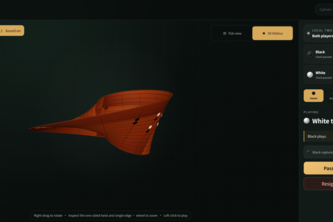
What the company appears to be: Topology Go: Baduk Beyond Flat Boards is a self-reported 3D, AI-powered multiplayer game that allows players to play Go on non-Euclidean topological surfaces such as cylinders, tori, and Möbius strips. The author describes it as a fully playable game with online multiplayer, AI opponents, replay, import/export, and AI-assisted post-game analysis.
What changed: The project was built during OpenAI Build Week as a hackathon submission. It represents an experimental approach to board game design using topology and AI assistance for development.
The single most important open question: Is there any evidence of traction, revenue, or customer adoption beyond the author's own account? The description states no commercial data exists.
What The Product Actually Is
- The description states that Topology Go is a "fully playable Go game built around three topologies"
- It supports cylinder (left-right edges connect), torus (both pairs of opposite edges connect), and Möbius strip (one pair connects with reversed orientation)
- Players can play locally, create online rooms, face an AI opponent, import/export games, replay matches, and use AI-assisted analysis
- The main interaction happens on a flat grid that visually repeats continuously through connected directions
- It supports switching between flat board and corresponding 3D surface views
- AI analysis displays candidate moves and evaluations on both views
Positioning & Claim Evolution
- The description states the project is "A 3D, AI-powered multiplayer game that turns abstract topology into intuitive strategy"
- It positions itself as an experiment in "turning abstract topology into intuitive strategy" rather than a commercial product
- The author claims to have "turned an unusual idea into a game that I genuinely enjoy playing within a single Build Week"
- The project is described as having evolved from "a geometric demonstration" into "a complete, playable game"
- No evidence of pricing, monetization or commercial positioning beyond the author's own account
Target Customer & ICP
- Not evidenced. The description does not identify specific customer segments or personas
- The author states that players can play locally, create online rooms, and face AI opponents
- No evidence of target demographics, user types, or customer profiles
- The project appears to be primarily for Go enthusiasts interested in experimental game design
Business Model & Pricing Evidence
- Not evidenced. The description does not contain any information about pricing, monetization, revenue streams, or business model
- The author states this is a hackathon submission and no commercial data exists
- No evidence of paid features, subscriptions, or transactional models
Technical & Delivery Signals
- Built with: cloudflare, codex, durable, gpt-5.6, javascript, katago, objects, openai, tensorflow.js, three.js, websockets, workers
- The author reports using AI tools (ChatGPT and Codex) for implementation and debugging
- The project was built during OpenAI Build Week as a hackathon submission
- Uses KataGo for AI opponent
- Supports online multiplayer through websockets
- Implements 3D visualization with three.js
- Includes import/export functionality
Traction & Maturity Signals
- Not evidenced. The description contains no information about users, customers, revenue, or adoption metrics
- The project is described as a single-week hackathon effort
- No evidence of user engagement, retention, or usage data
- The author states they "genuinely enjoy playing" but provides no external validation of player interest
Competitive Context
- Not evidenced. The description does not mention competitors or market positioning relative to other Go games or topology-based applications
- No information about existing alternatives or competitive landscape
- No evidence of market analysis or differentiation strategy
Open Questions & Risks
- Unproven commercial viability: The project is described as a hackathon submission with no evidence of traction, revenue, or customer adoption
- Limited scope: Built for a single week during a hackathon; no indication of long-term development plans or scalability
- Self-reported only: All information comes from the author's own account without independent verification
- Technical uncertainty: Relies heavily on AI tools for implementation with no evidence of code quality, performance, or maintainability
- Niche appeal: The combination of Go + topology + 3D visualization may limit target audience size
Questions the description leaves open
- What specific user feedback have you received about the gameplay experience?
- How do you plan to monetize this product if at all?
- What is your roadmap for development beyond the current prototype?
- Have you conducted any user testing with non-expert players?
- What are the technical limitations of the current implementation that would prevent scaling?
- How does the AI opponent perform against human players in terms of skill level?
- What is your strategy for attracting and retaining users?
Overall Assessment
Not evidenced. The description provides no information about financial performance, customer base, or commercial traction to support any investment or partnership decision. This appears to be a single-week hackathon project with no demonstrated market validation or business metrics. The author's own account is the only evidence available, and it does not contain any commercial data.
User Stories BotA demo video on every pull request
Get a demo video on every new feature
GitHub App that watches your pull requests and records a narrated, captioned demo.
Save time on demo prep and make informed decisions faster with a video walkthrough of every new feature.
Source
Submitted to the OpenAI 2026 hackathon on Devpost. Project home on Devpost. Back to the full gallery on Devpost.
This competitive analysis was produced by top-founders.com (opens in a new tab)
Generated by a language model from this project's public Devpost page — its tagline, the author's own write-up and any built-with tags listed there — as captured in August 2026. Short quotations are the author's words. It is an opinion on the idea as a business, not on the people behind it, and it reflects the description as published then. If the project has moved on, request a correction below. The analysis is not independent research and contains no verified traction, revenue or customer data.
An independent guide by KFG International LLC — not affiliated with, endorsed by, or connected to Devpost or OpenAI.