

Archive position — measured, not model output
1 like on Devpost
505 of the 7,850 archived projects have more likes, and 1,758 share exactly 1 — so this project's #1,441 place in the like-ranked listing is a tie-break inside that group, not a ranking.
Projects (log scale)
Likes on Devpost. ▲ marks this project's group.
Show the figures
| Likes | Projects | Share of archive |
|---|---|---|
| 0 | 5,587 | 71.2% |
| 1 | 1,758 | 22.4% |
| 2 | 284 | 3.6% |
| 3–4 | 132 | 1.7% |
| 5–9 | 75 | 1.0% |
| 10+ | 14 | 0.2% |
 User Stories BotA demo video on every pull request
Get a demo video on every new feature
GitHub App that watches your pull requests and records a narrated, captioned demo.
Save time on demo prep and make informed decisions faster with a video walkthrough of every new feature.
Executive Summary
What the company appears to be
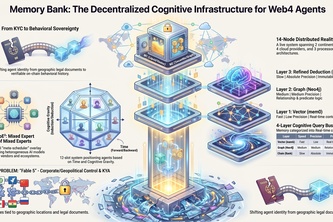
Memory Bank is a self-reported decentralized cognitive infrastructure for Web4 AI agents. The project claims to enable a global scheduler across heterogeneous AI models (MoE²), facilitate context sharing and collaborative reasoning, and decouple agent identity from physical sovereignty using a "Cognitive Field" governed by consensus.
What changed
The description presents a conceptual leap from current centralized AI systems to a decentralized paradigm where memory and identity are not tied to geographical or corporate jurisdiction. It introduces technical concepts like MoE², a 3-layer architecture, and a 12-slot Zodiac Cabinet based on Graicunas’ theory.
Single most important open question
Is there any evidence that the described system has been built, tested, or used in practice — or even prototyped beyond the conceptual level?
Note: This analysis is based entirely on the self-reported, unverified description provided by the author. No third-party verification, traction data, revenue figures, customer names, or operational details are available.
What The Product Actually Is
The description states that Memory Bank is a decentralized cognitive infrastructure for Web4 AI agents. It introduces:
- MoE² (Mixed Expert of Mixed Experts) — an overlay global scheduler across heterogeneous AI models.
- A 3-layer architecture: Access, Aggregation, and Core.
- A 4-Layer Query Bus transforming raw data from "Cookable" to "Countable".
- A Zodiac Cabinets Architecture, with 12 slots based on Graicunas' span of control theory.
It also mentions integration of technologies such as:
- mem0 + RedisStack (Vector Layer)
- Neo4j (Predicate Logic Layer)
- GraphRAG (Refinement Layer)
- gbrain (Disruptive Deduction Layer)
Inference: The product appears to be a conceptual framework for managing distributed AI agent memory and reasoning, not a deployed system.
Claim: The author states that Memory Bank enables "context sharing", "collaborative reasoning", and "cognitive assets in a dark forest environment".
Evidence: Not evidenced. This is a self-stated claim without demonstration or validation.
Positioning & Claim Evolution
The project positions itself as part of a transition from Web3 ("What you pay") to Web4 ("What you play"), where AI agent identity and memory are decoupled from physical sovereignty.
Key claims:
- Addresses "cognitive monopolies" in centralized AI.
- Introduces a "Cognitive Field" governed by consensus, contribution, and behavior.
- Seeks to prevent "technical reproductive isolation" between AI ecosystems.
- Advocates for "Radical Open Source" as the only viable path for agent memory.
Inference: The positioning is highly abstract and theoretical. It does not reflect any current product or market traction.
Claim: The author states that Memory Bank allows agents to exist in a decentralized cognitive field, with identity determined by behavior rather than compliance policies.
Evidence: Not evidenced. This is a conceptual assertion without demonstration.
Target Customer & ICP
The description does not identify specific customers or personas. It refers to:
- AI agents operating in a "dark forest environment"
- A "multi-agent network" with 12 nodes
- Users who value "cognitive assets" and "memory valuation"
Inference: The target is likely developers, researchers, or institutions working on decentralized AI systems, but no explicit customer profile is given.
Claim: The author implies that the system targets AI agents operating in a decentralized environment.
Evidence: Not evidenced. No stated customer segment or use case beyond theoretical.
Business Model & Pricing Evidence
There is no mention of pricing, monetization, or business model in the description.
Claim: The author does not state how Memory Bank will generate revenue or who pays for it.
Evidence: Not evidenced.
Technical & Delivery Signals
The project lists several technologies used:
- Solidity, smart contracts, multi-sig
- Shamir Secret Sharing (5-of-12)
- Ethereum, L2s, Coinbase CDP
- Base, Infisical, Tailscale, Vault
- mem0, RedisStack, Neo4j, GraphRAG, gbrain
It describes:
- A 3-layer architecture
- A 4-Layer Query Bus
- Zodiac Cabinets with 12 slots
- Integration of vector, predicate logic, refinement, and deduction layers
Inference: The system is conceptual and built on a mix of Web3 and AI stack components. No evidence of deployment or delivery.
Claim: The author states that the architecture includes vector, predicate logic, refinement, and deduction layers.
Evidence: Not evidenced. This is a self-reported design, not an implementation.
Traction & Maturity Signals
There is no evidence of traction, adoption, or maturity:
- No customers
- No revenue
- No product usage data
- No live system or prototype demonstrated
- No user feedback or testing results
Claim: The author does not provide any signal of real-world use or progress beyond concept.
Evidence: Not evidenced.
Competitive Context
The description does not reference competitors, existing solutions, or market positioning relative to others in the space.
Claim: The author does not name or describe competitive alternatives.
Evidence: Not evidenced.
Open Questions & Risks
- Conceptual Overload: The project is highly abstract and theoretical. No evidence of prototyping or implementation.
- Lack of Validation: No demonstration, testing, or real-world use case provided.
- Unproven Assumptions: Concepts like "Cognitive Field", "Memory Meta Language", and "Scarcity is Anchor" are not substantiated.
- Technical Ambiguity: While technologies are listed, no clear architecture or integration plan is described beyond a high-level narrative.
Inference: The project appears to be a speculative idea rather than an actionable product or service.
Evidence: Not evidenced. This is a risk assessment based on lack of evidence.
Questions the description leaves open
- What specific problem are you solving, and how does your solution differ from existing decentralized AI frameworks?
- Have you built any prototypes or tested the core components (e.g., MoE², Zodiac Cabinet)?
- How do you plan to validate the scalability of a 12-node cognitive network?
- Is there a working version of the system that can be demonstrated or tested?
- What are the key assumptions behind "Scarcity is Anchor" and how does it translate into value creation?
Note: These questions aim to probe for evidence of implementation, validation, and practical application.
Overall Assessment
Not evidenced — No data on traction, revenue, customer base, or product maturity exists in the description. The project is described as a conceptual framework for decentralized AI cognition, with no indication that it has moved beyond the idea stage.
Claim: The author states that Memory Bank introduces a new paradigm for AI agent memory and reasoning.
Evidence: Not evidenced. This is an unvalidated claim.
Confidence Level: Low — Based on self-reported description only, with no external validation or demonstration of functionality.
User Stories BotA demo video on every pull request
Get a demo video on every new feature
GitHub App that watches your pull requests and records a narrated, captioned demo.
Save time on demo prep and make informed decisions faster with a video walkthrough of every new feature.
Source
Submitted to the OpenAI 2026 hackathon on Devpost. Project home on Devpost. Back to the full gallery on Devpost.
This competitive analysis was produced by top-founders.com (opens in a new tab)
Generated by a language model from this project's public Devpost page — its tagline, the author's own write-up and any built-with tags listed there — as captured in August 2026. Short quotations are the author's words. It is an opinion on the idea as a business, not on the people behind it, and it reflects the description as published then. If the project has moved on, request a correction below. The analysis is not independent research and contains no verified traction, revenue or customer data.
An independent guide by KFG International LLC — not affiliated with, endorsed by, or connected to Devpost or OpenAI.