

Archive position — measured, not model output
1 like on Devpost
505 of the 7,850 archived projects have more likes, and 1,758 share exactly 1 — so this project's #1,442 place in the like-ranked listing is a tie-break inside that group, not a ranking.
Projects (log scale)
Likes on Devpost. ▲ marks this project's group.
Show the figures
| Likes | Projects | Share of archive |
|---|---|---|
| 0 | 5,587 | 71.2% |
| 1 | 1,758 | 22.4% |
| 2 | 284 | 3.6% |
| 3–4 | 132 | 1.7% |
| 5–9 | 75 | 1.0% |
| 10+ | 14 | 0.2% |
 User Stories BotA demo video on every pull request
Get a demo video on every new feature
GitHub App that watches your pull requests and records a narrated, captioned demo.
Save time on demo prep and make informed decisions faster with a video walkthrough of every new feature.
Executive Summary
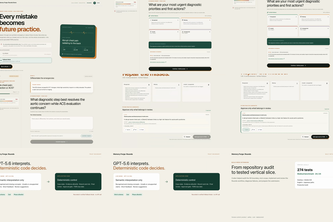
Memory Forge: Rounds is a self-reported educational tool built for medical students to practice clinical reasoning using synthetic cases. The author states that it uses GPT-5.6 for interpreting learner responses but keeps all clinical decision-making, evidence selection, branching logic, and scheduling deterministic. The system turns missed concepts into learner-approved spaced-review prompts using FSRS scheduling. It includes both a Live Mode (with API calls) and Fallback Mode (without API calls), with the latter labeled as such.
The project is described as a vertical slice of a larger idea, built during a single week-long hackathon. The author emphasizes that no real patient data or medical advice is involved, and all functionality is deterministic except for language interpretation by GPT-5.6. There is no evidence of revenue, customers, traction, or funding.
The single most important open question is: What is the actual educational impact or retention benefit of this specific approach to spaced recall? The description does not provide any data on learning outcomes, user engagement, or effectiveness compared to traditional methods.
What The Product Actually Is
- The description states that Rounds is an "account-free clinical-reasoning exercise built around one synthetic acute-chest-pain case."
- It follows learners through five short phases involving aortic dissection and acute coronary syndrome.
- Learners explain their reasoning in English or Japanese.
- The system separates responses into recognized concepts, missed concepts, unsafe assumptions, and unsupported claims.
- Feedback is shown with fixed educational evidence.
- Case branching is deterministic, not model-driven.
- Missed concepts are turned into learner-approved recall prompts using FSRS scheduling.
Inference: Based on the description, Rounds appears to be a single-case clinical reasoning exercise designed for medical education. It uses a synthetic case and deterministic logic for most of its functionality while relying on GPT-5.6 only for language interpretation.
Positioning & Claim Evolution
- The author states that Rounds was built around the line: “Every mistake becomes future practice.”
- It is positioned as an educational tool where feedback from clinical cases leads to spaced review.
- The system is described as deliberately not being an open-ended medical chatbot.
- The author claims that the model needed enough freedom to understand learner words but not enough to invent patient data or next clinical state.
- The project is described as a vertical slice of a larger idea, suggesting it's part of a broader vision.
Inference: The positioning evolved from a general idea about turning feedback into practice to a specific implementation focused on one synthetic case with deterministic control and model-assisted interpretation.
Target Customer & ICP
- The description states that the product is for "medical students."
- It is described as an educational tool.
- The system supports both English and Japanese learners.
- No other customer segments are mentioned.
Not evidenced: There is no evidence of specific targeting beyond medical students, or any segmentation strategy.
Business Model & Pricing Evidence
- The description states that the public version includes both Live Mode and Fallback Mode.
- It is described as account-free.
- No pricing information is provided.
- No evidence of monetization strategy or business model is present.
Not evidenced: There is no evidence of revenue streams, pricing models, or commercialization plans.
Technical & Delivery Signals
- Built with Next.js, React, TypeScript, Zod, Tailwind CSS, OpenAI Responses API, and ts-fsrs.
- Uses a strict JSON Schema, bounded output, low reasoning effort, and store: false for GPT-5.6 requests.
- Separated into explicit boundaries including versioned synthetic case, GPT adapter, deterministic fallback adapter, response schemas, evidence allowlists, branching engine, and FSRS adapter.
- The system requires no account, database write, API key, or patient data.
- Includes 58 Vitest files with 274 tests, four Playwright flows covering English and Japanese on desktop and mobile.
- The author ran a budget-controlled smoke test against the real model.
Inference: The technical architecture shows deliberate separation of concerns, with deterministic control over clinical logic and model use limited to interpretation. The system is designed for reproducibility and safety.
Traction & Maturity Signals
- The project was submitted to the OpenAI 2026 hackathon.
- It includes a complete learning loop from answer to review item.
- The author mentions that it passed 58 Vitest files with 274 tests, four Playwright flows, and a 24/24 deterministic medical benchmark.
- No evidence of user adoption, retention metrics, or usage data is provided.
Not evidenced: There is no evidence of traction, user base, or product maturity beyond the single hackathon submission.
Competitive Context
- The description does not mention any competitors.
- No market analysis or competitive positioning is provided.
- The author does not reference existing tools in medical education or clinical reasoning practice.
Not evidenced: There is no evidence of competitive landscape or differentiation from other educational tools.
Open Questions & Risks
- The system uses synthetic cases only, with no real-world data or patient information.
- The Live Mode failed a safety-pause phase due to out-of-bound evidence reference, suggesting potential reliability issues.
- The author notes that the demo is explicit about its limits but does not provide evidence of how these limitations affect educational outcomes.
- No evidence of clinical validation or effectiveness studies.
- The system is described as a single-case vertical slice, which may limit scalability or generalizability.
Inference: The main risk is that the educational value and effectiveness of this approach are unproven, especially given the synthetic nature of the cases and the limited scope of testing.
Questions the description leaves open
- What specific clinical reasoning skills does Rounds aim to improve?
- How does the author define success for this tool beyond technical completion?
- Are there any plans to validate the educational effectiveness of the spaced recall approach?
- What is the long-term vision for expanding from one synthetic case to multiple cases or domains?
- How will the system handle learner feedback and iteration on the educational content?
- What are the implications of using only synthetic cases for real-world clinical application?
- How does the author plan to address the failed safety-pause phase in Live Mode?
Overall Assessment
Not evidenced: There is no evidence of funding, investment interest, or partnership opportunities. The project is described as a single-week hackathon submission with no indication of commercial viability or strategic value beyond its demonstration.
The author states that this is part of a larger vision but provides no details about how the current prototype might evolve into a scalable product or service. Given the self-reported nature of all information and lack of any traction data, there is insufficient evidence to assess potential for investment or partnership.
User Stories BotA demo video on every pull request
Get a demo video on every new feature
GitHub App that watches your pull requests and records a narrated, captioned demo.
Save time on demo prep and make informed decisions faster with a video walkthrough of every new feature.
Source
Submitted to the OpenAI 2026 hackathon on Devpost. Project home on Devpost. Back to the full gallery on Devpost.
This competitive analysis was produced by top-founders.com (opens in a new tab)
Generated by a language model from this project's public Devpost page — its tagline, the author's own write-up and any built-with tags listed there — as captured in August 2026. Short quotations are the author's words. It is an opinion on the idea as a business, not on the people behind it, and it reflects the description as published then. If the project has moved on, request a correction below. The analysis is not independent research and contains no verified traction, revenue or customer data.
An independent guide by KFG International LLC — not affiliated with, endorsed by, or connected to Devpost or OpenAI.