

Archive position — measured, not model output
0 likes on Devpost
2,263 of the 7,850 archived projects have more likes, and 5,587 share exactly 0 — so this project's #5,368 place in the like-ranked listing is a tie-break inside that group, not a ranking.
Projects (log scale)
Likes on Devpost. ▲ marks this project's group.
Show the figures
| Likes | Projects | Share of archive |
|---|---|---|
| 0 | 5,587 | 71.2% |
| 1 | 1,758 | 22.4% |
| 2 | 284 | 3.6% |
| 3–4 | 132 | 1.7% |
| 5–9 | 75 | 1.0% |
| 10+ | 14 | 0.2% |
 User Stories BotA demo video on every pull request
Get a demo video on every new feature
GitHub App that watches your pull requests and records a narrated, captioned demo.
Save time on demo prep and make informed decisions faster with a video walkthrough of every new feature.
Executive Summary
What the company appears to be
Mold Sentinel AI™ HVAC Inspection Platform is a self-reported AI-assisted mobile inspection tool designed for HVAC contractors, home inspectors, indoor environmental professionals, and air duct cleaning companies. It integrates field observations with laboratory findings using AI orchestration to generate technician-reviewed reports.
What changed
The author, Steve McLeod, a 30+ year veteran in indoor environmental consulting, claims to have used OpenAI’s GPT-5.6, Codex, and other tools during an OpenAI Build Week sprint to rapidly prototype this platform. The project evolved from domain expertise into a working software solution through AI collaboration.
Single most important open question
Is there evidence of real-world usage or traction beyond the author's own development effort? The description lacks any data on customers, revenue, or adoption — all claims are self-reported and unverified.
What The Product Actually Is
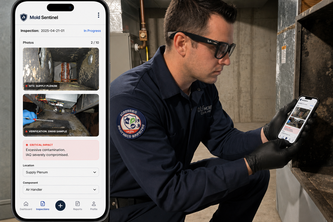
The description states that Mold Sentinel AI is a mobile-first inspection platform for HVAC professionals. It allows technicians to:
- Photograph HVAC components
- Record observations
- Assign standardized Green/Yellow/Red condition statuses
- Use camera, smartphone, or Ray-Ban Meta Smart Glasses
It also includes an AI orchestration layer that:
- Extracts structured information from both inspection and laboratory reports
- Matches inspection and lab data
- Creates a Master Case Record
- Generates technician-reviewed custom reports
- Prepares laboratory chain-of-custody forms
The platform is described as modular, with AI agents performing specific tasks while the technician retains final decision-making authority.
Evidence
- The author describes the platform’s functionality in detail.
- It uses OpenAI tools (GPT-5.6, Codex) for report drafting and workflow automation.
- It integrates with Supabase for backend infrastructure and Lovable for rapid development.
Inference The system is built to reduce administrative burden on professionals by automating documentation and report generation.
Positioning & Claim Evolution
The author positions Mold Sentinel AI as a tool that "AI Assists. The Technician Decides. The Lab Confirms."
Key claims include:
- Combines field experience with AI to automate repetitive tasks.
- Reduces time spent on documentation so professionals can focus more on solving problems.
- Improves consistency and communication in reporting.
- Does not replace expertise but enhances it through AI.
The project evolved from a personal challenge — how to scale indoor environmental consulting — into a technical prototype using AI tools during OpenAI Build Week.
Evidence
- The author explicitly states the platform’s positioning and evolution.
- He emphasizes that the goal is not to replace professionals, but to support them with AI.
Inference The positioning reflects an intent to serve niche B2B professionals who need better documentation tools, rather than mass-market consumers.
Target Customer & ICP
The description identifies several potential user groups:
- HVAC contractors
- Home inspectors
- Indoor environmental professionals
- Air duct cleaning companies
These are described as users who perform inspections and document findings that must be communicated to homeowners or clients.
Evidence
- The author lists these professional roles directly.
- The platform is designed for mobile use, suggesting field-based professionals.
Inference The target customer segment appears to be small-to-medium-sized service businesses in the indoor environmental space, likely operating locally or regionally.
Business Model & Pricing Evidence
There is no evidence provided about pricing models, monetization strategies, or business structure. The description does not mention subscriptions, per-use fees, licensing, or any commercial arrangements.
Evidence
- No mention of revenue streams.
- No indication of whether the platform will be sold to end-users or offered as a SaaS product.
Inference If this becomes a commercial product, it may follow a SaaS model with tiered pricing for different types of users (e.g., contractors vs. inspectors), but no such details are stated.
Technical & Delivery Signals
The platform was built during an OpenAI Build Week sprint using:
- GPT-5.6
- OpenAI Codex
- Lovable
- Supabase
- GitHub
- Visual Studio Code
It uses a modular architecture with AI agents handling distinct functions such as information extraction, report drafting, and workflow coordination.
The author notes that he had no prior software engineering background and learned new tools quickly through AI assistance.
Evidence
- The tech stack is listed.
- The development process involved AI collaboration.
- Modular design is described.
Inference This suggests a lean, agile approach to building a product using generative AI as a core component. However, no production-ready code or delivery timeline is mentioned.
Traction & Maturity Signals
There is no evidence of traction, customers, or usage beyond the author’s own development effort.
The description states that this was a prototype built during a hackathon and that the next step is to expand it into a production-ready platform.
Evidence
- The project was submitted to OpenAI Build Week.
- No mention of real users, pilot programs, or beta testing.
- No data on adoption rates, retention, or revenue.
Inference The product exists only as a concept and prototype at this stage. It has not yet reached market maturity or demonstrated commercial viability.
Competitive Context
There is no evidence provided about existing competitors or market positioning relative to them.
The author does not reference similar platforms or tools in the indoor environmental or HVAC inspection space.
Evidence
- No competitor names, products, or market share data are mentioned.
- No indication of how this compares to current solutions used by HVAC professionals.
Inference It is unclear whether there are existing platforms doing similar work. The author’s claim of being the first step toward a vision implies either a gap in the market or lack of awareness of alternatives.
Open Questions & Risks
Several risks and open questions emerge from the self-reported nature of the description:
- No commercial traction: No evidence of customers, revenue, or usage beyond author’s own development.
- Unverified claims: All statements about functionality, impact, and outcomes are self-reported.
- Founder background mismatch: The founder is a domain expert, not an engineer — raises questions about scalability and technical execution.
- AI dependency without validation: Reliance on GPT-5.6 and Codex for critical workflows lacks evidence of accuracy or reliability in real-world settings.
- Lack of product-market fit signal: No indication that the problem being solved is widely recognized or urgent enough to drive demand.
Evidence
- The description makes strong claims without substantiation.
- No mention of user feedback, testing, or validation.
Inference Without external validation or real-world usage, the risk of misalignment between stated goals and actual utility remains high.
Questions the description leaves open
- What specific problems do current professionals face in documenting HVAC inspections? How does Mold Sentinel AI address those?
- Have you conducted any pilot testing with actual users (HVAC contractors, inspectors)?
- What is the expected timeline for moving from prototype to production-ready platform?
- Are there any partnerships or integrations planned with laboratories or inspection agencies?
- How do you plan to validate the accuracy of AI-generated reports and ensure compliance with industry standards?
- What is your go-to-market strategy for reaching HVAC professionals, home inspectors, etc.?
- Is there a long-term roadmap beyond the current demo? If so, what are the key milestones?
Overall Assessment
Not evidenced
There is no evidence of financial performance, customer traction, or commercial viability to support an investment or partnership decision.
The description is entirely self-reported and unverified. It describes a prototype built during a hackathon with no indication of real-world usage, revenue, or scalability.
Confidence Level Low This analysis is based solely on the author’s own account — there are no independent sources or verifiable metrics to assess whether this project represents a viable business opportunity.
User Stories BotA demo video on every pull request
Get a demo video on every new feature
GitHub App that watches your pull requests and records a narrated, captioned demo.
Save time on demo prep and make informed decisions faster with a video walkthrough of every new feature.
Source
Submitted to the OpenAI 2026 hackathon on Devpost. Project home on Devpost. Back to the full gallery on Devpost.
This competitive analysis was produced by top-founders.com (opens in a new tab)
Generated by a language model from this project's public Devpost page — its tagline, the author's own write-up and any built-with tags listed there — as captured in August 2026. Short quotations are the author's words. It is an opinion on the idea as a business, not on the people behind it, and it reflects the description as published then. If the project has moved on, request a correction below. The analysis is not independent research and contains no verified traction, revenue or customer data.
An independent guide by KFG International LLC — not affiliated with, endorsed by, or connected to Devpost or OpenAI.