

Archive position — measured, not model output
0 likes on Devpost
2,263 of the 7,850 archived projects have more likes, and 5,587 share exactly 0 — so this project's #3,404 place in the like-ranked listing is a tie-break inside that group, not a ranking.
Projects (log scale)
Likes on Devpost. ▲ marks this project's group.
Show the figures
| Likes | Projects | Share of archive |
|---|---|---|
| 0 | 5,587 | 71.2% |
| 1 | 1,758 | 22.4% |
| 2 | 284 | 3.6% |
| 3–4 | 132 | 1.7% |
| 5–9 | 75 | 1.0% |
| 10+ | 14 | 0.2% |
 User Stories BotA demo video on every pull request
Get a demo video on every new feature
GitHub App that watches your pull requests and records a narrated, captioned demo.
Save time on demo prep and make informed decisions faster with a video walkthrough of every new feature.
Executive Summary
What the company appears to be
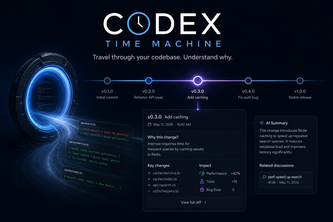
Codex Time Machine is a self-reported tool designed to enable controlled counterfactual experiments in AI-assisted software engineering. It allows users to replay an AI agent's decision-making process from a historical snapshot, injecting minimal, non-revealing clues about what investigation was missed, and measuring whether that intervention leads to different but observable outcomes.
What changed
The project description presents a novel approach to evaluating AI coding agents by focusing on target coverage rather than correctness or activity volume. It introduces the concept of a "Ghost Engineer clue" — a minimal hint revealing only what was not investigated, not the answer itself.
Single most important open question
Is there any evidence that this system has been used in production or integrated into real engineering workflows? The description is entirely self-reported and lacks any data on adoption, usage, or impact beyond a demo.
What The Product Actually Is
The description states that Codex Time Machine is a nine-phase temporal evidence pipeline for replaying AI engineering decisions. It operates by:
- Freezing an original historical run.
- Sealing later evidence behind a temporal boundary.
- Identifying the investigation the agent missed.
- Generating a minimal "Ghost Engineer clue".
- Replaying the task from the same starting snapshot.
- Comparing baseline and replay histories to measure target-specific coverage.
It is implemented in Python (with Pydantic, Pytest) for the backend and React/TypeScript/Vite for the frontend. The system publishes deterministic JSON and Markdown artifacts with SHA-256 manifests.
Inference This appears to be a proof-of-concept or hackathon project focused on AI auditing and reproducibility in software engineering contexts.
Positioning & Claim Evolution
The author claims that Codex Time Machine makes AI engineering decisions falsifiable, auditable, and reproducible, and that it addresses a gap in current tools: “none of these tools answer a deeper question: Was the outcome caused by a bad implementation, or did the agent simply fail to investigate the right thing?”
It introduces a new evaluation paradigm where:
- The focus is on target coverage rather than correctness.
- The system avoids revealing answers or chain-of-thought.
- It separates total activity from investigation quality.
The project positions itself as a tool for controlled counterfactual reasoning, aiming to make AI agent decisions more transparent and testable.
Inference This is a conceptual framework for evaluating AI agents in engineering workflows, not a commercial product yet. The claims are aspirational and self-reported.
Target Customer & ICP
The description does not name specific customers or personas. However, it implies use cases around:
- AI engineering teams evaluating agent behavior.
- Software engineers seeking to audit AI-assisted decisions.
- CI/CD pipelines or pull request integrations (mentioned in "What’s next").
- Engineering decision auditors or researchers.
It is not clear whether the tool targets individual developers, teams, or enterprises.
Inference The ICP appears to be technical users or engineering teams working with AI agents, but no explicit segmentation or targeting is stated.
Business Model & Pricing Evidence
There is no evidence of a business model or pricing structure in the description. The project is presented as a demo and a hackathon submission.
Inference No commercialization or monetization strategy is evident from the self-reported content.
Technical & Delivery Signals
The system is built with:
- Backend: Python, Pydantic, Pytest
- Frontend: React, TypeScript, Vite
- Tools: Docker, Git, OpenAI Codex, GPT-5.6 (used via Codex)
- Architecture: Nine-phase pipeline with integrity checks and deterministic outputs
It includes:
- SHA-256 manifests
- Canonical hashing
- Source-lineage validation
- Immutable phase receipts
- Fail-closed integrity checks
- 500+ backend tests, 19 frontend tests
The demo is a static public application with no API key or live model required.
Inference The technical architecture is robust for a proof-of-concept but lacks evidence of scalability or production deployment.
Traction & Maturity Signals
There is no evidence of traction, including:
- No revenue
- No customers
- No usage data
- No product adoption beyond the demo
The project is described as a hackathon submission and a public demo, with no indication of real-world application or integration.
Inference This is an early-stage concept, likely not yet in production or used by any users.
Competitive Context
The description does not mention competitors. It implies that current tools for AI agent evaluation do not address the question of what was missed during investigation — only whether the final output was correct.
It positions itself as a novel approach to AI auditing and counterfactual reasoning, but no comparison with existing tools is made.
Inference No competitive landscape or differentiation from other AI engineering tools is evident in the description.
Open Questions & Risks
- No real-world usage or adoption: The system is described only as a demo, not a product.
- Unproven utility: The value proposition is conceptual and untested in practice.
- Limited scope: The demo focuses on one specific use case (LegalRAG retrieval) with no indication of generalization.
- Self-reported only: No independent verification or third-party validation.
- No monetization path: No evidence of a business model or roadmap toward commercial viability.
Inference The project is a conceptual innovation, not a product ready for market or investment.
Questions the description leaves open
- Has this system been used in any real engineering workflows or CI/CD pipelines?
- What are the actual limitations of applying this to larger, more complex AI agent systems?
- Are there plans to integrate with existing development tools (e.g., GitHub, GitLab)?
- How would you scale this approach beyond a single demo?
- What is the intended roadmap for production deployment or commercialization?
Overall Assessment
Not evidenced.
The description presents a conceptual innovation in AI agent auditing and reproducibility but lacks any evidence of traction, revenue, customers, or product-market fit.
It is not clear whether this project has evolved into a product or is merely an idea or prototype.
Confidence: Low.
This is a self-reported hackathon submission with no independent verification or commercialization evidence. It may be a promising concept for future development but does not yet meet the criteria for investment or partnership consideration based on the provided information.
User Stories BotA demo video on every pull request
Get a demo video on every new feature
GitHub App that watches your pull requests and records a narrated, captioned demo.
Save time on demo prep and make informed decisions faster with a video walkthrough of every new feature.
Source
Submitted to the OpenAI 2026 hackathon on Devpost. Project home on Devpost. Back to the full gallery on Devpost.
This competitive analysis was produced by top-founders.com (opens in a new tab)
Generated by a language model from this project's public Devpost page — its tagline, the author's own write-up and any built-with tags listed there — as captured in August 2026. Short quotations are the author's words. It is an opinion on the idea as a business, not on the people behind it, and it reflects the description as published then. If the project has moved on, request a correction below. The analysis is not independent research and contains no verified traction, revenue or customer data.
An independent guide by KFG International LLC — not affiliated with, endorsed by, or connected to Devpost or OpenAI.