

Archive position — measured, not model output
0 likes on Devpost
2,263 of the 7,850 archived projects have more likes, and 5,587 share exactly 0 — so this project's #3,406 place in the like-ranked listing is a tie-break inside that group, not a ranking.
Projects (log scale)
Likes on Devpost. ▲ marks this project's group.
Show the figures
| Likes | Projects | Share of archive |
|---|---|---|
| 0 | 5,587 | 71.2% |
| 1 | 1,758 | 22.4% |
| 2 | 284 | 3.6% |
| 3–4 | 132 | 1.7% |
| 5–9 | 75 | 1.0% |
| 10+ | 14 | 0.2% |
 User Stories BotA demo video on every pull request
Get a demo video on every new feature
GitHub App that watches your pull requests and records a narrated, captioned demo.
Save time on demo prep and make informed decisions faster with a video walkthrough of every new feature.
Executive Summary
Company: Codex Web Education
Self-reported basis: The description is entirely self-reported by the author, unverified, and lacks any evidence of revenue, customers, or traction.
What it appears to be: A debugging education platform built as a hackathon project, using React, Next.js, and Playwright, with a game-like interface for teaching frontend debugging skills.
What changed: The project was submitted to the OpenAI 2026 hackathon; no prior version or evolution is evidenced.
Most important open question: Is there any evidence of product-market fit, user adoption, or commercial traction beyond this single-authored hackathon submission?
What The Product Actually Is
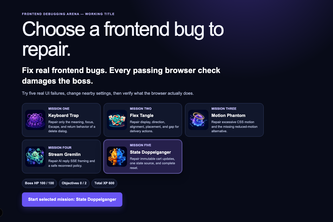
The description states that Codex Web Education is a bilingual (Korean and English) debugging arena with five focused missions. Each mission addresses specific frontend debugging challenges such as keyboard traps, flexbox issues, animation timing, SSE framing, and state management.
- It uses a visual interface where users manipulate UI elements to repair broken components.
- The system includes:
- Allowlisted controls beside the broken fixture.
- Immediate visual feedback on changes.
- Real DOM and browser behavior checks (e.g., keyboard focus, timing).
- A reward system based on verified failure resolution, not clicks or button presses.
- Optional AI-style coaching that appears only after a failed verification.
Inference: The product is designed to teach debugging through direct manipulation of UI elements in a safe, simulated environment. It is not a commercial tool but a prototype or educational experiment.
Positioning & Claim Evolution
The author claims the platform:
- Turns real UI failures into verified debugging missions.
- Provides an immediate cause-effect learning loop.
- Uses real browser behavior, not abstract quizzes or checklists.
- Offers a game-like experience with XP and boss battles.
Inference: The positioning is that of an interactive, hands-on frontend debugging education tool, aimed at learners who benefit from visual and experiential instruction. It does not claim to be a commercial product or platform for developers in production environments.
Target Customer & ICP
The description states:
- The target audience is learners interested in frontend debugging.
- It is designed for those who want to understand how UI failures manifest in the browser and how to fix them.
- The interface supports both Korean and English, suggesting a global or multilingual educational audience.
Inference: The ICP appears to be frontend developers or aspiring developers who are learning debugging skills through interactive, visual instruction. No evidence of enterprise customers or B2B use is provided.
Business Model & Pricing Evidence
The description does not mention:
- Any pricing structure.
- Revenue model.
- Monetization strategy.
- Subscription plans or paid features.
Inference: There is no evidence of a business model or pricing. The project is presented as an educational hackathon submission, not a commercial offering.
Technical & Delivery Signals
The author states:
- Built with Next.js 16, React 19, TypeScript, CSS, Vitest, Playwright.
- Uses a reducer-driven battle state, separated from typed interfaces (e.g., RepairProvider, DialogObjectiveEvaluator).
- Mission presets use curated allowlisted values.
- The source preview is explanatory text and never executed.
- Default coach is deterministic, no account or API key required.
- Optional Ollama vision provider for structured input validation.
Inference: The technical stack suggests a modern frontend development environment with strong typing, testing practices (unit + E2E), and simulation-based learning. It is not a production-grade SaaS offering but a prototype.
Traction & Maturity Signals
The description states:
- The project was submitted to the OpenAI 2026 hackathon.
- Includes 29 unit tests and 15 end-to-end tests.
- Has five missions with visual bosses and defeated states.
- Learner progress analytics are mentioned as a future feature.
Inference: There is no evidence of user adoption, customer base, or revenue. The project is at the prototype stage, likely not yet deployed for public use.
Competitive Context
The description does not mention:
- Competitors.
- Existing tools in the debugging education space.
- Market positioning relative to other platforms like Codecademy, freeCodeCamp, or interactive debugging tools.
Inference: No competitive context is provided. The project appears to be a novel educational experiment, but its place in the market is unknown.
Open Questions & Risks
- No commercial traction or revenue evidence.
- Single-person team (Chang Yong Mun).
- Hackathon submission — no indication of long-term development or product-market fit.
- No mention of scalability, deployment, or user feedback loops.
- Unverified claims: The system’s effectiveness in teaching debugging is not demonstrated.
Inference: The project is a proof-of-concept, not a scalable or commercially viable offering. It lacks any evidence of real-world usage or impact.
Questions the description leaves open
- What is the intended user base beyond the hackathon submission?
- Are there plans to expand beyond the five missions, and how will they be developed?
- Is there any feedback from users or educators on the effectiveness of this approach?
- How would you monetize this if it were to become a product?
- What are the technical challenges in scaling this beyond a prototype?
Overall Assessment
Not evidenced: There is no evidence of commercial traction, revenue, or customer adoption. The project is a single-authored hackathon submission, not a viable investment or partnership opportunity at this stage.
Confidence level: Low — based entirely on self-reported claims with no external validation or data points.
User Stories BotA demo video on every pull request
Get a demo video on every new feature
GitHub App that watches your pull requests and records a narrated, captioned demo.
Save time on demo prep and make informed decisions faster with a video walkthrough of every new feature.
Source
Submitted to the OpenAI 2026 hackathon on Devpost. Project home on Devpost. Back to the full gallery on Devpost.
This competitive analysis was produced by top-founders.com (opens in a new tab)
Generated by a language model from this project's public Devpost page — its tagline, the author's own write-up and any built-with tags listed there — as captured in August 2026. Short quotations are the author's words. It is an opinion on the idea as a business, not on the people behind it, and it reflects the description as published then. If the project has moved on, request a correction below. The analysis is not independent research and contains no verified traction, revenue or customer data.
An independent guide by KFG International LLC — not affiliated with, endorsed by, or connected to Devpost or OpenAI.