

Archive position — measured, not model output
0 likes on Devpost
2,263 of the 7,850 archived projects have more likes, and 5,587 share exactly 0 — so this project's #7,329 place in the like-ranked listing is a tie-break inside that group, not a ranking.
Projects (log scale)
Likes on Devpost. ▲ marks this project's group.
Show the figures
| Likes | Projects | Share of archive |
|---|---|---|
| 0 | 5,587 | 71.2% |
| 1 | 1,758 | 22.4% |
| 2 | 284 | 3.6% |
| 3–4 | 132 | 1.7% |
| 5–9 | 75 | 1.0% |
| 10+ | 14 | 0.2% |
 User Stories BotA demo video on every pull request
Get a demo video on every new feature
GitHub App that watches your pull requests and records a narrated, captioned demo.
Save time on demo prep and make informed decisions faster with a video walkthrough of every new feature.
Executive Summary
What the company appears to be
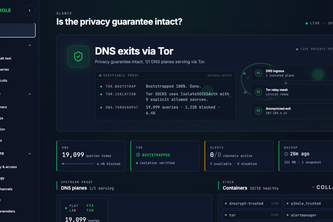
Torhole is a self-hosted DNS privacy gateway designed to protect DNS queries by routing them through Tor, encrypting resolver traffic, and proving the protected path live. It is built as a Docker Compose platform with Pi-hole, dnscrypt-proxy, and Tor forming the core privacy path.
What changed
The project was developed during a hackathon (OpenAI 2026) and is presented as an open-source tool for individuals or small networks to enforce DNS privacy using Tor. It includes two capability profiles: Home and Advanced, with distinct deployment modes and UI features.
Single most important open question
Is there evidence of real-world usage or adoption beyond the hackathon context? The description does not indicate any revenue, customers, or traction beyond the author's own development work.
What The Product Actually Is
The description states that Torhole is a self-hosted DNS privacy gateway. It uses:
- Pi-hole for local DNS blocking
- dnscrypt-proxy to encrypt resolver traffic
- Tor to route queries through the Tor network
- A Docker Compose platform for deployment
It ships with two capability profiles:
- Home: Provides a guided installer, lightweight dashboard, live verification, and safe everyday controls.
- Advanced: Adds VLAN operation, telemetry, SSO, backups, metrics, logs, alerts, and container operations.
The system enforces privacy structurally through firewall and container rules. It does not act as a full VPN; it only protects DNS requests that actually use Torhole.
Inference The product is a self-contained, open-source tool for individuals or small networks to protect their DNS queries via Tor.
Positioning & Claim Evolution
The description states that Torhole takes a narrower, verifiable approach to privacy compared to tools like full-tunnel VPNs. It aims to make one precise guarantee visible and testable: DNS handled by Torhole is filtered locally, encrypted to the resolver, and sent through Tor so the resolver sees a Tor exit rather than the public IP.
It explicitly does not promise anonymity, nor does it hide normal browser traffic or control applications that bypass DNS.
Inference The positioning is focused on verifiable DNS privacy, not broad network anonymity. It positions itself as a tool for users who want to see proof of their DNS protection, not just trust a badge.
Target Customer & ICP
The description states that Torhole ships with two capability profiles:
- Home profile targets households and first-time self-hosters.
- Advanced profile targets users needing single-LAN or Trusted/IoT VLAN operation.
It also mentions support for Raspberry Pi hardware validation, router-specific setup guides, and public read-only demo environments — indicating a focus on technical users with some infrastructure knowledge.
Inference The ICP is likely tech-savvy individuals or small teams who want to self-host DNS privacy tools and understand the trade-offs involved. No evidence of enterprise or B2B customers.
Business Model & Pricing Evidence
The description does not state any pricing, monetization, or business model. It only describes a self-hosted tool with two capability profiles (Home and Advanced), both of which are part of a Docker Compose platform.
Inference No evidence of a commercial business model. The tool appears to be open-source or freemium in nature, but no pricing or revenue data is provided.
Technical & Delivery Signals
The project was built using:
- Docker Compose
- Pi-hole, dnscrypt-proxy, Tor
- React/TypeScript for UI
- Python for control and recovery services
- Prometheus, Grafana, Loki, Alertmanager
- Caddy, Authelia
It includes:
- Guided web installer
- Live verification of Tor circuit and DNS path
- Topology-aware dashboards
- Automated CI/CD (shell/config CI, TypeScript build/typecheck, Playwright tests)
- Disposable staging VMs for validation
Inference The tool is built with modern infrastructure and observability practices. It emphasizes operational transparency, distinguishing between confirmed failures and inconclusive verifier outages.
Traction & Maturity Signals
The description states that the project was submitted to a hackathon (OpenAI 2026), and includes:
- Fresh staging deployments validated end-to-end
- Automated backend characterization and tests
- Public documentation stating exactly what Torhole protects and does not protect
However, there is no evidence of revenue, customers, or real-world usage beyond the author's own development.
Inference The project is in a development or early-stage prototype phase, with no traction or adoption data available.
Competitive Context
The description contrasts Torhole with:
- Pi-hole: Blocks domains but does not hide where queries originate.
- Full-tunnel VPNs: Change the path of all traffic and transfer trust to an operator.
Torhole is positioned as a narrower, verifiable DNS privacy tool, not a general-purpose privacy solution.
Inference Torhole competes in the DNS privacy and self-hosted security tools space. It does not appear to directly compete with full VPNs or general-purpose privacy suites.
Open Questions & Risks
- No evidence of real-world usage or adoption, only a hackathon submission.
- Self-hosted tool: Not suitable for non-technical users, limiting scalability.
- No commercial model or monetization strategy described.
- Limited team size (1 person): May limit development speed and support.
- Dependency on Tor network: Vulnerable to Tor infrastructure issues or outages.
Inference The project is not yet a product with traction, but rather an experimental tool. Risks include lack of adoption, scalability, and commercial viability.
Questions the description leaves open
- What is the actual user base or adoption rate beyond the hackathon?
- Are there any plans to monetize or commercialize this tool?
- How does Torhole handle edge cases like transient TLS failures or Tor circuit instability?
- What are the long-term maintenance and support plans for a self-hosted tool?
- Has the tool been tested in real-world environments beyond staging VMs?
Overall Assessment
The description states that this is a hackathon submission with no evidence of revenue, customers, or traction.
Inference At this stage, Torhole is an experimental prototype, not a product ready for investment or partnership. It lacks commercial viability, adoption, and a clear path to monetization.
There is no evidence of a business model, customers, or traction beyond the author’s own development work. The tool is self-hosted, technical, and in early-stage development.
Assessment Not ready for investment or partnership. A potential future product if traction emerges, but currently lacks commercial due-diligence signals.
User Stories BotA demo video on every pull request
Get a demo video on every new feature
GitHub App that watches your pull requests and records a narrated, captioned demo.
Save time on demo prep and make informed decisions faster with a video walkthrough of every new feature.
Source
Submitted to the OpenAI 2026 hackathon on Devpost. Project home on Devpost. Back to the full gallery on Devpost.
This competitive analysis was produced by top-founders.com (opens in a new tab)
Generated by a language model from this project's public Devpost page — its tagline, the author's own write-up and any built-with tags listed there — as captured in August 2026. Short quotations are the author's words. It is an opinion on the idea as a business, not on the people behind it, and it reflects the description as published then. If the project has moved on, request a correction below. The analysis is not independent research and contains no verified traction, revenue or customer data.
An independent guide by KFG International LLC — not affiliated with, endorsed by, or connected to Devpost or OpenAI.