

Archive position — measured, not model output
0 likes on Devpost
2,263 of the 7,850 archived projects have more likes, and 5,587 share exactly 0 — so this project's #7,239 place in the like-ranked listing is a tie-break inside that group, not a ranking.
Projects (log scale)
Likes on Devpost. ▲ marks this project's group.
Show the figures
| Likes | Projects | Share of archive |
|---|---|---|
| 0 | 5,587 | 71.2% |
| 1 | 1,758 | 22.4% |
| 2 | 284 | 3.6% |
| 3–4 | 132 | 1.7% |
| 5–9 | 75 | 1.0% |
| 10+ | 14 | 0.2% |
 User Stories BotA demo video on every pull request
Get a demo video on every new feature
GitHub App that watches your pull requests and records a narrated, captioned demo.
Save time on demo prep and make informed decisions faster with a video walkthrough of every new feature.
Executive Summary
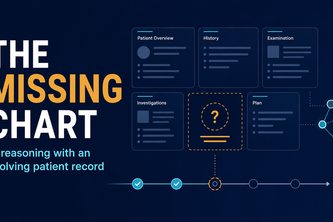
The Missing Chart, as described by its author, is an interactive clinical education simulation built around an evolving synthetic patient record. The project aims to teach learners how incomplete and evolving patient information affects AI-assisted clinical reasoning. It is presented as a tool for bridging the gap between clinicians and AI developers by modeling how clinical decisions change with new information.
The description states that it was built using Codex, GPT-5.6, Next.js, React, TypeScript, and Node.js, deployed via OpenAI Sites. It includes deterministic logic to ensure consistent learner experiences without requiring API keys or credits.
Key commercial due-diligence read: The author claims the simulation teaches learners to examine how information supplied affects AI responses — but there is no evidence of actual users, adoption, revenue, or product-market fit beyond the self-reported narrative. The project appears to be a proof-of-concept or prototype with limited traction and unclear monetization strategy.
Most important open question: Is there any evidence that this concept has been tested in real-world clinical or educational settings? If not, what is the path from prototype to validated use case?
What The Product Actually Is
The description states that The Missing Chart is an interactive clinical education simulation. It uses a synthetic patient record that evolves over time, allowing learners to review available information at specific points in care, make focused requests, and see how assessments change with new data.
It includes:
- An evolving timeline of patient information
- A mechanism for selecting what information to include in a request
- Assessment outputs that shift based on the information provided
- Verification activities to identify claims requiring further evidence
The simulation is designed to show how missing context can alter interpretation, urgency, and next steps — teaching users not just to trust AI responses but to question them in light of incomplete data.
Inference: The product appears to be a web-based educational tool built for clinical training or AI literacy. It is not described as a commercial SaaS offering or an API-based system.
Positioning & Claim Evolution
The author positions The Missing Chart as a way to bridge the divide between clinicians and AI developers by modeling how clinical reasoning evolves with new information.
Key claims:
- The tool reflects how clinicians think: reasoning with what is known, recognizing what is missing, verifying consequential claims, and revising assessments when evidence changes.
- It helps learners understand that AI output may be internally reasonable but still clinically insufficient due to missing context.
- It integrates clinical education, AI literacy, safety, and evaluation into one workflow.
The project evolved from the author’s experience in healthcare and AI, aiming to address a perceived gap between how clinicians work and how AI systems are often evaluated or used.
Inference: The positioning is centered on clinical AI education, not commercial productization. There is no indication of market expansion plans beyond the current prototype.
Target Customer & ICP
The description states that The Missing Chart is intended for learners in clinical education and AI literacy training. It is designed to help:
- Clinicians understand how AI-assisted reasoning changes with evolving information
- AI developers better grasp how clinical decisions unfold in practice
- Educators train students on safe AI use
It also mentions potential future users such as researchers working on AI safety and medical AI systems.
However, the description does not name specific customer segments or buyer personas beyond “learners” and “educators.”
Inference: The ICP is likely clinical educators, AI training institutions, or healthcare organizations focused on clinical decision-making. No evidence of a defined sales motion or target accounts.
Business Model & Pricing Evidence
The description does not mention any pricing, monetization strategy, or business model.
It states that the application uses entirely synthetic patient information, requires no login or credentials, and keeps interpretation with the human learner — suggesting it is free to access for users.
There is no indication of paid features, subscriptions, or API access.
Inference: The project appears to be non-commercial in nature. It may be a prototype or open-source educational tool, but there is no evidence of a monetization path.
Technical & Delivery Signals
The author states that the application was built with:
- Next.js, React, TypeScript, and Node.js
- Deployed via OpenAI Sites
- Powered by Codex and GPT-5.6
- Includes deterministic logic to ensure consistent learner experience
- Designed for accessibility and testing
It is described as a deterministic structure that gives every learner the same experience without requiring API keys or credits.
Inference: The tech stack suggests a modern, web-based educational platform built with AI integration. However, there is no evidence of scalability, performance metrics, or production-grade infrastructure.
Traction & Maturity Signals
The description does not provide any data on:
- Number of users
- Engagement metrics
- Customer feedback
- Adoption rates
- Revenue or funding
It mentions that the project was submitted to the OpenAI 2026 hackathon, indicating it is a prototype or proof-of-concept.
There is no evidence of product-market fit, user testing, or real-world deployment beyond the author’s own account.
Inference: The project is at an early stage — likely a prototype or demo. No traction or maturity indicators are evident.
Competitive Context
The description does not reference any competitors or similar tools in the market.
It does not describe how The Missing Chart compares to existing clinical education platforms, AI training tools, or simulation software.
There is no mention of whether other tools exist that teach clinical reasoning with evolving information or AI literacy through interactive simulations.
Inference: No competitive landscape is described. The project may be unique in its approach, but there is no evidence of prior art or market positioning.
Open Questions & Risks
- No traction or user data: The project is presented as a prototype with no evidence of adoption or usage.
- Unclear commercial viability: No monetization model or business plan is evident.
- Limited scalability: The deterministic structure and lack of API access suggest limited ability to scale or integrate into larger systems.
- Unverified clinical impact: While the author claims it bridges clinician-AI gaps, there is no evidence of clinical validation or effectiveness studies.
- Self-contained tool: It does not appear to be designed for integration with existing healthcare or AI platforms.
Inference: The project may be a valuable educational concept, but its lack of traction and commercial strategy raises concerns about viability as a product or investment opportunity.
Questions the description leaves open
- Has the simulation been tested in real clinical or educational settings?
- What is the intended path from prototype to scalable product or platform?
- Are there any plans for monetization, partnerships, or distribution channels?
- How does the tool differentiate from existing AI literacy or clinical education platforms?
- What clinical validation or feedback has been gathered during development?
- Is there a plan to expand beyond the current synthetic patient use case?
Overall Assessment
Not evidenced — The description provides no data on financials, traction, or commercial readiness.
The project is presented as an educational prototype with strong conceptual alignment to clinical AI challenges. However, it lacks:
- Revenue or customer data
- Product-market fit indicators
- Scalability or monetization plans
It may be a promising idea for educational or research use, but there is no evidence that it has moved beyond the prototype stage or has commercial viability.
Inference: The project is not ready for investment or partnership at this time. It would require further development, testing, and validation to assess its potential as a product or platform.
User Stories BotA demo video on every pull request
Get a demo video on every new feature
GitHub App that watches your pull requests and records a narrated, captioned demo.
Save time on demo prep and make informed decisions faster with a video walkthrough of every new feature.
Source
Submitted to the OpenAI 2026 hackathon on Devpost. Project home on Devpost. Back to the full gallery on Devpost.
This competitive analysis was produced by top-founders.com (opens in a new tab)
Generated by a language model from this project's public Devpost page — its tagline, the author's own write-up and any built-with tags listed there — as captured in August 2026. Short quotations are the author's words. It is an opinion on the idea as a business, not on the people behind it, and it reflects the description as published then. If the project has moved on, request a correction below. The analysis is not independent research and contains no verified traction, revenue or customer data.
An independent guide by KFG International LLC — not affiliated with, endorsed by, or connected to Devpost or OpenAI.