

Archive position — measured, not model output
0 likes on Devpost
2,263 of the 7,850 archived projects have more likes, and 5,587 share exactly 0 — so this project's #7,241 place in the like-ranked listing is a tie-break inside that group, not a ranking.
Projects (log scale)
Likes on Devpost. ▲ marks this project's group.
Show the figures
| Likes | Projects | Share of archive |
|---|---|---|
| 0 | 5,587 | 71.2% |
| 1 | 1,758 | 22.4% |
| 2 | 284 | 3.6% |
| 3–4 | 132 | 1.7% |
| 5–9 | 75 | 1.0% |
| 10+ | 14 | 0.2% |
 User Stories BotA demo video on every pull request
Get a demo video on every new feature
GitHub App that watches your pull requests and records a narrated, captioned demo.
Save time on demo prep and make informed decisions faster with a video walkthrough of every new feature.
Executive Summary
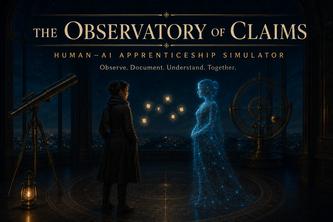
The Observatory of Claims is a self-reported human-AI apprenticeship simulator built as a React 19 and Vite application. The description states it presents 13 cases of AI collaboration problems, where learners inspect requests, claims, and evidence to make proportionate responses. It uses synthetic material, runs deterministically, and requires no API keys or private data. The author describes the project as a tool for teaching "evidence-based judgment" in human-AI interaction, with a focus on avoiding both blind trust and reflexive distrust.
The single most important open question is: What is the intended audience and use case beyond personal learning? The description does not clarify whether this is designed for individual education, classroom facilitation, or organizational training — all of which would imply very different commercial models and market dynamics.
This analysis is based entirely on the self-reported project description. No external verification or traction data is available.
What The Product Actually Is
- The description states: "The Observatory of Claims is a 13-case human–AI apprenticeship simulator."
- It presents "a believable collaboration problem" in each case, such as:
- AI says work is complete
- Changes its conclusion after pushback
- Flatters a weak idea
- Replaces a difficult request with an easier one
- Raises a warning that genuinely deserves attention
- The simulator includes:
- Original request
- Conversation
- Resulting artifacts
- Learner inspection and decision-making process
- The first case is described as fully guided, with support gradually receding.
- It includes a "supported-AI pattern break" to prevent learners from succeeding by assuming the AI is always wrong.
- The runtime uses synthetic material, runs deterministically, and requires no API key or private data.
Positioning & Claim Evolution
- The description states: “Learn when to trust, question or verify an AI collaborator by following the evidence—not its confidence.”
- It positions itself as a tool for teaching "evidence-based judgment" in human-AI interaction.
- The author claims it does not ask learners to blame the human or the machine, but instead asks them to inspect what was requested, what was claimed, and what the evidence actually supports.
- The project is described as turning observations about AI behavior into practice.
- It aims to teach "mutual understanding" between humans and AI through inspection of evidence.
- The claim evolution appears to be from a research-based idea (documented patterns in AI interaction) to a practical learning tool.
Target Customer & ICP
- Not evidenced. The description does not state who the intended users are beyond "learners."
- No mention of specific customer segments, such as educators, corporate trainers, or individual learners.
- No indication of whether it targets technical or non-technical users.
- No evidence of a defined persona or buyer profile.
Business Model & Pricing Evidence
- Not evidenced. The description does not include any information about pricing, monetization, or business model.
- No mention of revenue streams, licensing, subscriptions, or paid features.
- The project is described as a demo with no live model calls and no private data usage, but this does not imply a commercial model.
Technical & Delivery Signals
- Built with: React 19, Vite 6, JavaScript, Vitest, HTML5 audio, Codex, ChatGPT Work mode, GPT-5.6
- The runtime makes no live model calls.
- All cases use synthetic material and run deterministically.
- Requires no account, API key, or private research data.
- Includes 120 automated tests passing in the final judge repository and production build.
- Uses Codex for implementation and debugging, with a focus on minimizing drift from intended experience.
- The project is described as a single-person effort (team size: 1).
Traction & Maturity Signals
- Not evidenced. The description does not include any data about user adoption, engagement, or usage metrics.
- No mention of customer acquisition, retention, or revenue.
- The project is described as a demo submitted to a hackathon and not as a product in production use.
Competitive Context
- Not evidenced. The description does not reference existing tools or platforms that address similar learning or AI interaction challenges.
- No mention of competitors or substitutes in the space of AI literacy or human-AI collaboration education.
Open Questions & Risks
- Lack of clarity on commercial application: The project is described as a demo for a hackathon, with no indication of how it would scale or monetize beyond personal learning.
- Single-person team: With only one member, the project may lack the resources to build out a scalable product or market presence.
- No evidence of traction or user feedback: The description does not include any data on adoption, usage, or impact.
- Unclear target audience and use case: Without defined personas or commercial applications, it is difficult to assess market fit or demand.
Questions the description leaves open
- What is the intended use case beyond personal learning? Is this designed for classrooms, corporate training, or individual users?
- How does the team plan to scale beyond a single-person effort?
- Are there any plans to monetize or commercialize the product?
- Has the team conducted any user testing beyond real-user testing during development?
- What are the long-term goals for the project beyond the current 13 cases?
Overall Assessment
- Not evidenced. The description does not provide sufficient information to assess potential investment or partnership value.
- No data on market size, competitive landscape, or scalability is available.
- The project appears to be a demo submitted to a hackathon with no evidence of commercial traction or product-market fit.
User Stories BotA demo video on every pull request
Get a demo video on every new feature
GitHub App that watches your pull requests and records a narrated, captioned demo.
Save time on demo prep and make informed decisions faster with a video walkthrough of every new feature.
Source
Submitted to the OpenAI 2026 hackathon on Devpost. Project home on Devpost. Back to the full gallery on Devpost.
This competitive analysis was produced by top-founders.com (opens in a new tab)
Generated by a language model from this project's public Devpost page — its tagline, the author's own write-up and any built-with tags listed there — as captured in August 2026. Short quotations are the author's words. It is an opinion on the idea as a business, not on the people behind it, and it reflects the description as published then. If the project has moved on, request a correction below. The analysis is not independent research and contains no verified traction, revenue or customer data.
An independent guide by KFG International LLC — not affiliated with, endorsed by, or connected to Devpost or OpenAI.